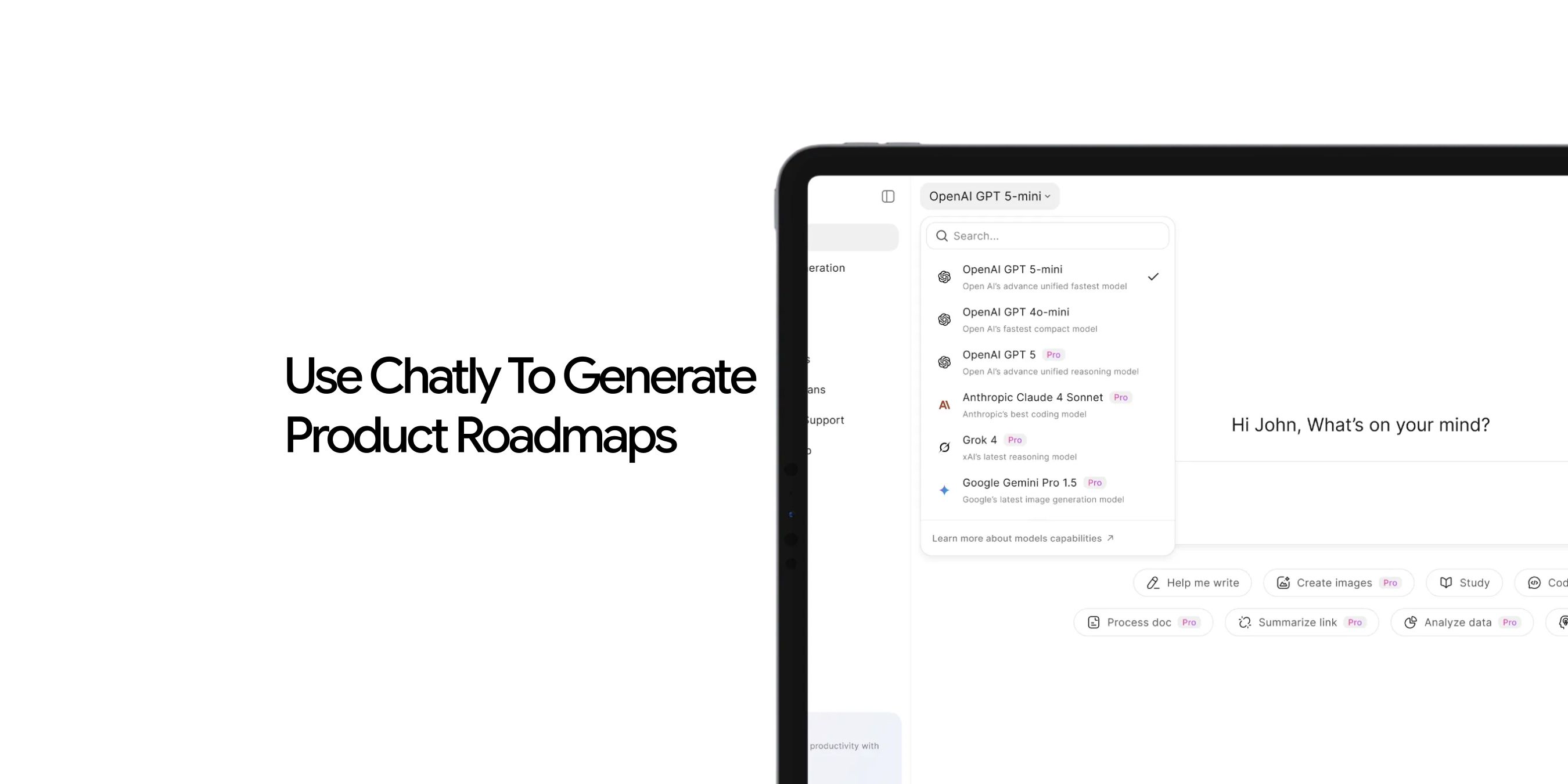
How to Turn User Feedback into a Product Roadmap with AI
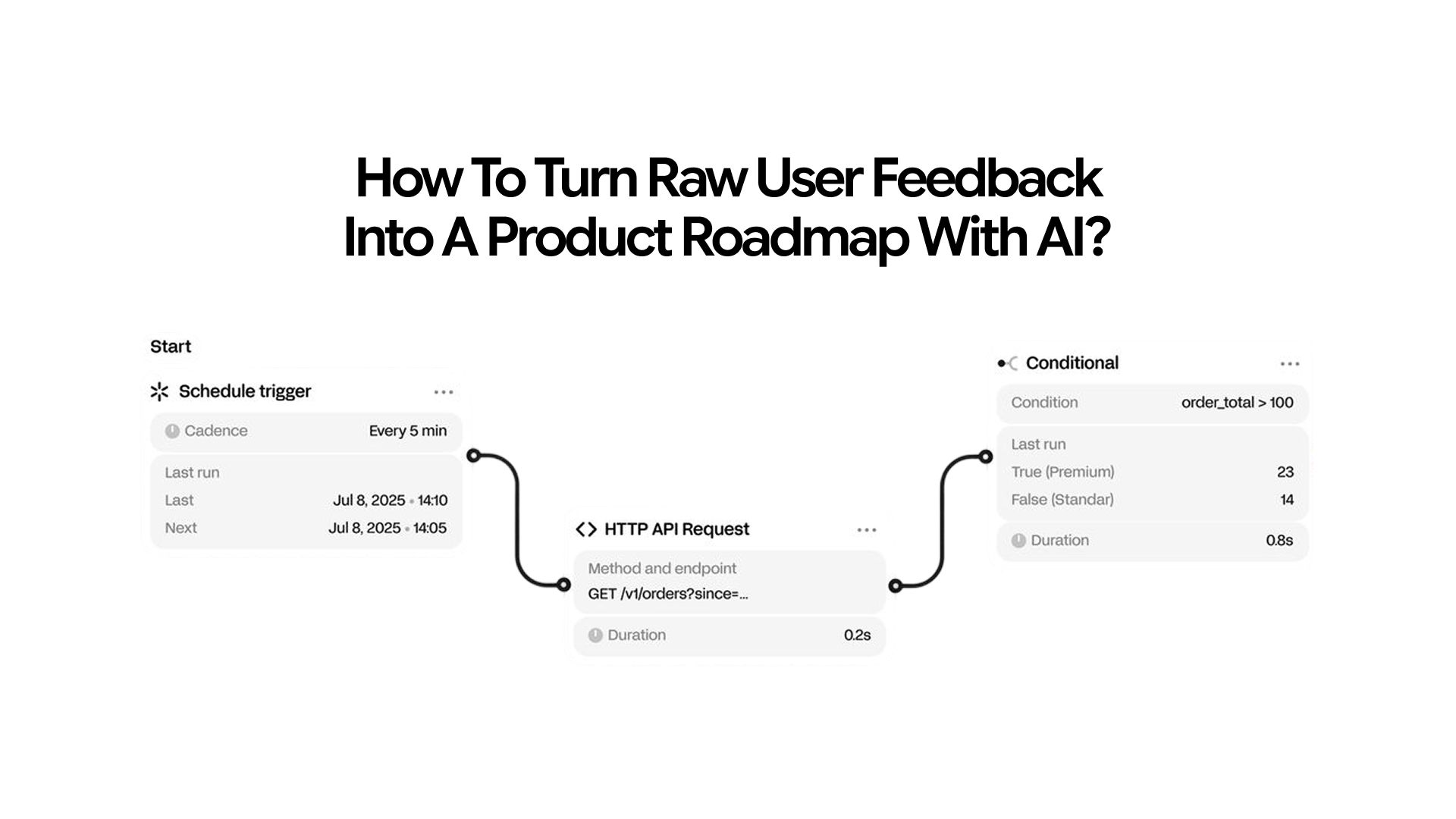
Most product teams already have feedback. What they lack is a process to convert it into roadmap decisions that hold up in a stakeholder review. Teams that skip the structured decision layer ship features nobody asked for, fix problems that are not problems, and spend quarters on work that does not move retention or revenue.
This article starts where feedback analysis ends. It assumes you have validated themes from user research and covers the five-phase AI workflow that converts those themes into a scored, sequenced, rationale-backed roadmap.
Process to Turn User Feedback into a Product Roadmap
AI converts validated feedback themes into scored opportunities, applies prioritisation frameworks consistently across every insight, writes the rationale most PMs skip, and produces audience-specific roadmap versions from the same source.
It does not make roadmap decisions. Every prioritisation call, every sequencing choice, and every strategic judgment stays with the PM. What changes is the speed and consistency of the work between analysis and decision.
Here is how AI helps you work through the process used to turn user feedback into a product roadmap, step by step:
- Phase 1: Translating Feedback Themes into Product Opportunities
- Phase 2: Scoring and Prioritising Opportunities with AI
- Phase 3: Structuring the Product Roadmap Timeline
- Phase 4: Writing the Rationale That Makes the Roadmap Defensible
- Phase 5: Producing Cross-Audience Roadmap Versions
Phase 1: Translating Feedback Themes into Product Opportunities
Validated themes from user research are not yet roadmap inputs. A theme tells you what users said. A product opportunity tells you what problem the product should solve and why solving it matters.
Reframing a Theme as a Product Opportunity
A theme named "users struggle with the export flow" is an observation. The product opportunity is: "Reduce the time to first successful export for users completing their first project, because 43% of first-session exits happen on the export screen."
Use this prompt to make the reframe:
"Here is a validated feedback theme: [paste theme]. Reframe this as a product opportunity by identifying the affected user segment, the specific friction they experience, and the measurable consequence if it goes unresolved. Do not suggest a solution."
The no-solution constraint matters. Solutions in the opportunity statement close off options before the team has evaluated them. If your themes came from structured qualitative research, the guide to AI customer feedback analysis covers how to validate theme strength before moving into the opportunity reframing step.
Separating Feature Requests from Underlying User Needs
Users request features. What they are actually expressing is a need that the current product does not meet. Building the feature is one solution. Improving the underlying experience is often a better one.
When a theme contains a direct feature request, run this prompt:
"Users are requesting [feature]. What underlying need does this request most likely express? List three alternative ways the product could address that need without building the requested feature."
Review the alternatives before committing to the feature as specified. The request is a signal, not a specification.
Flagging Edge Cases vs Widespread Signals Using Frequency Data
Not every theme in your research represents a widespread problem. Before any theme moves into the scoring phase, confirm whether it reflects a pattern across your user base or an edge case from a vocal minority.
Paste your theme alongside frequency data and run:
"Here is a feedback theme and the frequency data showing how many users mentioned it: [paste both]. Based on the frequency, classify this as: a widespread signal (more than 25% of respondents), a notable pattern (10 to 25%), or an edge case (under 10%). Then flag whether the users who mentioned it share a common profile that might indicate a segment-specific rather than product-wide issue."
Edge cases do not belong in the scoring queue. They belong in a separate backlog with a note about the segment they affect.
Phase 2: Scoring and Prioritising Opportunities with AI
With a set of properly framed product opportunities, the next step is applying a prioritisation framework consistently across all of them. AI applies the framework without the bias that affects manual scoring, where high-visibility requests or stakeholder preferences distort the results. AI can also merge NPS results with usage data to surface not just which features users want, but which ones actually drive retention or growth.
The AI customer feedback analysis guide covers how to structure that data combination before it enters the scoring phase.
Running RICE Scoring as an Interactive AI Session
RICE scoring (Reach, Impact, Confidence, Effort) produces a ranked list of opportunities when each dimension is estimated honestly. Running it as an interactive session forces you to think through each dimension rather than assigning numbers quickly.
Start with this prompt:
"I want to score a set of product opportunities using the RICE framework. For each opportunity I share, ask me for: Reach (users affected per quarter), Impact (0.25, 0.5, 1, 2, or 3), Confidence (percentage), and Effort (person-weeks). After I answer, calculate the RICE score and hold it. Once all opportunities are scored, rank them and present the full table."
Run each opportunity through the session in sequence. The interactive format catches inconsistent estimates before they produce a misleading ranking.
For a broader look at how RICE fits into the full PM workflow alongside other prioritisation frameworks, the complete AI workflow guide for product managers covers each framework with worked examples.
What RICE Does Not Account For
RICE produces a score based on the dimensions you provide. It does not account for:
- Strategic alignment: whether this opportunity supports the current product direction or pulls against it
- Team capacity: whether the team has the skills to execute the work in the current cycle
- Dependencies: whether the opportunity requires another item to ship first
- Competitive pressure: whether a competitor has already shipped a version of this
After running RICE, add a second pass: "Review the top five scored opportunities and flag any that have strategic, capacity, or dependency constraints that the RICE score does not reflect. Do not change the scores. Return a separate list of flags to consider alongside the ranking."
This keeps the scoring objective while surfacing the context that changes how you act on it.
When to Use MoSCoW Over RICE
MoSCoW (Must have, Should have, Could have, Won't have) is a better framework when the team needs to align quickly on scope for a specific release rather than rank a full backlog.
Use MoSCoW when:
- You are preparing for a sprint or release planning session and need scope boundaries, not a ranked list
- You have a fixed timeline and need to separate what ships from what gets cut
- Stakeholders need to agree on the scope quickly without getting into RICE arithmetic
Use this prompt: "Apply MoSCoW to the following opportunities in the context of a [timeframe] release. The constraints are [team size, technical dependencies, and any hard deadlines]. Classify each as Must, Should, Could, or Won't for this release cycle only."
Identifying Quick Wins vs Strategic Bets
A RICE-ranked list will contain two distinct types of items: quick wins with high scores from high confidence and low effort, and strategic bets with high potential impact but lower confidence or higher effort. Treating them the same way produces the wrong mix for any given quarter.
Run this prompt after scoring: "From this ranked list of opportunities, identify which are quick wins (high confidence, low effort, near-term impact) and which are strategic bets (high potential impact, higher uncertainty, longer time horizon). For each strategic bet, state what would need to be true for it to move from a bet to a confident investment."
You can run this entire interactive RICE session inside AI Chat for multi-step PM scoring sessions, where context from each prompt carries forward without needing to re-paste the full list at each step.
Phase 3: Structuring the Product Roadmap Timeline
A scored list of opportunities is not a roadmap. A roadmap sequences those opportunities across time in a way that reflects dependencies, team capacity, and the relationship between short-term delivery and long-term product direction. This is where a feedback-driven product roadmap takes shape.
Organising into Short, Mid, and Long-Term Buckets
Paste your scored and classified list into the AI and prompt:
"Organise these scored opportunities into three timeline buckets: Now (current quarter), Next (following one to two quarters), and Later (beyond six months). Base the placement on RICE score, MoSCoW classification where applicable, and strategic fit. Flag any item where placement is ambiguous because of conflicting signals."
The Now bucket should contain only items the team can realistically complete in the current cycle. A Now bucket that is over-full is a planning problem that surfaces here rather than in a sprint retrospective. Use AI Chat for roadmap structuring and sequencing sessions to run this bucketing pass in the same conversation as your scoring session, so the scored context carries forward directly.
Sequencing Based on Dependencies, Not Just Scores
A high-scoring item that depends on a lower-scoring item must be sequenced after it, regardless of its rank. Dependencies override scores in sequencing decisions.
Prompt: "Review this roadmap timeline and identify any sequencing conflicts where a higher-scored item depends on a lower-scored item that is currently placed later. Propose a revised sequence that resolves the conflicts without dropping any items from the plan."
Resolve every flagged conflict before sharing the roadmap with engineering or design.
What Goes in the Backlog vs What Gets Dropped
Not every scored opportunity belongs on the roadmap. Items that score low, address edge cases, or fall outside the current product direction belong in the backlog. Items that score low, address edge cases, and fall outside the current direction should be dropped.
Prompt: "From the opportunities not placed in the Now, Next, or Later buckets, classify each as: Backlog (worth revisiting in a future cycle), Drop (not aligned with current direction and unlikely to become relevant), or Monitor (low frequency now but worth tracking if volume increases). Include a one-sentence reason for each classification."
Once the roadmap is structured, the natural next step is capturing the decisions it reflects in a format that engineering and design can work from. The guide to writing a product requirements document with AI covers that process from the point where roadmap decisions have been made.
Phase 4: Writing the Rationale That Makes the Roadmap Defensible
Every roadmap gets challenged. An executive asks why X is in and Y is out. A stakeholder wants to know why a competitor's feature is not on the list. A team lead questions the sequence. A roadmap without a written rationale turns every one of those questions into a conversation that has to recreate the decision from scratch.
A roadmap with a written rationale answers those questions before they are asked.
Four Things Every Rationale Must Address
Each item on the roadmap needs a rationale that covers:
- Signal strength: how many users raised this, across what segments, with what frequency
- Strategic fit: how this opportunity connects to the current product direction or business goal
- Dependencies and sequencing: what this item requires before it can ship, and what it unlocks after
- Effort-to-impact: why the estimated effort is justified by the expected outcome
A rationale that does not address all four can be challenged on any of the four. A rationale that addresses all four can only be challenged on the estimates, which is a much more productive conversation.
The AI Prompt That Writes Rationale from RICE Scores
Prompt: "Write a rationale for including [opportunity name] in the [Now/Next/Later] roadmap. Use the following inputs: RICE score [score], signal strength [number of users, segments, frequency], strategic fit [how it connects to current goals], dependencies [what it requires and unlocks], and effort-to-impact [RICE effort estimate vs expected outcome]. Write it in three to four sentences for a non-technical stakeholder audience. Do not use jargon."
Run this for every item in the Now and Next buckets. Later-bucket items can use a shorter one-sentence rationale.
Why Roadmaps Without Reasoning Fall Apart in Stakeholder Reviews
Stakeholder reviews fail at the roadmap level when decisions cannot be explained on the spot. The PM who approved the roadmap knows why each item is there. Everyone else in the room is working from the list alone.
Written rationale shifts the review from a debate about what is on the list to a review of whether the reasoning is sound. That is a significantly more productive conversation and one that produces alignment rather than escalation.
Phase 5: Producing Cross-Audience Roadmap Versions
The same roadmap communicates different things to different audiences. Engineering needs dependency logic and sequencing reasoning. Executives need user impact and business outcomes. Customers need to know what is coming and why it matters to them. Sending the same document to all three audiences is why roadmaps get ignored or misread.
Engineering Version: Dependency Logic and Sequencing Reasoning
Prompt: "Produce an engineering-facing version of this roadmap. For each item in the Now and Next buckets, include: the opportunity being addressed, the sequencing rationale based on dependencies, and any technical constraints or open questions the team needs to resolve before work can begin. Use precise language. Include dependency relationships between items."
For teams that need to turn the engineering version into full technical specifications, the complete guide to writing technical documentation with AI covers how to produce API references, setup guides, and runbooks from the same roadmap decisions.
Executive Version: User Impact and Business Outcomes
Prompt: "Produce an executive summary of this roadmap for a leadership audience. For each Now and Next item, state: the user problem being solved, the expected business outcome, the confidence level, and the link to the current strategic priority it supports. Keep it under 200 words total. Lead with outcomes, not features."
Customer-Facing Version: What Is Coming and Why It Matters
Prompt: "Produce a customer-facing roadmap update covering the Now bucket items. For each item, explain what is changing in plain language, why we decided to prioritise it, and what the user experience will be after the change. Avoid technical language. Do not include timelines or commit to specific dates. Frame each item as a commitment to solving a problem, not as a feature announcement."
Treating the User Feedback as a Product Roadmap as a Living Document
A roadmap that reflects last quarter's feedback is a liability. The product changes, user behaviour shifts, and new signals arrive continuously. Teams that treat the roadmap as a static document ship work that was relevant six months ago.
When to Revisit the Roadmap
Revisit the roadmap at three specific triggers, not on a fixed calendar schedule:
- After a feature ships, measure whether it produced the expected outcome. If it did not, the assumptions behind other items in the backlog may need to be revisited
- When a support category grows, a sharp increase in tickets around a specific issue is a signal that something already on the roadmap may need to move forward, or something not on it may need to be added
- Before a planning cycle: run a full re-score of the backlog using current frequency data, not the data from the last round of research
Closing the Loop with Users
Every piece of feedback that influenced a roadmap decision represents a user who gave time and attention to helping improve the product. Not communicating back to those users is a missed opportunity that erodes the relationship that makes future research valuable.
Close the loop in two ways:
- When an item ships, communicate directly with users who raised the underlying theme. Tell them what changed, why you prioritised it, and what outcome you are measuring
- When an item is deprioritised, communicate that too. Tell users what you heard, why other things took priority, and that the signal is tracked
Prompt for closing the loop: "Write a short message to users who raised the theme [theme name], informing them that [what shipped or what was decided]. Explain the reasoning in plain language, thank them for the input, and invite continued feedback. Keep it under 100 words. Do not use marketing language."
Common Mistakes to Avoid
Even with AI accelerating the process to turn user feedback into a product roadmap, the same patterns produce poor results across teams.
Building from feature requests instead of underlying needs. Users request features. The underlying need is usually different and solvable in multiple ways. Build from the need, not the specification.
Skipping the frequency filter. A vocal user with a specific request is not evidence of a widespread problem. Frequency data must validate every theme before it enters the scoring queue.
Letting RICE scores override strategic judgment. A high RICE score does not mean an item belongs in the current cycle. Strategic fit, team capacity, and dependencies are inputs that override scores when they conflict.
Writing the roadmap without a rationale. A list of items without reasoning does not survive a stakeholder review. Every Now and Next item needs a rationale that covers signal strength, strategic fit, dependencies, and effort-to-impact.
Treating the roadmap as finished. A roadmap that does not get updated after features ship is a document that stops reflecting reality. Revisit the three triggers above, not on a fixed schedule.
Conclusion
The process to turn user feedback into a product roadmap doesn't happen on its own. The gap between what users said and what the team builds is where product decisions either get made deliberately or get made by default. The five-phase process in this guide makes that gap explicit and gives you a repeatable way to work through it.
The teams that get this right do not have better feedback than everyone else. They have a cleaner process for converting it into decisions that hold up. AI handles the scoring, sequencing, rationale writing, and audience formatting. The judgment stays with you.
Start with the opportunities already in your backlog. Paste them into AI Chat for product roadmap workflows, run Phase 2, and see which items your current scoring actually supports.
Frequently Asked Questions
More about turning user feedback to product roadmap
More topics you may like
AI for Developers: Code Review, Debugging, Documentation, and Integrated Workflows

Arooj Ishtiaq

AI for Frontend Engineers: Component Generation, Refactoring, and Accessibility
Arooj Ishtiaq
AI for Product Managers: How to Use AI for PRDs, Research Synthesis, and Prioritisation?
Arooj Ishtiaq
How to Onboard onto an Unfamiliar Codebase Using AI?
Arooj Ishtiaq