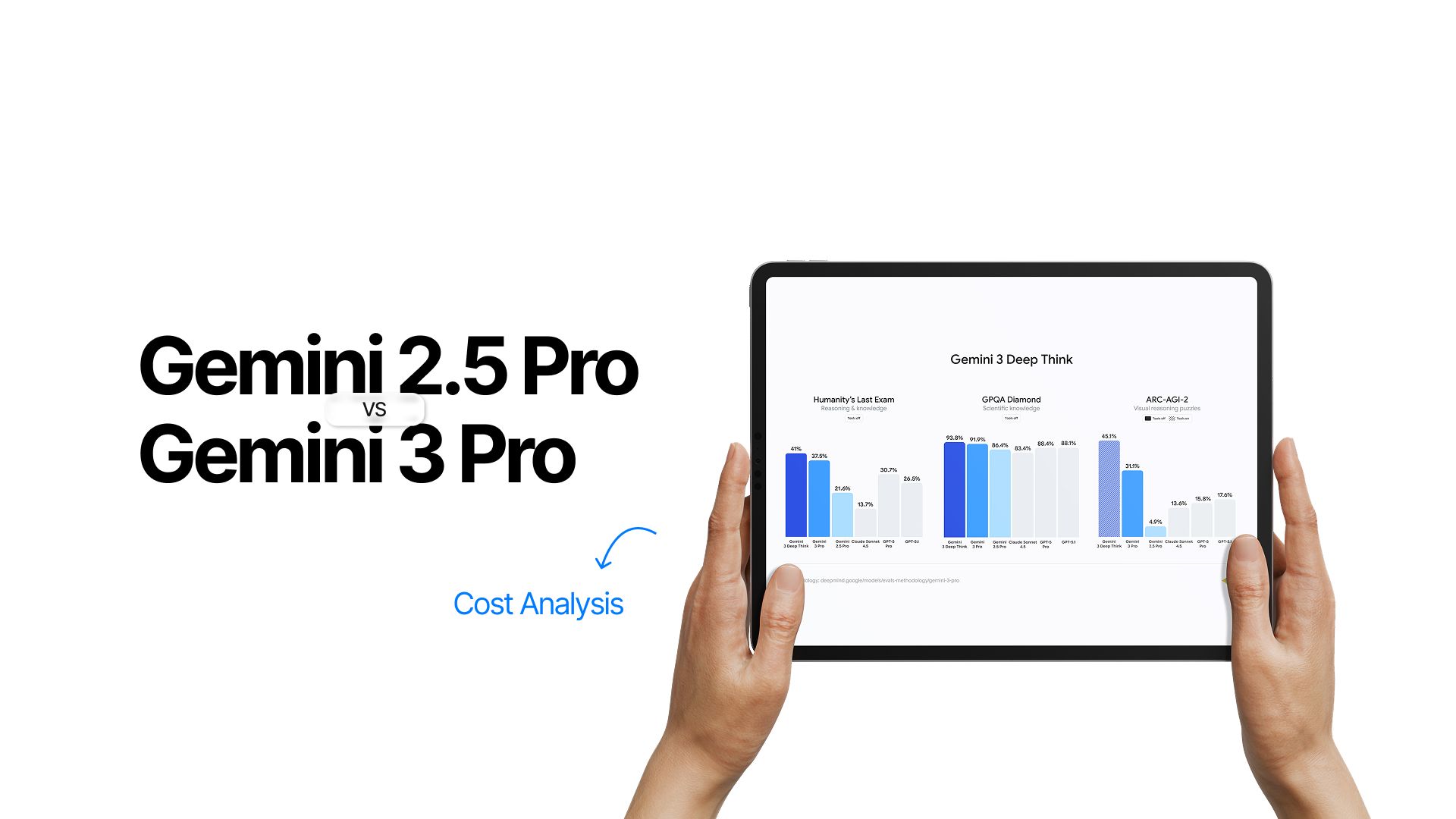
Gemini 2.5 Pro vs Gemini 3 Pro: Cost Analysis
The AI race is getting competitive and everyday there is a new model in the market that claims to be bigger and better than the others.
While it's welcome news for people looking to make their lives easier and their work more innovative, it also brings the added complexity of choosing a suitable model that fits their needs and budget.
Yes, the newer model is bigger and better, but:
- How much better is it?
- Is the change significant enough for you to abandon your previously trusted AI model and experiment with this new one?
- Does the cost of the new AI model reflect its features?
This is the dilemma that thousands of people are facing right now because Google has released Gemini 3 Pro which, according to benchmarks, outperforms every other model comprehensively in almost all categories.
With Gemini 3 Pro now in preview following the successful deployment of Gemini 2.5 Pro, understanding the cost implications has never been more critical for making informed decisions in 2025.
This analysis breaks down the pricing structures of both models, explores real-world cost scenarios, and provides a framework for determining which model delivers the best value for your specific use case.
Understanding the Gemini Model Lineup
Gemini 2.5 Pro was released on March 25, 2025 as an experimental release, achieving public preview status by April. This thinking-native model brought impressive capabilities including a 1M token context window and robust multimodal functionality. Today, it stands as a stable, widely-adopted option that has proven itself across countless production environments.
Gemini 3 Pro arrived on November 18, 2025 with ambitious improvements. The model showcases enhanced reasoning capabilities, an expanded context window of 1-2M tokens, and state-of-the-art benchmark performance. Early LMArena scores and SWE-bench results demonstrate significant gains over its predecessor, positioning it as a formidable option for demanding applications.
But here lies the rub. Is this new model worth it?
Take a couple of minutes and go through Gemini 3 Pro’s features and use cases to decide whether that is something that benefits you in your daily workings. Does it offer anything that will make your work stand out?
Done with the decision? Let’s now compare the prices of the two models to see what does this performance gain cost and whether it’s worth it.
Detailed API Pricing Breakdown
Every purchase you make must be tested in a critical balance of price and features. And the more features you get, the higher you’ll have to pay for them.
This is where you will have to be critical of your work to see:
- Do you even need that many features?
- Even if you do, is the price justified?
So, here is a cost analysis of Google’s two biggest and best models to see what the cost difference is and why?
Gemini 2.5 Pro API Pricing
The cost structure for Gemini 2.5 Pro varies based on context window usage:
Standard Context (≤200K tokens):
- Input: $1.25 per million tokens
- Output: $10 per million tokens
Long Context (>200K tokens):
- Input: $2.50 per million tokens
- Output: $15 per million tokens
When preview pricing applies, costs increase to $4 per million input tokens and $20 per million output tokens.
Gemini 3 Pro API Pricing
Standard Context (≤200K tokens):
- Input: $2.00 per million tokens
- Output: $12 per million tokens
Long Context (>200K tokens):
- Input: $4.00 per million tokens
- Output: $18 per million tokens
These preview rates are expected to stabilize between Q4 2025 and Q1 2026, though the final pricing structure may see adjustments based on market response.
Platform Considerations
Pricing varies between Google AI Studio and Vertex AI, with each platform offering distinct advantages. Free tier limitations and rate limits apply differently across platforms, while enterprise customers should evaluate additional factors like SLA guarantees and dedicated support options.
Cost Comparison Analysis
The numbers tell a clear story.
Gemini 3 Pro represents a significant increase for input and output tokens in standard context scenarios. These increases reflect the substantial computational resources required to deliver enhanced reasoning and performance improvements.
Let's examine what this means in practice across common use cases:
Basic Chat Application (1K input, 1K output)
- Gemini 2.5 Pro: ~$0.011
- Gemini 3 Pro: ~$0.014
Document Analysis (50K input, 5K output)
- Gemini 2.5 Pro: ~$0.113
- Gemini 3 Pro: ~$0.160
Code Generation (10K input, 20K output)
- Gemini 2.5 Pro: ~$0.213
- Gemini 3 Pro: ~$0.260
Long-Context Processing (500K input, 10K output)
- Gemini 2.5 Pro: ~$1.40
- Gemini 3 Pro: ~$2.18
While the absolute differences may seem modest for individual requests, these costs compound rapidly at scale. An application processing millions of tokens daily could see monthly bills increase by thousands of dollars when switching to Gemini 3 Pro.
Consumer Premium Plans: Beyond the API
While developers focus on API pricing, everyday users access Gemini through subscription tiers that bundle AI capabilities with additional Google services. Understanding these consumer plans helps contextualize the broader Gemini ecosystem and offers a different value proposition than pure API usage.
Google AI Pro, priced at $19.99 per month, provides access to Gemini 2.5 Pro and Gemini 3 Pro through the Gemini Advanced interface. This subscription includes:
- 2TB of Google cloud storage
- integration with Gmail, Docs, Sheets, and other Workspace apps
- priority processing during peak demand periods.
- NotebookLM with higher limits,
- the Jules coding agent with 5x higher limits than free users
- access to creative tools like Flow for video creation and Whisk for image animation
For power users, Google AI Ultra costs $249.99 per month and includes access to the most capable Gemini models, including Gemini 3 Pro where available.
- Ultra subscribers receive 30TB of storage
- YouTube Premium at no additional cost
- 20x higher limits for Jules coding workflows
- Early access to experimental features like Project Mariner for browser automation
- Advanced tier of Google Home Premium
This plan targets professional creators, analysts, and developers who require maximum capacity and cutting-edge capabilities.
The key difference in consumer plans versus API usage lies in predictability and bundling.
While API costs scale with actual token consumption, subscription plans offer unlimited usage within rate limits, eliminating surprise bills. For individual users who heavily utilize Google's ecosystem, particularly those already paying for storage and YouTube Premium, the bundled value often exceeds the subscription cost.
However, organizations building applications at scale will find API pricing more economical and flexible than purchasing individual consumer seats.
Google Cloud Vertex AI Pricing Considerations
Vertex AI introduces additional layers of pricing complexity and opportunity. The Model Optimizer feature enables dynamic pricing based on quality, cost, or balance settings, allowing teams to fine-tune their spending based on specific requirements.
Context caching delivers substantial savings of up to 50% for applications that repeatedly process similar content. Batch inference can reduce costs by 20-45% for non-time-sensitive workloads. Importantly, only HTTP 200 calls are billed, preventing charges for failed requests.
Cost Efficiency Analysis
When Gemini 2.5 Pro Makes More Sense
The established model remains the smart choice for high-volume, cost-sensitive applications where budget constraints are paramount. Standard reasoning tasks that don't require cutting-edge capabilities perform admirably on 2.5 Pro, making it ideal for projects with tight budgets or applications that benefit from a mature, thoroughly tested model with proven stability.
When Gemini 3 Pro Justifies Higher Costs
The ROI calculation extends beyond immediate costs. Performance improvements exceeding 50 Elo points translate to tangible benefits: reduced debugging time from higher code quality, fewer iterations due to improved accuracy on first attempts, and long-term value that outweighs immediate savings. For many teams, these factors justify the higher price point.
You can use both of these models along with many others in apps like Chatly which have AI chat features powered by the strongest AI models.
Competitive Pricing Landscape
Understanding where Gemini models sit in the broader market helps contextualize their value:
- OpenAI GPT-4o: $5 input / $20 output
- OpenAI GPT-4.5: $75 input / $150 output
- Anthropic Claude 3.7 Sonnet: $3 input / $15 output
- OpenAI o3-mini: $1.10 input / $4.40 output
- DeepSeek R1: $0.55 input / $2.19 output
Cost Optimization Strategies
Smart teams employ multiple strategies to control spending.
- Context caching implementation can dramatically reduce costs for applications with repetitive patterns.
- Prompt engineering to minimize token usage,
- Batch processing for bulk operations
- Strategic function calling to reduce round-trips all contribute to efficiency.
A hybrid approach often delivers optimal results. Use Gemini 2.5 Pro for routine tasks while reserving Gemini 3 Pro for complex operations requiring advanced reasoning. Leverage free tiers for testing and development, implement robust monitoring and analytics to track spending patterns, and establish budget limits with automatic alerts to prevent surprises.
Making Your Decision
Choosing between Gemini 2.5 Pro and Gemini 3 Pro requires honest assessment of your application's needs.
The best approach? Test both models with your specific workloads, calculate costs based on your actual usage patterns, and measure the performance differential on tasks that matter to your application. Google's free tiers make experimentation accessible, and the insights gained from hands-on testing will prove invaluable for making the right long-term investment.
Frequently Asked Question
Read these frequently asked questions to understand what questions other people have about these models.
More topics you may like
Gemini 3 Pro Overview: Features, Pricing, and Use Cases

Faisal Saeed
How to Build Generative UI with Gemini 3 Pro: A Complete Guide
Faisal Saeed

Google's Gemini 3 is Here (And It Just Shook the Competition)
Faisal Saeed
11 Best ChatGPT Alternatives in 2026 (Tested, Compared & Priced)

Muhammad Bin Habib

21 Journaling Techniques That Actually Work in 2025
Muhammad Bin Habib