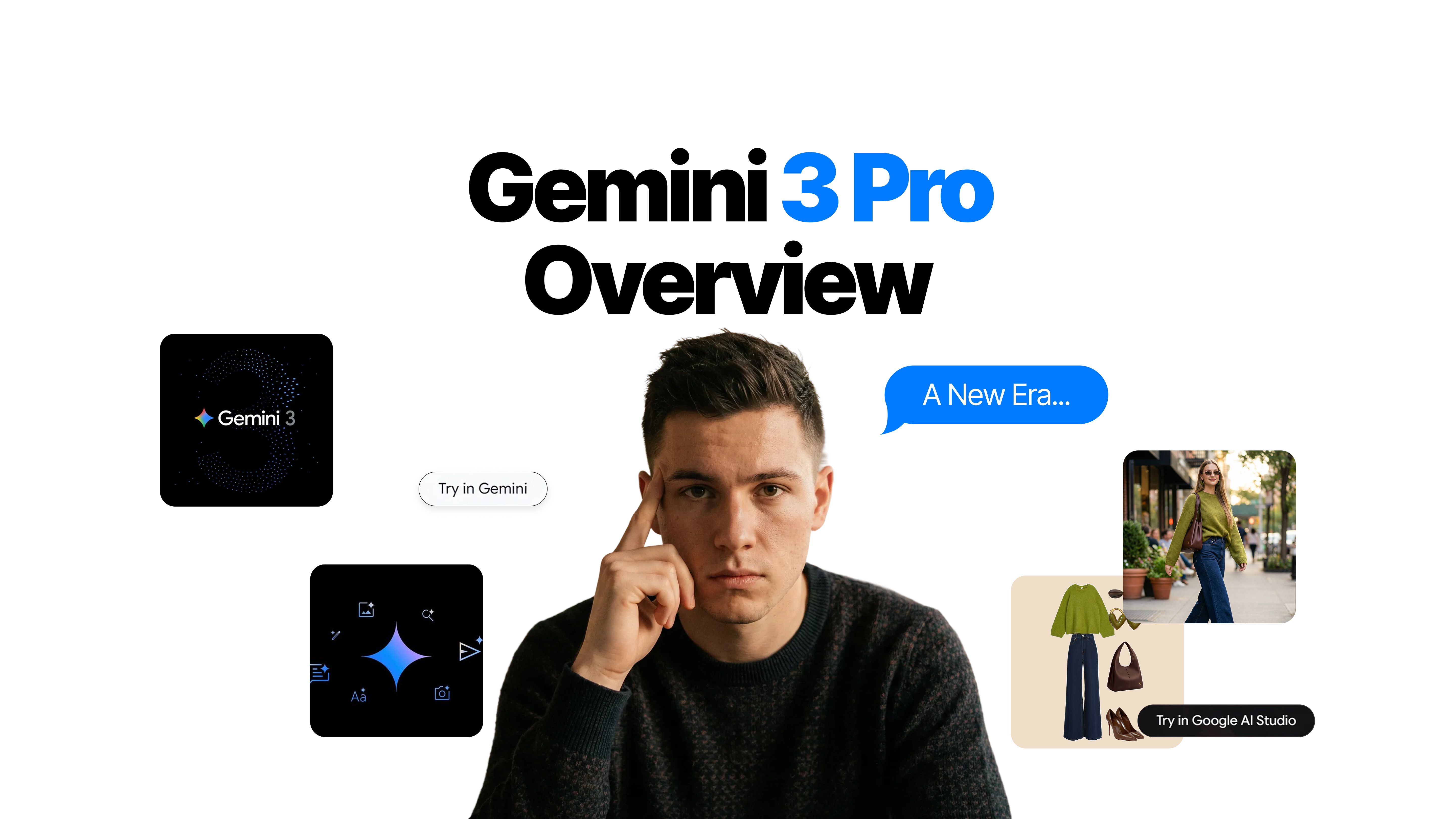
Gemini 3 Pro Overview: Features, Pricing, and Use Cases
Gemini 3 Pro arrived in November 2025 and it significantly shifted the power scale in Google’s favor. Released just days after OpenAI's GPT-5.1, this is Google's boldest step toward achieving artificial general intelligence, combining breakthrough reasoning capabilities and multimodal understanding.
While Gemini 3 Pro dominates nearly every benchmark, it is not the most remarkable thing about it. It’s the holistic approach to AI development.
This is a model built from the ground up to handle the complexity of real-world applications, from writing sophisticated code to analyzing hours of video content, all while maintaining the context and coherence that previous generations struggled to achieve.
Key Takeaways:
- First AI model to cross 1500 Elo on LMArena, outperforming competitors on 19 out of 20 major benchmarks
- Available immediately across Google AI Studio, Vertex AI, Gemini app, and multiple developer platforms
- Processes up to 1 million input tokens with 64,000 token output capacity
- Achieved 37.5% on Humanity's Last Exam and 31.1% on ARC-AGI-2, with Deep Think mode pushing even higher
- Built from the ground up to understand text, images, video, audio, and code as first-class inputs
- $2-4 per million input tokens and $12-18 per million output tokens depending on context length
- Enhanced reasoning capability currently in safety testing, delivering up to 45.1% on abstract reasoning tasks
- 76.2% on SWE-Bench Verified and 200-point Elo advantage over GPT-5.1 on algorithmic problems
This blog will provide a complete overview of this remarkable model and its capabilities to explore what it is capable of and how it can make your work more efficient and easier.
Understanding Gemini 3 Pro
Usually with AI model updates, what we see is a newer version which improves the existing features in the previous model and adds one or two new ones.
But that’s not what Gemini 3 Pro did. It's a fundamental reimagining of what AI models can accomplish by introducing not just new features but entire ecosystems to operate in.
1. Mixture-of-Experts (MoE) Architecture
At its core lies a sparse mixture-of-experts (MoE) architecture that allows the model to scale massive computational capacity while maintaining practical inference costs. This architectural innovation enables Gemini 3 Pro to activate only the relevant portions of its vast parameter space for each query, resulting in both exceptional performance and efficiency.
2. Next Level Multimodality
Most of the AI models just bolt image or audio understanding onto text-based foundations. But Gemini 3 Pro went one step further.
It processes text, images, video, audio, and code as first-class inputs from the ground up. This unified approach allows it to understand relationships between different data types in ways that feel more intuitive and human-like.
3. Reasoning Depth
Through its innovative "thinking level" parameter, the model can adjust the amount of internal reasoning it performs before responding. Set to "high," it methodically works through complex problems, evaluating multiple approaches and checking its logic—a capability that shows particularly striking results on challenging benchmarks that previous models have struggled with.
Release Timeline and Availability
Google officially launched Gemini 3 Pro in preview on November 18, 2025, making it available across multiple platforms simultaneously.
The release follows Google's established annual cadence of major model releases:
- Gemini 1.0 arrived in December 2023
- Gemini 2.0 in December 2024
- Gemini 2.5 Pro in mid-2025
The November timing for Gemini 3 Pro suggests Google's commitment to maintaining aggressive development cycles in response to intense competition from OpenAI and Anthropic.
Access to Gemini 3 Pro currently operates on a tiered system. Google AI Ultra subscribers and users with paid Gemini API keys receive immediate access, while other tiers including Google AI Pro, Gemini Code Assist Standard, and free tier users can join a waitlist.
The model is accessible through several channels:
- Gemini app for consumer use
- Google AI Studio for rapid prototyping
- Vertex AI for enterprise deployments
- Google Antigravity platform for agentic development
- Third party tools like Chatly
Benchmark Performance
The numbers tell a compelling story.
Gemini 3 Pro achieved a historic 1501 Elo score on LMArena, becoming the first model to cross the 1500 threshold and dethroning competitors that had held the top position for months.
This wasn’t a marginal victory either. Google's internal testing showed Gemini 3 Pro outperforming Gemini 2.5 Pro, GPT-5.1, and Claude Sonnet 4.5 on 19 out of 20 major AI benchmarks.
1. Overall Performance Leadership
LMArena Elo Score: 1501 (first model to break 1500)
- Surpassed all competitors including GPT-5.1 and Claude Sonnet 4.5
- Won on 19 out of 20 major AI benchmarks in Google's internal testing
2. Advanced Reasoning Benchmarks
Humanity's Last Exam (2,500 challenging questions across 100+ subjects)
- Standard mode: 37.5% (vs GPT-5.1's 26.5%)
- Deep Think mode: 41.0%
- 11-percentage-point lead represents a massive leap in reasoning depth
ARC-AGI-2 (abstract reasoning and pattern recognition)
- Standard mode: 31.1% (vs GPT-5.1's ~17.6%)
- Deep Think mode: 45.1%
- Long considered a proxy for general intelligence
3. Multimodal Understanding
MMMU-Pro (complex image reasoning)
- Score: 81%
- State-of-the-art performance in visual understanding
Video-MMMU (video content comprehension)
- Score: 87.6%
- Leading performance in understanding educational video content
ScreenSpot-Pro (UI understanding)
- State-of-the-art results in interpreting user interfaces
4. Coding and Development
SWE-Bench Verified (fixing real GitHub issues)
- Score: 76.2%
- Demonstrates practical software engineering capabilities
Terminal-Bench 2.0 (operating computers via terminal)
- Score: 54.2%
- Shows ability to navigate systems and execute complex commands
WebDev Arena
- Elo score: 1487
- Leading performance in web development tasks
LiveCodeBench Pro (algorithmic problem-solving)
- 200-point Elo advantage over GPT-5.1
- Superior performance in generating novel algorithms
Gemini 3 Pro Features
Gemini 3 Pro is Google’s state-of-the-art AI model, designed for advanced reasoning, large-context understanding, and native multimodal processing. It can handle massive datasets, process multimodal inputs seamlessly, and perform complex problem-solving tasks with high accuracy.
With flexible pricing, cost optimization features, and enterprise-ready tools, it is suitable for developers, researchers, and businesses building cutting-edge AI applications.
API Pricing and Cost Structure
Gemini 3 Pro introduces a transparent, context-tiered pricing model designed to match computational demands.
-
Pricing tiers:
- Up to 200,000 tokens: $2 per million input tokens, $12 per million output tokens.
- Beyond 200,000 tokens: $4 per million input tokens, $18 per million output tokens.
-
Free access: Developers can prototype via Google AI Studio with rate limits (~5–10 requests/minute, 250,000 tokens/minute, 50–100 requests/day).
-
Cost optimization strategies:
- Context caching: Stores frequently reused inputs at a lower hourly rate.
- Adjustable reasoning depth: Trades off response speed and computational cost.
- Media resolution: Controls token usage for images and video, balancing fidelity against cost.
This pricing approach is competitive with other frontier models like GPT-5.1 and Claude Sonnet 4.5, allowing developers to scale workloads economically. Enterprises accessing Gemini 3 Pro through Vertex AI can benefit from volume discounts, batch processing, and advanced prompt caching, enabling large-scale AI deployments while controlling costs.
Million-Token Context Window
Gemini 3 Pro supports up to 1 million input tokens and 64,000 output tokens, enabling it to process massive datasets in a single request.
-
Practical applications:
- Analyze full codebases for refactoring or optimization.
- Process multiple research papers simultaneously to find connections and contradictions.
- Review entire contracts or years of financial reports without chunking.
-
Video and image processing:
- Images: 280 tokens (low), 560 (medium), 1,120 (high).
- Video: 70 tokens/frame (low/medium), 280 tokens/frame (high).
Traditional models with smaller context windows required complex workarounds like splitting documents, maintaining separate conversation threads, or building retrieval systems. Gemini 3 Pro eliminates these limitations, maintaining coherence across long documents, codebases, and multimedia content.
- Context caching: Especially useful for educational, research, and business applications, caching reduces costs when repeatedly querying large datasets, making long-context interactions economically viable.
Multimodal Capabilities
Gemini 3 Pro natively understands text, images, audio, video, and code, enabling true cross-modal reasoning.
-
Image understanding:
- Can analyze charts, diagrams, and UI screenshots.
- Extracts structured data and interprets layouts and hierarchies.
-
Document comprehension:
- Maintains full structure of research papers, contracts, and manuals.
- Understands relationships between figures, tables, and body text.
-
Video processing:
- Tracks objects and concepts across frames.
- Links spoken audio to on-screen visuals.
- Efficient encoding allows hours of content to fit in the context window.
-
Audio understanding:
- Directly processes audio without prior transcription.
- Accurate recognition even in long recordings.
The real power of Gemini 3 Pro emerges in cross-modal reasoning. It can relate videos to documents, combine sketches with voice descriptions, or process PDFs with embedded charts. Developers can generate structured outputs such as JSON from video content or code from design mockups, enabling richer applications.
Reasoning and Problem-Solving
Gemini 3 Pro demonstrates advanced multi-step reasoning and problem-solving capabilities.
-
Thinking levels:
- Low: Fast, cost-efficient responses for simple instructions and chat interactions.
- High (default): Deeper reasoning for complex tasks.
-
Deep Think mode:
- Enhanced reasoning for creative, strategic, and iterative problem-solving.
- Benchmarks: Humanity's Last Exam 41.0% (vs. 37.5%), GPQA Diamond 93.8% (vs. 91.9%).
Domain-specific strengths:
- Mathematics: Formulates problems, evaluates multiple solutions, and balances trade-offs.
- Science: Applies graduate-level knowledge, performs multi-step derivations, and reasons about experimental design.
- Coding: Generates efficient, readable, and maintainable code, considering edge cases and time complexity.
- Abstract reasoning: Solves novel visual and logical patterns previously challenging for AI.
- Long-horizon planning: Maintains coherence across extended sequences and simulated environments. On benchmarks like Vending-Bench 2, it demonstrates superior decision-making and strategic planning over hundreds of sequential actions, making it ideal for long-term AI tasks.
Efficiency and Optimization
Gemini 3 Pro is designed for scalable and cost-effective deployment.
-
Context caching: Reduces repeated input costs for frequently queried datasets.
-
Media resolution control: Balances visual fidelity against token consumption and latency.
-
Production-ready features:
- Batch processing for multiple queries.
- Prompt caching for repeated instructions.
- Enterprise tools for scaling workloads with optimization and monitoring.
These features ensure that developers can leverage Gemini 3 Pro for high-volume, long-context, and multimodal applications without incurring prohibitive costs.
Gemini 3 Pro vs Gemini 2.5 Pro vs GPT-5.1: Competitive Analysis
The leap from Gemini 2.5 Pro to Gemini 3 Pro is more than just incremental improvement. When we compare both Gemini models with GPT-5.1, the differences in reasoning, coding, multimodal understanding, and user experience become clear.
Here’s a closer look at how each model performs across key areas.
Reasoning & Problem Solving
Reasoning has been a major focus in Gemini 3 Pro.
While Gemini 2.5 Pro was already strong and ranked highly on benchmarks like LMArena, it struggled with tasks requiring extended contemplation or abstract problem-solving. Gemini 3 Pro introduces Deep Think mode, enabling it to handle complex questions that previous models could barely approach.
On Humanity’s Last Exam, Gemini 3 Pro scored 37.5%, significantly higher than Gemini 2.5 Pro, and outperforming GPT-5.1’s 26.5%.
- Gemini 2.5 Pro: Solid for standard reasoning tasks but limited on abstract or multi-step problems.
- Gemini 3 Pro: Major gains in reasoning, excels at problems that require reflection and multi-step logic. Deep Think mode allows it to simulate extended cognitive effort.
- GPT-5.1: Focuses on adaptive reasoning, dynamically adjusting computation based on problem complexity. Particularly strong in tool-rich environments, though slightly behind Gemini 3 Pro on deep reasoning benchmarks.
The improvement from Gemini 2.5 Pro to Gemini 3 Pro was significant as it not only improved existing features but also introduced multiple new ones. GPT-5.1, by contrast, trades some deep reasoning for speed and adaptability, making it ideal for environments that need quick yet robust answers.
Coding & Algorithmic Performance
Gemini 3 Pro takes the cake when it comes to coding as well.
Gemini 2.5 Pro was capable but often struggled with multi-step algorithmic tasks. Gemini 3 Pro shows dramatic improvements, scoring 54.2% on Terminal-Bench 2.0 versus Gemini 2.5 Pro’s 32.6%. JetBrains testing confirmed over a 50% increase in solved coding tasks, while GitHub Copilot assessments showed 35% higher accuracy in addressing complex software engineering challenges.
- Gemini 2.5 Pro: Adequate for straightforward coding problems but limited in solving novel algorithms.
- Gemini 3 Pro: Excels at generating new algorithms and handling multi-file, complex coding tasks. Shows strong performance in live problem-solving scenarios.
- GPT-5.1: Slightly better at debugging and optimizing existing code, with Codex-Max variant scoring 77.9%, compared to Gemini 3 Pro’s 76.2%. Ideal for integrated developer workflows.
This distinction matters: Gemini 3 Pro is preferable when you need creative code generation, while GPT-5.1 is often the choice for tool-assisted debugging and optimization.
Multimodal Understanding
Gemini 3 Pro extends its advantages into multimodal reasoning. Gemini 2.5 Pro handled images and video reasonably well, but Gemini 3 Pro offers refined vision processing and deeper cross-modal coherence. It can simultaneously process text, images, video, and code with impressive accuracy, supported by a 1 million token context window, far exceeding GPT-5.1’s 400,000-token limit.
- Gemini 2.5 Pro: Good for single-modality tasks but limited in integrating multiple sources.
- Gemini 3 Pro: Sets a new benchmark in cross-modal reasoning, ideal for processing screenshots, PDFs, or multi-file repositories. Maintains coherence across diverse inputs.
- GPT-5.1: Strong multimodal capabilities, but context window and cross-modal depth are smaller. Excels in applications where external tools enhance input interpretation.
For teams dealing with large documents, videos, or mixed media inputs, Gemini 3 Pro’s multimodal prowess gives it a clear edge.
Response Style & User Experience
Compared to Gemini 2.5 Pro, which often relied on generic responses, Gemini 3 Pro offers concise, insight-driven outputs. Google describes it as trading “cliché and flattery for genuine insight,” making it more of a thought partner than a conversational companion.
GPT-5.1, on the other hand, emphasizes a more human-like tone, making it preferable for creative writing, storytelling, or emotionally nuanced tasks.
- Gemini 2.5 Pro: Useful but sometimes generic; lacks depth in complex explanations.
- Gemini 3 Pro: Direct, smart, and concise. Excels at technical analysis, structured reasoning, and insight-driven responses.
- GPT-5.1: Polished, conversational, and natural. Better suited for content requiring narrative flow or emotional nuance.
This means your choice can depend on task type: Gemini 3 Pro for structured technical tasks, GPT-5.1 for creative and human-centric content.
Cost & Production Considerations
Both are costlier than mid-tier models, but the enhanced capabilities justify the investment for demanding applications.
-
Gemini 3 Pro: Ideal for long-context, multimodal workloads involving large documents, multi-file codebases, video processing.
-
GPT-5.1: Suited for tool-heavy, code-first workflows, particularly when integrating into existing developer ecosystems.
-
Gemini 2.5 Pro: Still capable, but less competitive for production-grade multimodal or reasoning-intensive tasks.
Gemini 3 Pro, GPT-5.1, and Gemini 2.5 Pro each excel in different areas. Gemini 3 Pro leads in deep reasoning, multimodal understanding, and large-scale analysis with its Deep Think mode and extended context. GPT-5.1 shines in creative, conversational, and tool-integrated workflows, offering adaptive reasoning and natural, human-like responses. Gemini 2.5 Pro is a capable baseline model but is outpaced by both in reasoning, coding, and multimodal tasks.
Accessing Gemini 3 Pro: Multiple Pathways
Google has made Gemini 3 Pro available through several channels, each optimized for different use cases and user types. Understanding these access pathways helps developers and organizations choose the right approach for their needs.
- Google AI Studio: A browser-based platform for rapid prototyping and experimentation. Users can select Gemini 3 Pro, build quickly with Build mode, and iterate using annotations, with free access available under rate limits.
- Vertex AI: Enterprise-grade deployment on Google Cloud for production workloads. Offers enhanced security, compliance, batch processing, and data governance, making it suitable for regulated industries.
- Gemini API: Direct programmatic access for developers via official SDKs (Python, JavaScript/Node.js, Java). Supports multimodal inputs, function calling, streaming responses, and REST integration with any framework.
- Google Antigravity: A new agentic development platform where AI agents can code, test, and use tools in an IDE-like workspace. Enables “vibe coding,” letting Gemini 3 Pro generate and refine applications from natural language descriptions.
- Gemini CLI: Terminal-based access for developers who prefer command-line workflows. Supports auto-routing and pro-routing for model selection, available to Ultra subscribers or paid API users.
- Third-Party Integrations: Gemini 3 Pro is available in popular developer tools like Chatly’s AI Chat, GitHub Copilot, JetBrains AI Assistant, Cursor, Cline, and Figma Make, providing specialized interfaces optimized for each workflow.
- Gemini App: Consumer access on mobile and desktop. Base Gemini 3 is free for all users, while Gemini 3 Pro requires a Google AI Pro or Ultra subscription, with Ultra users gaining higher limits and early access to features like Deep Think mode.
For organizations evaluating access options, the choice depends on several factors. Startups and individual developers often begin with Google AI Studio for its zero-setup, free-tier access. Teams building production applications typically migrate to Vertex AI for its enterprise features and support. Developers deeply embedded in specific toolchains may prefer accessing Gemini 3 Pro through their existing IDEs and workflows via third-party integrations.
Authentication requirements vary by access method. Google AI Studio and the Gemini app use Google account login. API access requires generating API keys and storing them securely as environment variables. Vertex AI uses OAuth and service accounts, providing granular permission controls for enterprise environments. All access methods support rate limiting and quota management to ensure fair resource allocation.
Future Developments
Gemini 3 Pro sets new benchmarks for AI performance, with the roadmap ahead emphasizing enhanced reasoning, efficiency, and multimodal capabilities.
Future variants like Gemini 3 Flash will offer faster, cost-effective options for high-throughput applications, while extended multimodal support may handle longer videos, higher-resolution images, and specialized domains such as medical imaging.
Tool use and agentic capabilities are also evolving, enabling AI to propose shell commands, coordinate agents, and potentially complete complex projects independently.
Context window expansion beyond the current 1 million token limit could allow for processing entire document libraries or long-running conversations, although technical challenges remain. Safety and alignment continue to be priorities, with careful testing and refined mechanisms to ensure responsible use.
Integration across Google's ecosystem is expected to deepen, with Gemini 3 Pro assisting seamlessly in Search, Google Workspace, Android, Chrome, and Google Cloud services, making AI support more ambient and contextually available.
Conclusion
Gemini 3 Pro marks a significant leap in artificial intelligence, combining advanced reasoning, native multimodal understanding, massive context windows, and sophisticated tool use.
Developers can now build applications previously considered infeasible, from analyzing entire codebases to processing hours of video content while maintaining coherent context. For businesses, this opens opportunities for enterprise-grade solutions via Google Cloud or rapid prototyping through AI Studio.
Beyond technical feats, Gemini 3 Pro signals a broader shift in AI’s trajectory toward general-purpose intelligence. Its multi-step reasoning, long-context understanding, and multimodal capabilities lay the groundwork for AI agents that can autonomously manage complex projects and augment human creativity.
The competitive landscape, with rivals like OpenAI and Anthropic, accelerates innovation, benefiting users with increasingly capable and accessible AI systems. Ultimately, Gemini 3 Pro offers a clear glimpse of the future, where AI goes beyond automation to truly understand, anticipate, and collaborate with humans.
Frequently Asked Question
Learn more about gemini 3 and it's features through online user queries.
More topics you may like

11 Best ChatGPT Alternatives in 2026 (Tested, Compared & Priced)

Muhammad Bin Habib
10 Different Ways You Can Use Chatly AI Chat and Search Every Day

Faisal Saeed

21 Journaling Techniques That Actually Work in 2025
Muhammad Bin Habib

50+ Ready-to-Copy, Battle-Tested System Prompts That Actually Work in 2025
Muhammad Bin Habib
28 Best AI Tools for Students in 2025 – The Complete AI-Powered Academic Success Guide
Muhammad Bin Habib