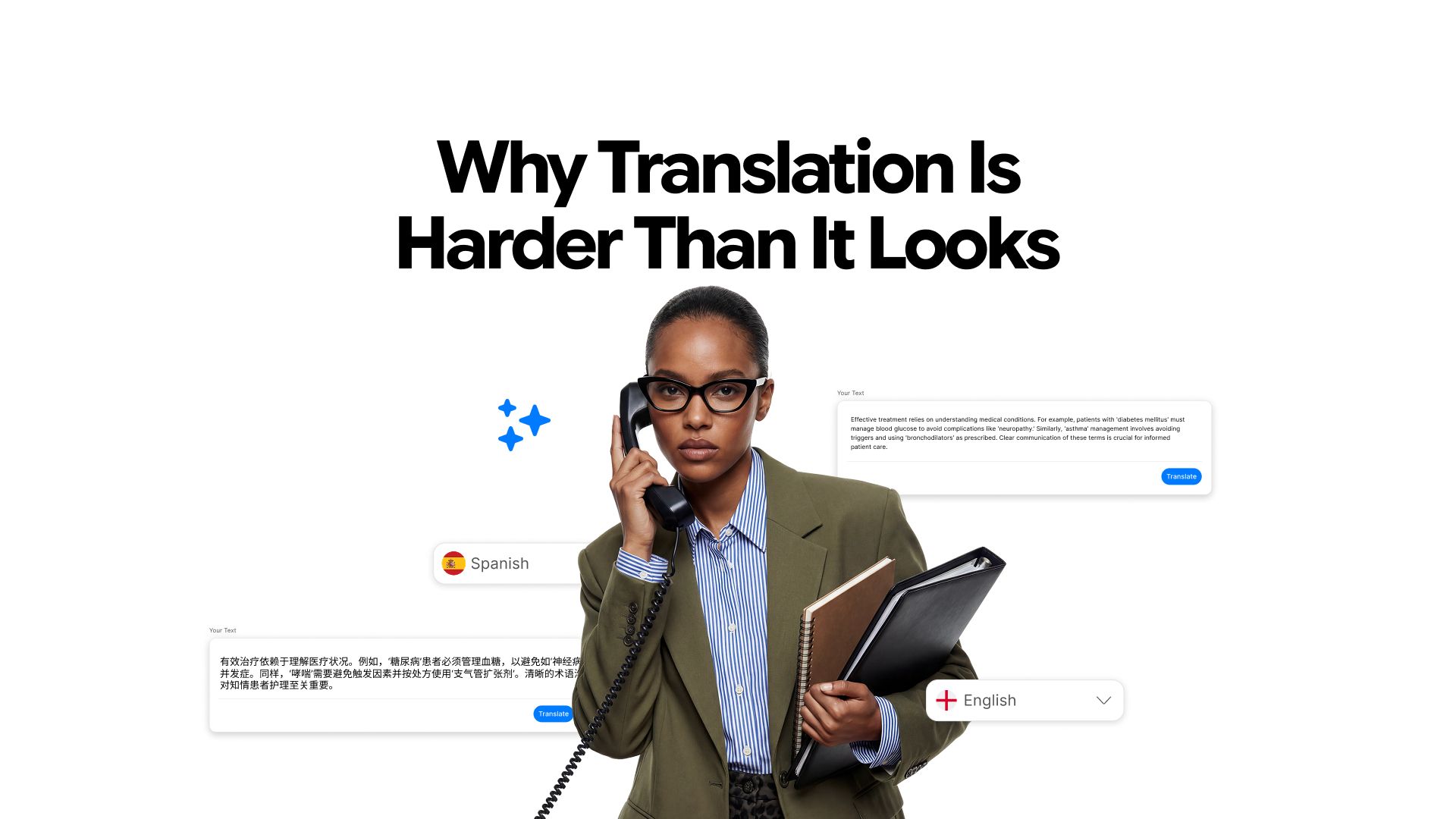
Why Translation Is Harder Than It Looks
Most people and businesses think translation is simple. You take a word in one language, find its match in another, and you're done.
Right? Wrong.
If that were true, we wouldn't have ended up with some of the most spectacular communication failures in modern history.
In 1987, Braniff Airlines ran a campaign in Latin America promoting their new leather seats with the slogan "Fly in leather." Seems like a nice slogan. After all, who wouldn’t want to fly in the comfort of leather seats.
However, The English to Spanish translation came out as “Vuela en cuero*”* which, in several Latin American dialects, reads as "Fly naked."
Pepsi had a similar fate. Their slogan "Come Alive with the Pepsi Generation" reportedly rendered into Chinese as something close to "Pepsi brings your ancestors back from the dead." However, this is often dismissed as an urban legend, but Pepsi never denied it either.
The result in both cases was a severe dip in sales. They were failures of cultural translation which is a different problem entirely from linguistic translation.
The real issue is that language is just the visible surface. Underneath it sits an entire iceberg of cultural assumptions, historical references, and social norms. Translation isn't about converting words. It's about converting meaning, and meaning is the hardest thing to move from one mind to another.
The Linguistic Traps (Structure and Grammar)
The problems begin even before you get into tricky stuff like idioms and humor. Grammar is not neutral. The way a language is structured shapes what it can say, and how.
Gendered Languages
Let’s start with a simple example.
- In English, a chair is just a chair.
- In French, it's la chaise (feminine).
- In Spanish, el puente (bridge) is masculine.
This is the basic concept that most online translators get wrong.
When translating from English into a gendered language, the translator is forced to make a gender decision about every noun in the text. That choice can subtly shift the personality of an object, which matters enormously in literature and advertising.
The challenge gets sharper with people.
English uses "they" comfortably as a gender-neutral singular pronoun. Many languages have no structural equivalent, forcing translators to either construct an awkward workaround or make a binary choice that the original text deliberately avoided.
Untranslatable Concepts
Some words simply refuse to cross borders. Here are a few words that most normal translators get wrong almost everytime:
- Schadenfreude (German): pleasure felt at someone else's misfortune. English borrowed the word outright because there was no native equivalent.
- Saudade (Portuguese): a deep, melancholic longing for something or someone lost. It's not quite nostalgia, not quite grief.
- Mamihlapinatapai (Yagán): the wordless look shared between two people who both want the same thing but neither wants to be the one to initiate.
When a translator encounters one of these words, they face a genuine dilemma: borrow it, invent one, or write a full sentence to explain it. Each option costs either rhythm or clarity.
The Syntax Shuffle
Word order is another structural trap that often goes unnoticed.
- English follows Subject-Verb-Object: "The dog bit the man."
- Japanese follows Subject-Object-Verb: “Inu ga otoko o kanda.” Dog [subject particle] man [object particle] bit), with the action "bit" (kanda) arriving last.
This changes the reading experience in real time.
In Japanese, you don't know what the dog did until the sentence finishes. Suspense is built into the grammar itself. Translating that structure from Japanese to English without losing the effect requires rebuilding the sentence from the ground up, not just reshuffling its parts.
False Friends and Semantic Traps
Now that you have bypassed the initial hurdles, a new category of hazards opens up. The most dangerous ones are the words that look like they should be safe because they closely resemble something familiar. But they present the biggest challenge.
False Cognates
False friends are words that look identical or similar across languages but carry completely different meanings.
- Spanish embarazada looks like "embarrassed." It means "pregnant."
- German Gift looks like a present. It means "poison."
- French actuel looks like "actual." It means "current" or "present-day."
A translator that misses one of these hands their client a different story than the one that was written.
The Nuance of Word Choice
Even when a word has a technically correct translation, "correct" is rarely the whole job. Consider the difference between "shining" and "glistening." Both describe reflected light, but one suggests cold, wet surfaces and the other feels warmer.
A good translator reads the emotional temperature of a scene and picks accordingly. Not just the definition, but the texture.
This is the point where translation stops looking like dictionary work and starts looking like editing.
Polysemy (One Word, Many Meanings)
Polysemy is the term for words that carry multiple meanings depending on context. In English, "crane" can be a bird or a piece of construction equipment. "Bank" can hold money or flank a river.
Most languages have their own polysemic words, and they don't overlap with English ones. Translating a sentence that deliberately holds two meanings (a pun, a metaphor, a wink) often means that one of its meanings simply ceases to exist in the new language.
Idioms
If false cognates are landmines, idioms are entire minefields. An idiom is a phrase that functions as a unit, where the meaning of the whole has nothing to do with the individual words. They are also everywhere.
Why Literal Fails
"Kick the bucket." "Break a leg." "It's raining cats and dogs."
Translated word for word into almost any other language, these are complete nonsense. A German reader encountering "it's raining cats and dogs" in a literal translation would picture something disturbing, not a rainy afternoon.
Finding Equivalents
The solution isn't to translate the words but to translate the function. The goal is finding an idiom that does the same job in the target language.
- German uses Es regnet Bindfäden (it's raining string) for heavy rain.
- Spanish speakers say Está lloviendo a cántaros (it's raining pitchers).
The image is different; the effect lands the same way.
Local Flavor Problem
The deeper issue with idioms is that they are anchored to a specific place and time. An idiom common in Mexico City won't always land with a Madrid audience. One from 1950s America will feel dated regardless of the language it's in.
This is why localization exists as a discipline separate from translation. A word-for-word translation of an American fast food ad into Brazilian Portuguese might be grammatically correct and still feel completely foreign to the people reading it.
Humor Hurdle
Humor is where translation earns its reputation for difficulty. A well-translated idiom preserves meaning. A well-translated joke has to preserve surprise, timing, and the specific pleasure of getting it. None of which are written on the page in any obvious way.
Wordplay and Puns
Puns work because one sound accidentally carries two meanings in a specific language. That phonetic coincidence almost never exists in a second language.
When a translator hits a pun, the real options are:
- Explain the joke in a footnote (which kills it completely)
- Invent an entirely new joke in the target language that achieves the same comic effect.
The second option is genuinely creative. It is also closer to original writing than translation.
The "Vibe" Translation
Sometimes the content of a joke is almost beside the point. What matters is the rhythm. Setup, beat, punchline. The pause before the payoff.
A translator who preserves the words but breaks that rhythm has failed, even if every word is technically right. Getting the timing right often means rewriting sentences entirely, not replacing them.
Cultural and Social Sensitivity
Language doesn't just carry meaning — it carries manners. The way people address each other, the topics left unspoken, the things said indirectly. All of this has to survive the translation process, and most of it is invisible until something goes wrong.
High-Context vs. Low-Context Cultures
Japanese communication is famously high-context. Much of what's being communicated is implied, embedded in tone, deliberately left unstated. A direct English to Japanese translation can read as oddly blunt or even rude, because the softening layers have been removed entirely.
German and American English tend toward low-context communication. State the thing directly, don't make the listener guess. Translating between these two styles isn't just a language problem. It's a cultural recalibration.
Politeness Levels
Consider the word "you." In English, it works for everyone: your boss, your child, a stranger at a bus stop.
Spanish separates tú (informal) from usted (formal). Korean has a layered system of verb endings that encode age, status, and familiarity between speaker and listener. A mistranslated level of formality can make a character sound dismissive in a scene where they were being respectful.
Localization
Even within the same language, regional differences demand attention. Spanish spoken in Mexico carries different vocabulary, slang, and cultural references than Spanish spoken in Spain.
Translating content from English into "Spanish" without specifying the target audience is a common mistake. The words might be understood everywhere, but the tone and references might land only in one country.
The Human Element in an AI World
Where machine translation still struggles is everything covered in this post. Puns, false friends in context, high-context social cues, regional idioms, and gender-neutral language all require judgment, not pattern matching.
An LLM translating literary fiction can produce sentences that are grammatically correct and tonally wrong. It might miss that a character's formal register is meant to signal coldness rather than respect. The words check out; the story breaks.
While AI translators are doing a much better job, the safe bet is always to run your translation by professional human translators in case of severe and important cases.
Conclusion
Translation doesn't announce itself. When it works, you just read the book, laugh at the joke, follow the argument.
That invisibility is the job. But it hides an enormous amount of labor.
The next time you read a translated novel or watch a subtitled film, remember: what you're holding isn't the original. It's a careful and deliberate interpretation.
Frequently Asked Question
Learn more on how to avoid translation mistake to conserve message and meaning.
More topics you may like

How to Create an Outstanding Resume Using AI Resume Builder (Secret Sauce = Chatly’s AI Docs)

Faisal Saeed

How to Decline an Internship Offer Professionally and Politely

Muhammad Bin Habib

How to Generate an Essay Outline in Minutes
Muhammad Bin Habib

How to Write a 2-Week Resignation Letter
Muhammad Bin Habib

How to Write a Book with No Experience
Muhammad Bin Habib