How to Prepare for a Sales Call Using AI

Knowing how to prepare for a sales call used to take 30 to 40 minutes per meeting. Top-performing reps spend six times more time on pre-call research than average performers, and buyers say understanding their business is the number one differentiator a rep can demonstrate.
This guide covers the five-step AI workflow that compresses the preparation into 10 minutes without losing any of the context that makes a call productive. For writing the email that books this meeting, see how to write sales prospecting emails that get replies.
What Effective Sales Call Preparation Actually Requires
How to prepare for a sales call effectively comes down to three things.
- Understanding the prospect's current situation
- Defining the specific outcome the call needs to produce
- Being ready for the objections most likely to surface before the conversation starts.
82% of B2B decision-makers perceive sales reps as under-prepared going into meetings. Preparation means turning research into a structured agenda, specific questions, and ready objection responses. It is not the same as knowing information about a prospect.
The AI search engine for researching live company signals surfaces the recent company activity that makes the research brief genuinely current rather than generic.
Benefits of Preparing for Sales Calls With AI
Using AI for sales call preparation does more than save time. It changes the quality and consistency of the conversation itself.
The biggest benefit is context consolidation. Instead of manually piecing together CRM notes, LinkedIn activity, Slack messages, email threads, and past call summaries, AI can combine everything into a single brief that is actually usable before a meeting.
AI also improves preparation quality in ways that are difficult to maintain manually at scale:
- Faster research across multiple sources without switching tools
- Better qualification gap detection before the call starts
- More personalised discovery questions tied to the prospect’s actual situation
- Stronger objection preparation based on real deal context instead of generic scripts
- More consistent preparation quality across every rep and every meeting
- Shorter prep time without sacrificing deal intelligence
- Less cognitive load during the call because the key context is already organised
The result is that reps spend less time gathering information and more time having relevant conversations that move deals forward.
How to Prepare for a Sales Call
How to prepare for a sales call in 10 minutes follows a five-step sequence where AI handles the research and question generation while the rep provides deal context and judgment. AI reduces meeting prep time by 70 to 90% compared to manual preparation. For the high-level overview of where call preparation fits across the full sales workflow, see AI for sales teams, including deal summaries and pipeline management.
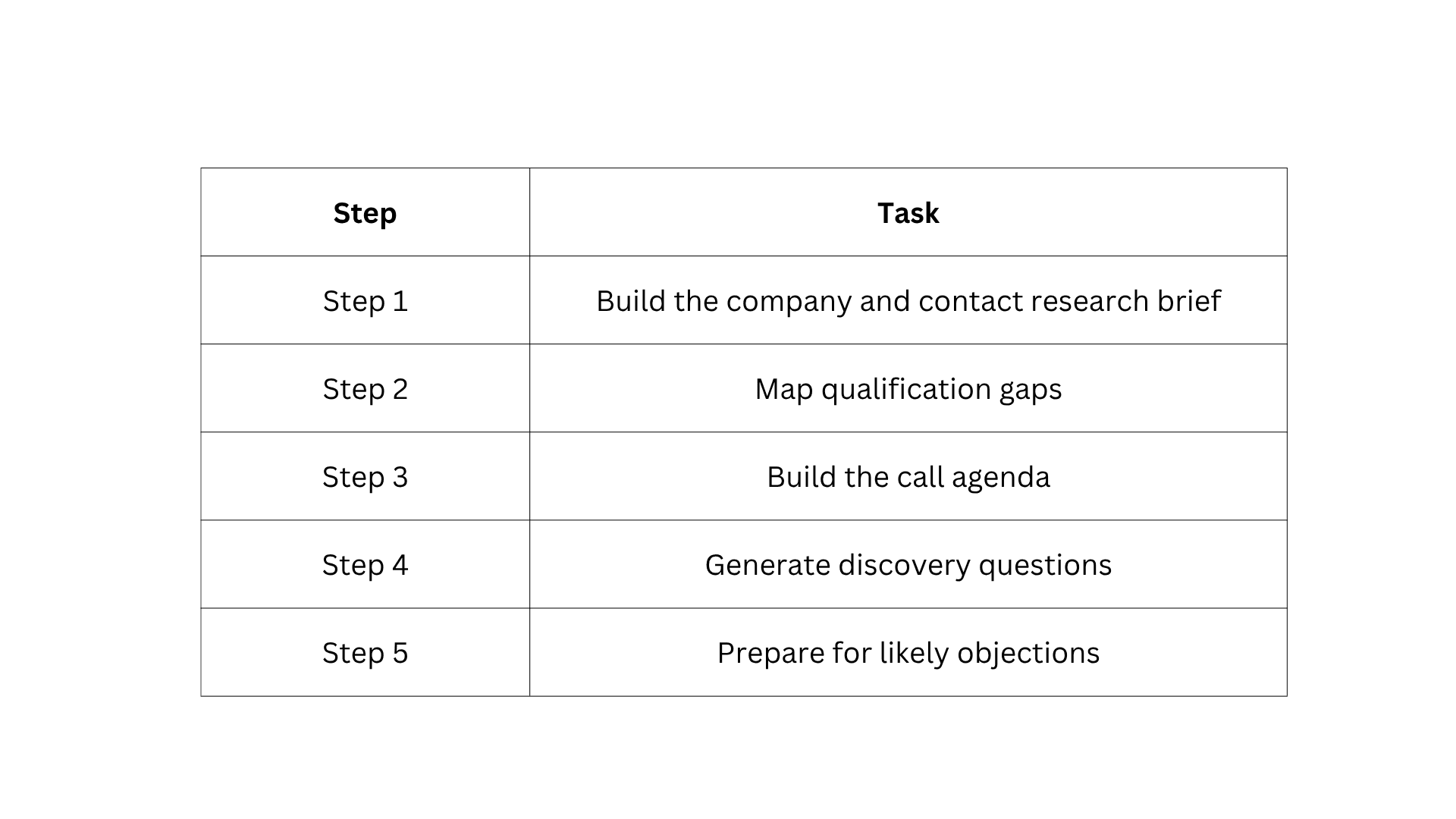
Step 1: Build the Company and Contact Research Brief (3 Minutes)
The foundation of how to prepare for a sales call is a research brief that explains what the company does, what is happening at the company right now, who you are speaking with, and the full context behind the deal.
In practice, this process is often longer than expected because it requires online research, document parsing, CRM review, and human validation and iteration before the information is accurate and usable for a live sales conversation.
A complete research brief typically combines information from multiple sources, including:
- The company website and recent announcements
- LinkedIn profiles and recent activity
- Previous CRM records and call notes
- Email threads with the prospect
- Slack conversations and internal handoff notes
- Product usage data or support tickets
- Previous proposals, demos, or meeting summaries
- Competitor mentions and current tech stack information
The final brief should contain five components:
- What the company does in one sentence, including their market position and the customers they serve.
- Their current growth stage, size, and any signals from the past 60 days, such as a funding announcement, a hiring push, or a product launch.
- The contact's current role, how long they have been in it, and any recent LinkedIn activity that signals what they are currently focused on.
- The deal context from your CRM, covering what has been discussed before, any objections raised, and any commitments made on either side.
- Any competitors that have been mentioned or are likely to come up, given the company’s current tools and stage.
The prospect research and pre-call briefing tool can help consolidate these inputs into a structured research brief without manually switching between tabs and systems.
AI prompt to use:
Generate a pre-call research brief for a [discovery / follow-up / closing]
call with [contact name], [title] at [company name].

Use these inputs:
- Company URL
- LinkedIn profile text
- CRM notes
- Previous sales call summaries
- Relevant email threads
- Slack conversations or internal handoff notes
- Product usage or support history (if available)

Structure the brief with five sections.

Company overview: what they do in one sentence, their current stage and
approximate size, and any publicly visible growth signals from the past 60 days.

Contact profile: current role, how long they have been in it, and any recent
LinkedIn posts or shared content that indicates their current priorities.

Deal context: a summary of where this deal stands, including what has been
discussed before, any open questions, and any commitments made by either side.

Competitive context: any tools they currently use in your category and any
competitors that have come up or are likely to be relevant.

One thing to know: the single most important context point for this specific
call given everything above.

Keep the brief readable in under three minutes.
For the signal research that feeds this brief, when preparing for a first cold call, see how to research and qualify sales leads with AI.
Step 2: Map Your Qualification Gaps Before the Call
The most efficient approach to generating relevant questions is to run your sales qualification framework against what you already know and identify exactly what remains unknown.
For BANT, check each of the four dimensions against the research brief and CRM notes. Tag each as confirmed, hypothesised, or unknown. Unknown dimensions become the primary agenda items. Hypothesised dimensions need one validation question.
The prospect research tool for pre-call qualification gap mapping surfaces any recent company changes that may affect the Budget, Timeline, or Authority dimensions since the last interaction.
The four BANT dimensions and what confirms each:
- Budget is confirmed when a specific figure, budget cycle, or spending authority has been mentioned in any prior interaction.
- Authority is confirmed when you have identified who the economic buyer is, who the champion is, and who else participates in the final decision.
- Need is confirmed when the prospect has described the problem specifically and quantified what it is costing them.
- Timeline is confirmed when the prospect has named a specific quarter, deadline, or event that is driving their evaluation.
For enterprise deals, run the same gap analysis against MEDDIC by checking each of the six dimensions (Metrics, Economic Buyer, Decision Criteria, Decision Process, Identify Pain, and Champion) against what the deal record shows.
AI prompt to use:
Based on this deal context: [paste research brief and CRM notes].

Run a BANT qualification gap analysis.

For each of the four dimensions (Budget, Authority, Need, and Timeline),
classify the current state as confirmed, hypothesised, or unknown based on
what the deal record shows.

For each dimension that is hypothesised or unknown, write one specific question
I can ask in the call to confirm or disqualify it.

Each question must be under 15 words and sound like natural conversation.
Step 3: Build the Call Agenda With AI
Building the agenda is the step in how to prepare for a sales call that most reps skip, which is why most calls end without a clearly defined next step.
A call agenda confirms the rep is prepared for this specific conversation and gives the call a structure that makes it possible to reach the defined outcome within the time available.
Write the close before you write the opening, because the opening should be designed to get you to the close. For the B2B email templates and follow-up sequences that are triggered by the next step committed to in this agenda, see the B2B sales email templates and sequences guide.
A complete call agenda has four parts:
- Opening: a personalised observation based on the research brief that signals preparation without making the prospect feel studied.
- Discovery: structured around the qualification gaps from Step 2, with the most important unknown addressed in the first five minutes.
- Value alignment: connecting what was heard in discovery to the specific outcome the product delivers, using the prospect's language.
- Close and next step: the specific commitment the rep will propose, named and dated, before the call ends.
AI prompt to use:
Using the research brief and qualification gaps below, build a specific
agenda for a [25 / 30 / 45]-minute [discovery / follow-up / closing]
call with [contact name] at [company].

Research brief: [paste from Step 1].
Qualification gaps: [paste from Step 2].

Build the agenda with four sections.

Opening: one specific personalised question or observation that signals
I prepared for this call. Base it on the research brief, not a generic compliment.

Discovery: the three to four most important questions for this call based on
the qualification gaps, ordered from most to least critical.

Value alignment: two to three talking points that connect what I expect to
hear in discovery to the outcomes we deliver for companies at this stage.

Close and next step: the exact commitment I should propose at the end of this
call given the current deal stage.

Format it so I can scan it in under 60 seconds before the call starts.
Step 4: Generate Discovery Questions Tailored to This Call
The highest-leverage part of how to prepare for a sales call is generating questions specific to this prospect's situation rather than repeating the same list across every conversation.
Three question types structure every effective discovery conversation.
- Situation questions establish what is currently true for the prospect before moving into problem exploration. An example: "How is your team currently managing the process your product addresses?"
- Problem questions surface the specific challenge and the business consequence of not solving it. An example: "What has that been costing the team in time or revenue over the past quarter?"
- Implication questions extend the problem forward so the prospect articulates what happens if the challenge goes unsolved. An example: "If this problem is still present in six months, what does that mean for the team's ability to hit the Q3 target?"
Question sequencing matters as much as question quality. Starting with situation questions before problem questions earns the right to explore deeper challenges. Opening with implication questions before establishing the situation breaks rapport early in the call.
For the prompt structures that produce a reusable question library for your specific ICP, the guide to AI prompts for sales outreach and call preparation covers the framing patterns that work across all call types.
AI prompt to use:
Based on this prospect context: [paste research brief and qualification gaps].

Generate ten discovery questions for a [discovery / follow-up / closing]
call with [title] at [company].

Organise the questions into three groups.

Situation questions: three questions that establish the current state and
confirm my understanding of their context.

Problem questions: four questions that surface the specific challenge and
quantify what it is costing them.

Implication questions: three questions that extend the problem forward so
they articulate what happens if it goes unsolved.

Each question must sound like natural conversation. Include one question
they have probably not been asked by other vendors.

For each question, add a one-sentence note explaining what intelligence
it is designed to surface.
The AI chat for generating call-specific discovery questions runs this prompt in one session with the research brief from Step 1 already loaded as context.
For the full workflow that converts these questions into a structured agenda, the guide to best system prompts for sales call preparation covers reusable templates that work across discovery, follow-up, and closing calls.
Step 5: Prepare for the Three Most Likely Objections
The final component of how to prepare for a sales call is identifying the objections most likely to surface and having a response ready before the conversation starts.
Reps who prepare handle objections without losing momentum. Reps who improvise often concede on points that did not need conceding. For the editing system that makes AI-generated email responses sound human before they go out, see how to make AI cold emails sound human.
A three-part response structure works for every objection:
- Acknowledge: restate the objection in a way that shows you understood what the prospect actually meant, not just the surface-level words.
- Explore: ask a question that surfaces the real concern because the stated objection is often not the actual blocker.
- Reframe: connect what you know about their specific situation to an outcome or proof point that addresses the real concern.
AI prompt to use:
Based on this deal context and call type: [paste research brief,
qualification gaps, and deal stage].

Identify the three objections most likely to surface in this specific
conversation.

For each objection, provide three things.

What the prospect actually means: the real concern behind the words they
will use.

An explore question: one question that surfaces the real concern without
sounding defensive.

A reframe response: one to two sentences that connect their specific situation
to an outcome or proof point that addresses the real concern.

Keep all responses conversational and under 30 words each.
The 5-Minute Pre-Call Check Before Joining the Meeting
How to prepare for a sales call in the five minutes before it starts is a review task, not a research task. Everything is already built. This pass makes it accessible in memory when the call starts.
Five checks before joining:
- Read the opening line from the agenda so it comes out naturally, not like it is being read aloud.
- Confirm the specific next step you are proposing so you can commit to it directly when the moment arrives.
- Check if anything new has happened at the company since the brief was built.
- Review the top qualification gap from Step 2, so it is your first substantive question rather than something you remember 10 minutes in.
- Read the likely objection and response from Step 5 so it is in memory when the prospect raises it.
For the post-call deal summary and CRM logging workflow, see AI for sales teams, including deal summaries and CRM logging. For the follow-up email sequence after the call, see the follow-up email sequence after the call.
How Sales Call Preparation Differs by Call Type
How to prepare for a sales call changes depending on whether the meeting is a discovery, follow-up, or closing call because the defined outcome and qualification gaps are different at each stage.
Discovery Call Preparation
The defined outcome is confirmation of a qualified need and a booked follow-up with the right stakeholders in attendance.
Preparation focuses heavily on Steps 2 and 4 because most BANT dimensions are unknown at this stage. Ask AI to generate situation questions first and only three to four problem questions, because the primary job is understanding the situation before exploring challenges.
Follow-Up Call Preparation
The defined outcome is moving a confirmed dimension forward: assessing the economic buyer, confirming the decision process, or resolving the top open objection.
Preparation focuses on Step 2 and Step 5 because at least one dimension is confirmed, and the most pressing job is identifying what is still blocking progress. Give AI the discovery call summary and ask it to identify the one gap most likely to determine whether the deal advances. The AI document generator for follow-up call prep briefs formats the previous call summary and gap analysis into a clean prep document.
Closing Call Preparation
The defined outcome is a signed agreement or a clear verbal commitment with a specific date for the next action.
Preparation focuses most heavily on Step 5 because the most common reason closing calls fail is a final concern that surfaces without a prepared response. Ask AI to identify the two most likely last-minute objections given the full deal history and generate a response that does not require conceding on price or scope.
The AI document generator for closing call objection prep formats the full deal history and objection prep into a clean document readable in under three minutes.
Common Sales Call Preparation Mistakes That Cost Deals
The most common mistakes in how to prepare for a sales call come from applying effort to the wrong part of the preparation.
Preparing for The Wrong Call Type
Reps who use the same prep approach for a discovery call as a closing call spend time on questions that are not relevant to the outcome. The defined outcome changes between call types, and the preparation should change with it.
Skipping the Gap Analysis
Generating questions without first mapping what is known and unknown produces questions that re-ask things the prospect already answered. The gap analysis in Step 2 is what makes every question additive rather than redundant.
Building An Agenda Without a Defined Close
A call agenda that does not name the specific commitment being proposed at the end almost always produces "let me send you some information" rather than a real next step. Write the close before you write the opening.
Preparing For Generic Objections
Preparing for standard objections without connecting them to this specific deal produces generic responses that miss the real concern. Use the research brief and deal context to ask AI for objections specific to this prospect's stage and situation. For the signal research that improves deal context quality, see how to research and qualify sales leads with AI.
Confusing Research With Preparation
Knowing information about a prospect is not the same as being prepared for a call with them. Preparation means converting research into a structured agenda, specific questions, and ready responses before the meeting begins. The PDF tool for analysing sales call methodology frameworks extracts relevant frameworks from research documents without reading them in full.
Conclusion
Sales calls rarely fail because reps lack information. They fail because the right information is scattered across too many places and never turns into a clear conversation plan.
AI makes that preparation process faster, more consistent, and easier to scale across every deal stage. Instead of spending time gathering context, reps can focus on asking better questions, handling objections confidently, and moving the deal forward.
If your team is still preparing for calls manually, this workflow is one of the highest-leverage places to introduce AI into the sales process.
Frequently Asked Questions
Learn more about how to use AI in sales workflow
More topics you may like

How to Write a Sales Prospecting Email That Gets Replies

Arooj Ishtiaq
B2B Sales Email Templates, Sequences, and Multi-Channel Outreach Guide
Arooj Ishtiaq

How to Qualify Sales Leads with AI
Arooj Ishtiaq

AI for Sales Teams: Call Prep, Deal Summaries, and Pipeline Intelligence
Arooj Ishtiaq

How to Make AI Cold Emails Sound Human
Arooj Ishtiaq