52 Best AI Prompts for Business That Save Hours Every Week (2026)
You have AI. You also have a to-do list that never gets shorter, reports that take three times longer than they should, and emails you have been putting off since Tuesday. Something is not adding up.
The gap is not the tool. It is that most business teams use AI like a search engine and wonder why the outputs read like a search engine. This guide gives you 50+ AI prompts for business built to produce real first drafts across communication, strategy, reporting, meetings, HR, finance, legal, supply chain, product ideation, and marketing. Copy, fill in the brackets, run it. That is it.
Where Business Teams Waste the Most Time and How AI Prompts Fix It
Not every business task is worth handing to AI. But the ones eating your week almost certainly are.
High-ROI Business Tasks to Automate with AI Prompts First
The tasks that drain the most time and require the least creative judgment are the ones to hand AI immediately:
- First drafts of any internal or external document
- Restructuring existing content into a new format (report to bullet points, email to memo, meeting notes to action log)
- Summarizing long inputs into short, shareable outputs
- Generating multiple options for a decision so you can react rather than create
- Translating internal jargon into plain language for clients, partners, or leadership
- Writing the difficult email you have been putting off because you do not know how to start
- Building templates and frameworks your team will use repeatedly
- Producing first-pass research summaries from materials you have already gathered
None of these need a human to start from zero. They all need a human to make the final call. That is the right division of labor.
What Makes a Strong AI Prompt for Business vs a Weak One
A weak prompt says: "Write me a report on Q3 performance." A strong prompt says: "Act as a senior finance analyst. Write a 250-word Q3 performance summary for a board audience. Include: revenue vs target with variance, top two drivers of the result, one risk for Q4, and a recommended action. No jargon. Lead with the headline number."
The difference is specificity. Role, task, audience, format, constraints. Give the model those five things and the output is 80% there on the first run.
How to Fill in Prompt Placeholders to Get Outputs You Can Actually Use
Every prompt in this guide uses brackets like [role], [company], or [paste data here]. Fill those in before you run the prompt. Do not leave them empty and expect AI to guess. The more real context you put in, the less editing you do on the way out.
AI Prompts for Business Communication and Professional Writing
Business writing is where most teams burn the most avoidable time. Writing, rewriting, second-guessing tone, then rewriting again. AI does not fix bad thinking but it eliminates the blank page problem entirely.
Internal Memo and Company Announcement Prompts That Employees Actually Read
Most internal memos are too long, too formal, and written like a legal notice. These prompts fix that.
Prompt 1: Internal memo
"Act as a senior business communications specialist. Write an internal memo from [sender title] to [audience] about [topic]. Include: one paragraph of context, the key update in plain language, what this means for the reader specifically, any action required with a deadline, and who to contact with questions. Tone: clear and direct. No corporate filler. Under 300 words."
What this is for: Any internal update, policy change, or announcement that needs to reach staff without being ignored.
Prompt 2: Company-wide announcement
"Write a company-wide announcement about [news or change] for a [company size and type]. Include: what is happening, why it is happening, what changes for employees, what stays the same, and a note of genuine appreciation where appropriate. Tone: warm but professional. Under 250 words. Avoid "excited to announce" and "incredible journey"."
What this is for: Leadership announcements, restructures, new hires, product launches communicated internally.
Difficult Conversation and Negotiation Email Prompts
The emails people avoid writing for three days are the ones AI helps with most.
Prompt 3: Difficult internal email
"Write an email addressing [situation: e.g. missed deadline, conflict between teams] from [sender role] to [recipient role]. Acknowledge the situation directly without blame. State the impact clearly. Propose a specific next step. Invite a response. Tone: direct, professional, not passive aggressive. Under 200 words."
What this is for: Performance issues, team conflicts, missed commitments, any message where tone matters as much as content.
Prompt 4: Negotiation email
"Write a negotiation email about [topic: contract terms, pricing, timeline] from our position to [counterparty type]. Our goal: [desired outcome]. Non-negotiables: [list]. Open to compromise on: [list]. Tone: collaborative not combative. Under 250 words. End with a clear proposed next step."
What this is for: Vendor negotiations, client contract discussions, internal resource negotiations.
Cross-functional Update and Stakeholder Alignment Prompts
Prompt 5: Cross-functional project update
"Write a cross-functional update from [team name] to [other teams or leadership]. Cover: what we completed this week, what we are waiting on from other teams, blockers we need help resolving, and what we are working on next week. Short bullets under each heading. Factual, no jargon. Under 200 words."
What this is for: Weekly standups, project syncs, any update that needs to land clearly across departments.
Prompt 6: Stakeholder alignment email
"Write an email to align [stakeholder group] on [decision or direction]. Background: [context]. The decision: [decision]. The rationale: [rationale]. What we need from them: [specific ask]. Anticipate one likely objection and address it in the body. Under 300 words."
What this is for: Getting sign-off, aligning leadership before a meeting, pre-empting pushback.
External Business Correspondence and Client Communication Prompts
Prompt 7: Client update email
"Write a client update email for [client name or type] on the status of [project or matter]. Include: progress since last contact, what is coming next, any action required from the client, and the expected timeline for the next update. Professional, warm, jargon-free. Under 200 words."
What this is for: Keeping clients informed without spending 40 minutes writing an email.
AI Prompts for Business Strategy and Competitive Analysis
Strategy work is where AI saves the most senior time. Not by making the strategic decisions but by doing the analytical groundwork that usually takes hours.
SWOT, PESTLE, and Competitive Landscape Analysis Prompts
Prompt 8: Full SWOT analysis
"Act as a strategy consultant with experience in [industry]. Run a full SWOT analysis for [company or product] in [market]. For each quadrant give 4 to 5 specific evidence-based points. After the SWOT, identify the top 3 strategic priorities for the next 12 months. Format as a board-ready summary with an executive recommendation at the top."
What this is for: Annual planning cycles, board presentations, new market entry decisions, investor prep.
Prompt 9: PESTLE analysis
"Run a PESTLE analysis for [company or industry] in [geographic market]. For each factor identify 2 to 3 specific forces currently affecting the business and assess whether each is an opportunity or a threat. Conclude with the top 3 macro factors requiring strategic attention in 2026."
What this is for: Market entry decisions, strategic planning, risk assessments for new product categories.
Prompt 10: Competitive landscape analysis
"Map the competitive landscape for [company] in [market]. Identify the top 5 competitors. For each: core positioning, main strengths, most visible weaknesses, and one gap they are leaving open that [company] could exploit. Present as a structured analysis with a strategic recommendation at the end."
What this is for: Go-to-market planning, pitch deck prep, understanding where to position against existing players.
OKR and Quarterly Goal-setting Prompts for Business Teams
Prompt 11: Quarterly OKRs
"Help me define Q[X] 2026 OKRs for [team or department]. Our strategic priority this quarter is [priority]. Write 1 Objective and 3 measurable Key Results. Each KR should be quantifiable, time-bound, and within our team's control to influence. Flag any KR that is a vanity metric."
What this is for: Quarterly planning sessions, team goal alignment, performance management frameworks.
Prompt 12: Annual goal framework
"Write an annual goal framework for [department] aligned to the company priority of [company goal]. Include: 3 annual goals, the KPIs we will track for each, the initiatives that will drive each goal, and the risks that could prevent us from hitting them. Format as a one-page strategy summary."
What this is for: Annual planning, budget justification, board-level strategy presentations.
Business Case and Investment Justification Prompts
Prompt 13: Business case
"Write a business case for [initiative or investment]. Sections: problem statement and cost of inaction, proposed solution, expected benefits quantified where possible, estimated cost and resources required, risks and mitigations, implementation timeline, and recommended next step. Audience: C-suite. Under 600 words. Lead with the ROI, not the background."
What this is for: Getting budget approved, pitching new initiatives, justifying headcount or tooling investments.
Market Entry and Growth Strategy Prompts
Prompt 14: Market entry brief
"Write a market entry brief for [company] entering [new market or geography]. Include: market size and growth rate, key customer segments, top 3 competitors and their positioning, our proposed differentiation, go-to-market approach, key risks, and a 90-day action plan. Under 500 words. Audience: leadership team."
What this is for: Expansion decisions, new product category launches, geographic growth planning.
AI Prompts for Business Reporting and Internal Documentation
If your team spends more than 30 minutes writing any standard internal report, AI should be doing the first draft.
Executive Summary and Board Report Prompts
Prompt 15: Executive summary from a long document
"Convert this document into a 200-word executive summary for a C-suite audience. Lead with: the single most important finding, the business impact, and the recommended action. No methodology. No hedging. Write as if the reader has 90 seconds. Document: [paste here]"
What this is for: Turning long reports, research, or analysis into something leadership will actually read.
Prompt 16: Board report
"Write a board report for [period] covering [company or department]. Sections: performance vs targets with variance explanation, strategic update, key risks and mitigations, financial snapshot, and decisions required from the board. Direct and data-led. No filler. Under 500 words."
What this is for: Monthly or quarterly board packs, investor updates, governance reporting.
SOP and Process Documentation Prompts That Teams Will Actually Follow
SOPs written by subject matter experts are usually too long, too technical, and completely unreadable. These prompts fix all three.
Prompt 17: Standard operating procedure
"Write an SOP for [process name]. Include: purpose in one sentence, scope, roles and responsibilities, step-by-step instructions numbered and each under 30 words, common errors and how to avoid them, escalation path if something goes wrong, and review frequency. Written for someone doing this task for the first time. Plain language only."
What this is for: Process standardization, onboarding new team members, compliance documentation.
Prompt 18: Process improvement document
"Document the current process for [process] and identify inefficiencies. Current steps: [list or describe]. For each step flag: estimated time, who owns it, and whether it could be automated, eliminated, or simplified. Then write a recommended future state with the improvements applied."
What this is for: Operational efficiency projects, cost reduction initiatives, team restructuring.
One-page Project Brief and Weekly Status Update Prompts
Prompt 19: One-page project brief
"Write a one-page project brief for [project name]. Include: background in 2 sentences, objective in 1 sentence, scope (in and out), key deliverables, timeline, resource requirements, success metrics, and top risks. Audience: internal approvers. Under 400 words. Make it scannable."
What this is for: Getting project sign-off quickly, kicking off cross-functional work, aligning on scope before work starts.
AI Prompts for Meetings and Faster Decision Making
Meetings cost more than most companies realize. AI does not shorten them but it makes every minute more useful.
Meeting Agenda and Pre-read Document Prompts
Prompt 20: Meeting agenda
"Write a structured meeting agenda for a [meeting type: e.g. quarterly business review, project kickoff] with [attendees or roles]. Duration: [X minutes]. Include: meeting objective in one sentence, agenda items with time allocations, pre-read or preparation required from attendees, and the decision or output we need by the end. Format for a calendar invite."
What this is for: Any meeting where you want people prepared and the outcome defined before it starts.
Prompt 21: Pre-read document
"Write a pre-read for a meeting about [topic]. Audience: [attendees]. Include: context, key data or background attendees need to know, the questions we are deciding on, and what each attendee should prepare before the meeting. Under 400 words. Scannable format."
What this is for: Leadership meetings, strategy sessions, any meeting where context needs sharing in advance.
Meeting Minutes and Action Item Tracker Prompts
Prompt 22: Meeting minutes
"Based on these rough notes, produce structured meeting minutes. Include: date, attendees, decisions made numbered, action items with owner and deadline, open questions or parking lot items, and next meeting date if agreed. Notes: [paste here]"
What this is for: Every meeting that produces decisions or actions that need to be tracked.
Prompt 23: Action item tracker
"Convert these meeting notes into a clean action item list. For each action: task description, owner, due date, priority (High/Medium/Low), and dependencies. Flag any actions missing an owner or deadline. Notes: [paste here]"
What this is for: Post-meeting follow-up, project tracking, accountability across teams.
Decision Framework and Business Risk Evaluation Prompts
Prompt 24: Decision matrix
"I need to decide between these options: [list options]. Help me evaluate each across these criteria: [list criteria, e.g. cost, time, risk, strategic fit]. Score each option 1 to 5 per criterion. Present as a decision matrix with a recommended choice and rationale. Flag any assumptions I should validate before deciding."
What this is for: Strategic decisions, vendor selection, hiring choices, investment decisions.
AI Prompts for HR and People Operations
Generic HR outputs cause real damage. A job description that sounds like every other one attracts every other candidate.
Job Description and Interview Question Prompts That Attract the Right Candidates
Prompt 25: Job description
*"Write a job description for a [role] at [company type and size] in [industry]. Include: role summary in 2 sentences leading with impact not admin, 5 key responsibilities that are outcome-focused not task lists, required qualifications that are honest not a wish list, 3 nice-to-haves, compensation range placeholder, and a culture statement that is specific not generic. Avoid "fast-paced environment", "self-starter", and "wear many hats"."*What this is for: Open roles at any level. The more specific the context you fill in, the stronger the output.
Prompt 26: Interview question set
"Write 12 interview questions for a [role] candidate. Include: 3 behavioural questions using STAR format, 3 situational questions specific to this role's challenges, 3 technical or skill assessment questions, 2 culture and values questions, and 1 question that reveals how they think under ambiguity. For each, note what a strong answer looks like."
What this is for: Structured interviews, hiring panel alignment, reducing inconsistency across interviewers.
Performance Review and 360 Feedback Prompts
Prompt 27: Performance review
"Write a balanced performance review for a [role] who has demonstrated [key strengths] but needs to improve in [development areas]. Include: 3 specific examples of strong performance, 2 specific examples of areas for development, 2 measurable development goals for the next review period, and an overall performance summary. Constructive, direct, growth-oriented. Under 400 words."
What this is for: Annual and mid-year reviews, performance improvement plans, promotion documentation.
Prompt 28: 360 feedback summary
"I have 360 feedback for [role] from [number] reviewers. Raw comments: [paste]. Synthesize into: top 3 strengths with supporting evidence, top 2 development areas with supporting evidence, and 2 recommended actions. Fair, specific, and actionable."
What this is for: Leadership development programmes, senior team reviews, talent assessment cycles.
Employee Onboarding and Knowledge Transfer Prompts
Prompt 29: Onboarding guide
"Write an onboarding guide for a new [role] joining [team or department]. Include: overview of what the team does, top 5 things to know in the first week, key tools and systems with a brief description of each, who to go to for what, and common mistakes new starters make in this role. Conversational tone. Under 600 words."
What this is for: New hire onboarding, role transitions, team expansions.
Internal FAQ and HR Policy Communication Prompts
Prompt 30: Internal FAQ
"Write an internal FAQ for [topic: e.g. new expense policy, performance review process]. Anticipate the 10 questions employees are most likely to ask. For each: a plain-language answer under 60 words. Helpful not bureaucratic. Do not quote policy documents verbatim."
What this is for: Policy rollouts, process changes, anything employees will have questions about.
AI Prompts for Finance and Budget Management
Numbers without narrative are just spreadsheets. These prompts help finance and operations teams communicate data in a way that gets read and acted on.
Budget Justification and Cost Approval Prompts
Prompt 31: Budget justification
"Write a budget justification for a [department or project] budget of [amount] for [period]. Audience: CFO and finance committee. Include: what the budget covers, the business case for each major line item, the cost of not approving it, and the expected return or outcome. Under 400 words. Lead with business impact not line items."
What this is for: Annual budget submissions, mid-year top-up requests, headcount justifications.
Prompt 32: Cost reduction analysis
"Analyze the following cost base and identify reduction opportunities: [paste cost breakdown]. For each line item flag: whether it is essential, discretionary, or redundant, the estimated saving if reduced or cut, the operational risk of cutting it, and a recommended action. Present as a prioritized table."
What this is for: Cost efficiency reviews, recession planning, operational restructuring.
Variance Analysis and Financial Narrative Prompts for Leadership
Prompt 33: Variance explanation narrative
"Write a finance narrative explaining these budget vs actual variances for [period]: [paste data]. For each significant variance over 5%, explain: what drove it, whether it is structural or one-time, and what action if any is being taken. Audience: board of directors. Under 300 words. Plain language, no accounting jargon."
What this is for: Monthly board packs, investor reporting, management accounts commentary.
KPI Dashboard Commentary and CFO Update Prompts
Prompt 34: KPI commentary
"Write a monthly KPI commentary for [department] based on these results: [paste KPIs and values]. For each metric off-target: explain the likely cause, whether it is a leading or lagging indicator, and the recommended response. For metrics on-track: note any sustainability risks. Under 250 words. Audience: senior leadership."
What this is for: Monthly leadership reviews, investor dashboards, operational performance meetings.
AI Prompts for Legal and Compliance Communications
Legal language loses people. Compliance documents nobody reads do not protect anyone. These prompts fix both.
Contract Summary and Plain-language Explanation Prompts
Prompt 35: Contract plain-language summary
"Summarize this contract for a non-lawyer stakeholder who needs to understand it in 5 minutes. Include: what each party is agreeing to, the key obligations on our side, any unusual or high-risk clauses, termination conditions, and what we should push to negotiate before signing. Contract: [paste]"
What this is for: Getting internal sign-off from non-legal stakeholders, client contract reviews, vendor agreement summaries.
Compliance Policy and Internal Legal Document Drafting Prompts
Prompt 36: Compliance policy document
"Write a compliance policy for [topic: e.g. data handling, expense claims, conflicts of interest] for [company type and size]. Include: purpose, scope, key rules in plain language, examples of compliant and non-compliant behavior, consequences of non-compliance, and how to report a concern. Readable by a non-specialist. Under 500 words."
What this is for: Policy creation, regulatory compliance programmes, staff training documentation.
Risk Disclosure and Legal Notice Drafting Prompts
Prompt 37: Risk disclosure statement
"Write a risk disclosure statement for [product, service, or activity] targeting [audience]. Include: the key risks in plain language, what we are doing to mitigate each, what the reader should do if they have concerns, and any regulatory context relevant to [jurisdiction]. Under 300 words. Clear and honest, not designed to obscure."
What this is for: Product documentation, investor materials, regulated industry communications.
AI Prompts for Supply Chain and Operations Management
Supply chain communication is where vague language causes real operational damage. These prompts make every interaction specific.
Supplier Outreach, RFQ, and Vendor Communication Prompts
Prompt 38: Request for quotation (RFQ)
"Write an RFQ for [product or service] that we need [quantity/scope] of by [date]. Include: company background in 2 sentences, what we are looking for, technical specifications or requirements, evaluation criteria we will use, submission deadline, and contact details placeholder. Tone: professional and specific. No filler language."
What this is for: Procurement processes, new supplier onboarding, competitive tendering.
Prompt 39: Supplier performance email
"Write an email to [supplier name or type] addressing [performance issue: e.g. late delivery, quality problem]. Include: specific description of the issue with dates or data, the business impact it caused us, what we need them to do and by when, and the consequence if the issue is not resolved. Direct and professional. Under 250 words."
What this is for: Supplier relationship management, quality escalations, contract compliance.
Inventory and Logistics Status Update Prompts
Prompt 40: Logistics status update
"Write a logistics and inventory status update for [period] covering [product lines or regions]. Include: current stock levels vs target, incoming shipments and ETAs, any delays or disruptions and their cause, and recommended actions to prevent stockouts or overstock. Audience: operations and commercial teams. Under 300 words."
What this is for: Weekly ops reviews, supply chain reporting, cross-functional inventory alignment.
Vendor Evaluation and Supplier Scorecard Prompts
Prompt 41: Vendor evaluation scorecard
"Create a vendor evaluation scorecard for [category of supplier]. Include 8 to 10 evaluation criteria across: quality, delivery reliability, pricing competitiveness, communication responsiveness, financial stability, and compliance. For each criterion: a scoring scale (1 to 5), a description of what each score means, and a weighting based on our priorities: [list priorities]. Format as a usable scoring template."
What this is for: New vendor selection, annual supplier reviews, procurement standardization.
AI Prompts for Product Ideation and Business Innovation
Most ideation sessions produce a lot of talk and very little output. These prompts change that.
Product Brainstorming and Feature Ideation Prompts
Prompt 42: Feature ideation session
"Act as a product strategist. Generate 10 feature ideas for [product] targeting [user segment]. For each idea include: the user problem it solves, the expected impact on [key metric], the estimated implementation complexity (Low/Medium/High), and one risk or tradeoff. Prioritize ideas that solve high-frequency low-satisfaction problems."
What this is for: Product roadmap planning, sprint ideation sessions, innovation workshops.
Prompt 43: New product concept
"Generate 5 new product or service concepts for [company] targeting [market segment]. For each concept: the core value proposition in one sentence, the target customer in one sentence, the main competitor or alternative it displaces, the primary revenue model, and the biggest assumption that needs to be validated. Present as a structured concept sheet."
What this is for: Business development, new revenue stream exploration, internal innovation programmes.
User Problem Framing and Market Opportunity Sizing Prompts
Prompt 44: Problem framing brief
"Help me frame the following user problem clearly for a product team: [describe the problem loosely]. Produce a problem statement using the format: [User type] struggle to [task or goal] because [root cause], which results in [consequence]. Then identify 3 adjacent problems this user likely has that we are not solving yet."
What this is for: Discovery phases, product briefs, design sprint inputs.
Competitive Differentiation and Product Positioning Prompts
Prompt 45: Differentiation audit
"Audit the positioning of [product] against these 3 competitors: [list competitors]. For each competitor: how they position, what they do better than us, what we do better than them, and where neither of us is serving the market well. Then write a recommended positioning statement for [product] that exploits the gap."
What this is for: Go-to-market planning, sales enablement, product marketing strategy.
AI Prompts for Marketing Strategy and Go-to-market Planning
This section covers business-level marketing decisions: positioning, launch strategy, and campaign briefing. For channel-level prompts covering social media, email, SEO, and paid ads in detail, read AI prompts for digital marketing.
Go-to-market Launch Strategy and Campaign Brief Prompts
Prompt 46: Go-to-market strategy brief
"Write a go-to-market strategy brief for [product or feature] launching in [timeframe]. Include: target customer segment, core value proposition, primary and secondary channels, key messages for each audience, launch milestones and timeline, success metrics, and the top 3 risks to the launch. Audience: cross-functional leadership team. Under 500 words."
What this is for: New product launches, feature releases, market expansion announcements.
Prompt 47: Campaign brief
"Write a creative campaign brief for [campaign name or theme] targeting [audience]. Include: campaign objective, key insight about the audience that drives the creative approach, key message in one sentence, channels and formats, tone and style guidance, what success looks like, and what the campaign must never do or say. Under 400 words."
What this is for: Briefing internal creative teams or agencies, aligning on campaign direction before production starts.
Brand Positioning and Messaging Framework Prompts
Prompt 48: Brand positioning statement
"Write 3 brand positioning statement options for [company] using the formula: For [target audience] who [need or problem], [brand name] is the [category] that [key benefit] because [reason to believe]. Recommend which is strongest and explain why."
What this is for: Brand strategy work, pitch deck positioning, messaging alignment across teams.
Prompt 49: Crisis communication statement
"Write an internal and external communication statement for [company] addressing this situation: [describe crisis or issue]. Internal version: honest, reassuring, action-focused, under 200 words for employees. External version: transparent, measured, under 150 words for public or media. Both should acknowledge the situation, state what is being done, and avoid deflection."
What this is for: PR crises, product failures, public incidents, any situation where the wrong message causes more damage than the event itself.
Prompt 50: Investor update email
"Write a quarterly investor update email for [company type] at [stage]. Include: headline metric performance vs last quarter, top 3 business highlights, one honest challenge and how we are addressing it, key hires or milestones, and what we are focused on next quarter. Tone: transparent and confident. Under 400 words."
What this is for: Startup and scale-up investor communications, board updates, LP reporting.
Prompt 51: Company values and culture document
"Write a company values document for [company] in [industry]. Include: 4 to 6 core values, a one-sentence definition of each, what each value looks like in practice (concrete behavior example), and what violating that value looks like. Tone: genuine and specific. Avoid: integrity, innovation, excellence, and passion as standalone values without real definition."
What this is for: Culture documentation, onboarding materials, hiring alignment, employer branding.
Prompt 52: Exit interview synthesis
"I have notes from [X] exit interviews conducted over the past [period]. Key themes from the raw notes: [paste or summarize]. Synthesize these into: top 3 reasons people are leaving, top 2 things people valued before leaving, 3 actionable recommendations for the people team, and a one-paragraph executive summary for leadership. Be direct, not diplomatic."
What this is for: People team quarterly reviews, retention strategy, leadership reporting on culture health.
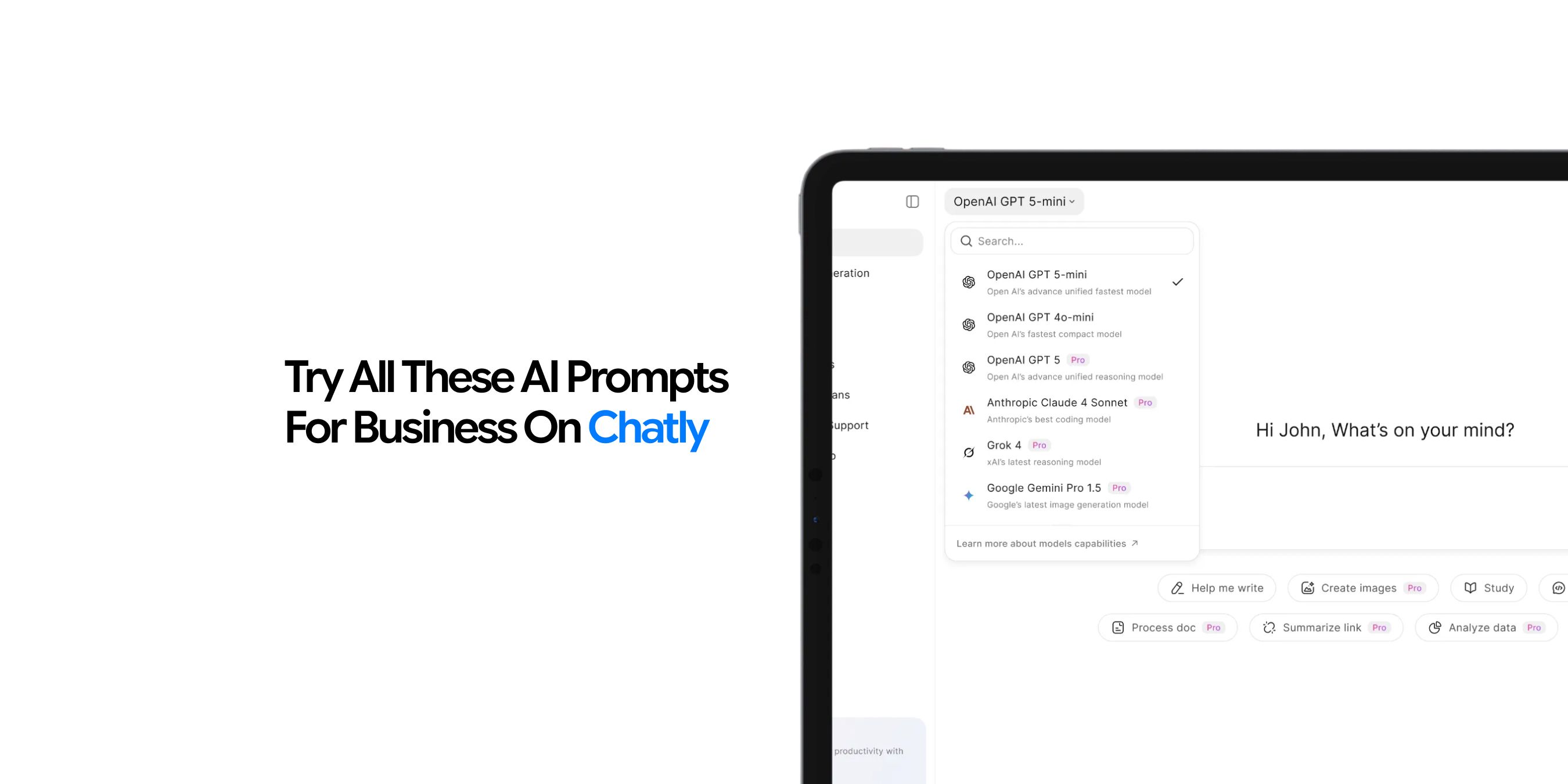
Get more done in one place. Test GPT-5, Claude, Gemini, and more on Chatly.
What Chatly Does that Single-model Tools Like ChatGPT and Copilot Cannot
Most AI tools miss this. You cannot know which model works best for your specific task without comparing. Chatly lets you run the same business prompt across GPT-5, Claude, Gemini, and Grok simultaneously. You pick the output that works. No extra subscriptions. No switching tabs. No starting over.
How Chatly Helps Business Teams Use the Right AI Model for Every Task
A business team using AI daily needs more than one model. The difficult stakeholder email needs Claude's tone sensitivity. The board report needs GPT-5's precision. The competitive analysis might need Gemini's data awareness.
Chatly brings 30+ AI models including GPT-5, Claude Sonnet 4.6, Gemini 2.5 Pro, and Grok 4 into a single interface. Write one prompt. Run it across the models that are strongest for that task. Compare outputs. Ship the best one.
You can also use Chatly's Summary Generator to compress long reports before briefing AI on them, the Paraphrasing Tool to adapt internal documents for external audiences, and the Ask AI tool to get fast answers from complex business documents without reading every page.
Less switching. More executing.
Conclusion: Stop Prompting Randomly and Start Prompting Like a Strategist
The business teams winning with AI right now are not the ones with the biggest budgets. They are the ones who learned to write a prompt like a brief and stopped treating AI like a search engine.
A good business AI prompt has a role, a task, a real audience, and a format. Fill those in and AI stops guessing. It starts producing. Every prompt in this guide follows that logic. Use them as frameworks, fill in the brackets with your actual situation, and run them on Chatly across two models. Use the output that works.
FAQs About Using AI Prompts for Business
Let us answer the most commonly asked questions:
More topics you may like
AI Sycophancy: Your AI Is Agreeing With You (And That Is A Problem)

Daniel Mercer
50+ Ready-to-Copy, Battle-Tested System Prompts That Actually Work in 2025

Muhammad Bin Habib

What Are JSON Prompts and What's So Special About Them?
Muhammad Bin Habib
What Is a System Prompt? The Complete 2025 Guide
Muhammad Bin Habib