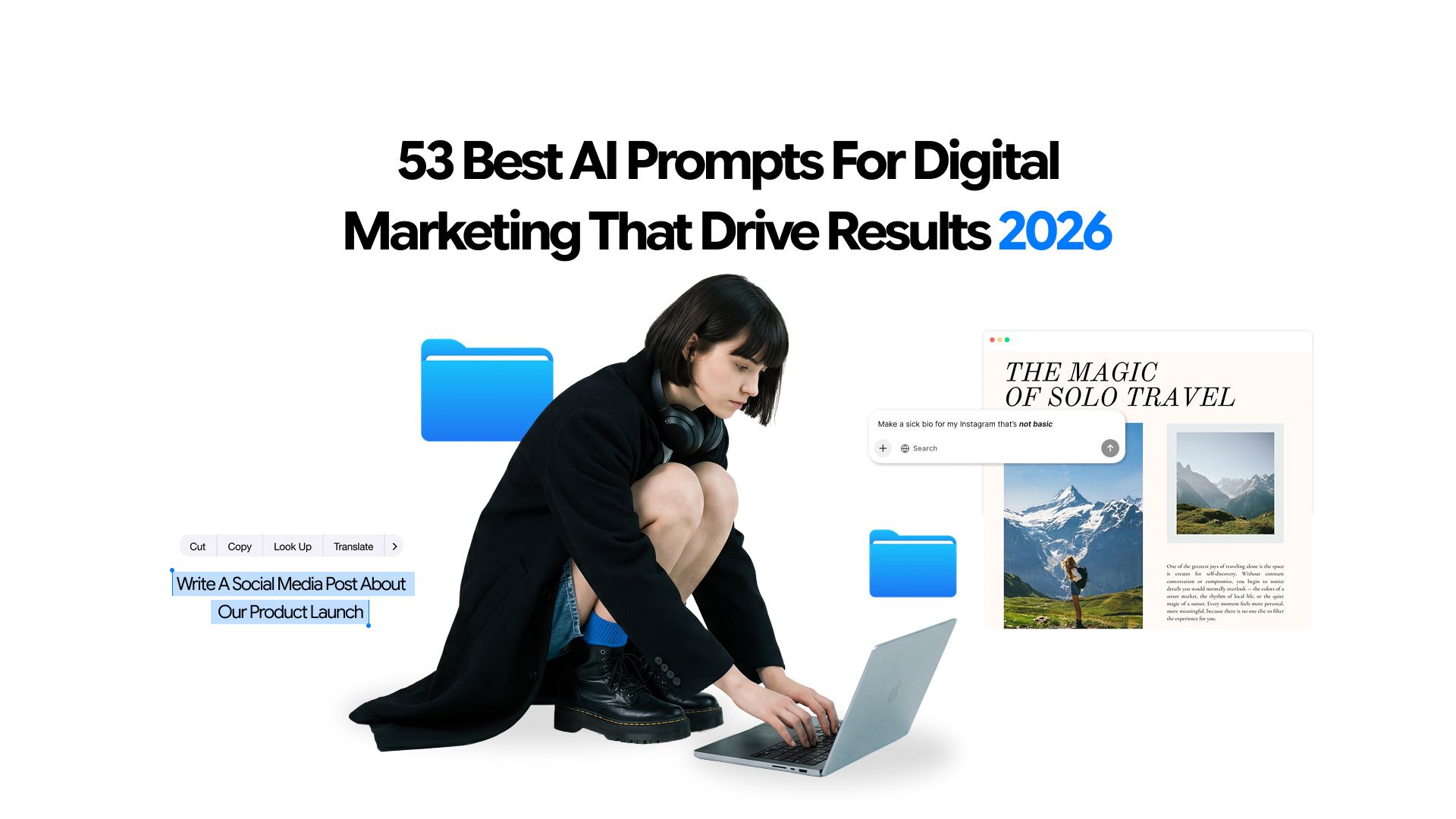
53 Best AI Prompts for Digital Marketing That Drive Results (2026)
You have been staring at that campaign brief for 40 minutes. Highly likely,
- The caption you wrote sounds like a press release.
- The email subject line is boring and you know it.
- The ad copy could belong to literally any brand on earth.
This is a classic prompt problem. But when there are hundreds of AI marketing tools to save you time and money, why the bad output?
Bad instructions produce bad output, every single time.
To help you nail your AI-powered marketing campaigns, here are 60+ AI prompts for digital marketing that I have categorized across multiple important marketing roles, context, and formats. These prompts will turn your blank pages into creatives you can immediately ship.
How to Write a Marketing Prompt That Works
Your marketing is only as good as the prompts you use. Here is a quick prompt guide to help you create the best ones for your campaigns.
Role, Context, and Format: The Three Things Every Prompt Needs
Every prompt that produces usable output has three things:
- A role
- Context
- An output format
Role tells the model who it is. "Act as a senior performance marketer with 10 years of B2B SaaS experience" gets you completely different output than "write me an ad." Context gives it your product, audience, goal, and positioning. Without context, AI fills the gaps with assumptions and those assumptions are always generic. Output format tells it exactly what to produce: word count, structure, tone, what to include, what to avoid.
Use this as your base formula for any AI prompt for digital marketing:
[Role] + [Task] + [Audience] + [Product context] + [Tone] + [Format and length] + [What to avoid]
You do not always need all seven. But the more you give, the less you rewrite.
Why Most AI Marketing Copy Sounds Generic
"Write a social media post about our product launch" gives AI zero to work with. It does not know your audience, your differentiator, or your CTA. Compare that to a fully briefed prompt with role, audience, tone, and format. That is a brief. Briefs produce better copy than requests every single time. If you want to go deeper on prompt structure before diving in, the types of prompts for generative AI guide breaks down every prompt format and when to use each one.
AI Prompts for Social Media Marketing
Social is where most marketers start with AI and where most get disappointed fastest. The output sounds like AI. That is a prompt problem, not a model problem.
Instagram Caption and Carousel Prompts
Prompt 1: Instagram carousel caption
"Act as a senior social media strategist. Write 5 Instagram carousel caption options for [brand] targeting [audience]. Each caption opens with a scroll-stopping hook in the first line, includes a clear CTA in the final line, and stays under 150 words. Tone: [tone]. No emoji as the first character. No corporate buzzwords. Include one hashtag suggestion per caption."
Prompt 2: Instagram story sequence
"Write a 5-slide Instagram story script for [brand] promoting [product or offer]. Each slide needs a header (max 6 words), 1 to 2 lines of body copy, and a visual direction note in brackets. Story arc: problem, agitation, solution, proof, CTA. Tone: [tone]."
Prompt 3: Educational carousel script
"Create a 7-slide carousel script on [topic] for [audience]. Slide 1: a hook that promises one specific outcome. Slides 2 to 6: one actionable insight per slide with a real example. Slide 7: CTA and save prompt. Max 30 words of copy per slide."
X (Twitter) Thread Prompts
Prompt 4: Twitter/X thread
"Write a 10-tweet thread on [topic] for [audience]. Tweet 1: a bold specific hook that makes someone stop scrolling. Tweets 2 to 9: one insight per tweet with a concrete example or stat. Tweet 10: summary and CTA. No filler. Every tweet under 280 characters."
Prompt 5: Contrarian take thread
"Write a 7-tweet thread that challenges the common belief that [industry assumption]. Tweet 1: the contrarian opening statement. Tweets 2 to 6: evidence or examples that support the position. Tweet 7: the nuanced conclusion. Tone: confident, not aggressive."
Facebook Ad Copy Prompts
Prompt 6: Facebook ad copy set
"Write 3 Facebook ad copy variations for [product] targeting [audience]. Three angles: pain-point lead, outcome lead, and social proof lead. For each: primary text under 125 words, headline under 40 characters, description under 30 characters. CTA button: [CTA]. Tone: [tone]."
TikTok Script Prompts
Prompt 7: TikTok video script
"Write a 30-second TikTok script for [brand] promoting [product]. Structure: Hook (3 seconds, one punchy line), Problem (5 seconds), Solution reveal (10 seconds), Proof or demo (8 seconds), CTA (4 seconds). Conversational tone, no corporate language. Include a visual direction note in brackets for each section."
LinkedIn and Long-Form Social Content Prompts
Prompt 8: LinkedIn post
"Write a LinkedIn post for [brand or personal brand] on [topic]. Open with a one-line hook that does not start with I. Use short paragraphs, max 3 lines each. Include one specific insight or data point. End with a question that invites comments. Under 200 words. No corporate buzzwords. Tone: [tone]."
Prompt 9: LinkedIn carousel script
"Write a 7-slide LinkedIn carousel script on [topic] for [audience]. Slide 1: a bold hook that promises one specific takeaway. Slides 2 to 6: one insight per slide with a concrete example or stat. Slide 7: summary and CTA to follow or save. Max 25 words of copy per slide."
Prompt 10: YouTube video description
"Write a YouTube video description for a video titled [video title] by [brand]. Include: a 2-sentence hook that sells the video without spoiling it, a bullet list of what viewers will learn, a CTA to subscribe, and 3 to 5 relevant hashtags at the end. Under 300 words. Include the primary keyword [keyword] in the first 100 characters."
Prompt 11: Pinterest pin description batch
"Write 5 Pinterest pin descriptions for [brand] promoting [product or content piece]. Each: 150 to 300 characters, includes the keyword [keyword], leads with a benefit, ends with a soft CTA. Tone: [tone]. Include 3 relevant hashtag suggestions per pin."
Check out our guide on writing a LinkedIn recommendation to learn useful tips!
AI Prompts for Email Marketing
Email is still the highest ROI channel. Most tools miss how much prompt specificity matters here. These AI prompts for digital marketing cover every stage of the funnel.
Email Subject Line Prompts
Prompt 12: Subject line batch test
"Generate 12 A/B testable subject lines for a [campaign type] email targeting [segment]. Write 4 using curiosity, 4 using urgency or scarcity, 4 using personalization or specificity. Flag the psychological trigger for each. Max 50 characters. Avoid spam trigger words like "free", "guarantee", and "act now"."
Prompt 13: Subject line and preview text pairs
"Write 5 subject line and preview text pairs for a [campaign type] email. The subject line creates the open. The preview text adds tension or completes the thought. Max 50 characters for subject, max 90 for preview. Audience: [audience]. Goal: [goal]."
Welcome and Onboarding Sequence Prompts
Prompt 14: Welcome email
"Write a welcome email for new subscribers to [brand or product]. Confirm what they signed up for, set expectations for what they will receive, deliver one piece of immediate value, and close with a low-friction CTA. Tone: [tone]. Under 200 words. No "welcome to the family" opener."
Prompt 15: 5-email onboarding sequence
"Write a 5-email onboarding sequence for new [product] users. Each email has one job. Email 1: welcome and first win. Email 2: overcome the biggest early obstacle. Email 3: social proof story. Email 4: feature spotlight. Email 5: check-in and offer. Include subject line, preview text, and body for each."
Re-Engagement and Win-Back Email Prompts
Prompt 16: Re-engagement email
"Write a re-engagement email for subscribers who have not opened in 60 days. Honest, self-aware tone. Acknowledge the silence without being apologetic. Offer one piece of new value. Subject line under 45 characters, preview text, body under 120 words, one CTA. Do not use "We miss you" as the subject."
Prompt 17: Win-back offer email
"Write a win-back email for lapsed customers of [product] who last purchased [X months] ago. Acknowledge the gap, lead with what is new or improved, include this time-sensitive offer: [offer]. Subject line, preview text, body under 180 words, CTA. Warm and direct. No guilt."
Promotional Campaign Email Prompts
Prompt 18: Promotional email
"Write a promotional email for [offer] targeting [audience]. Lead with the strongest benefit, not the discount percentage. Include: subject line, preview text, hero headline under 10 words, body under 150 words, CTA button text. Tone: [tone]. Add urgency naturally, not pushily."
Post-Purchase and Transactional Email Prompts
Prompt 19: Post-purchase email
"Write a post-purchase email for a customer who just bought [product] from [brand]. The email should: confirm the order warmly without being robotic, set expectations for delivery or next steps, offer one useful tip for getting the most out of the product, and include a subtle CTA to share or review. Under 180 words."
Prompt 20: Abandoned cart email sequence
"Write a 3-email abandoned cart sequence for [product] at [price point]. Email 1 (1 hour after abandonment): gentle reminder, no discount. Email 2 (24 hours): add social proof or address the most common objection. Email 3 (72 hours): time-limited offer if appropriate. Each email: subject line, preview text, body under 120 words, one CTA."
Prompt 21: Referral program email
"Write an email asking existing customers of [brand] to refer a friend. Lead with the value the customer already gets, introduce the referral offer, make the sharing action as simple as possible, and close with a personal tone. Subject line, preview text, body under 150 words. Tone: warm and appreciative, not transactional."
AI Prompts for SEO and Content Strategy
Content without SEO is invisible. SEO without good content does not rank. These prompts connect both so you are not wasting effort on either side.
Topic Cluster and Pillar Page Prompts
Prompt 22: Topic cluster map
"I am building a content cluster around the pillar topic: [topic]. Identify 10 supporting cluster articles with: proposed title, target keyword, search intent (informational, navigational, commercial, or transactional), and how each links back to the pillar. Prioritize keywords with informational or commercial intent."
Prompt 23: Pillar page structure
"Create a full pillar page structure for [topic]. Include: H1, 8 to 10 H2s each with 2 to 3 H3s, word count per section, internal link opportunities, and a table of contents. The page should cover the topic so completely that a reader has no reason to go back to Google."
Content Brief and Article Planning Prompts
Prompt 24: Full SEO content brief
"Create an SEO content brief for the keyword: [keyword]. Include: primary keyword, 3 secondary keywords, search intent, target audience, recommended word count, H1, 7 H2s with rationale, H3s under each H2, 3 internal link anchor text suggestions, 3 competitor content gaps, and 5 FAQ questions from People Also Ask. Format as a writer-ready brief."
Prompt 25: Competitor content gap analysis
"I want to outrank [competitor URL] for the keyword [keyword]. Identify: 3 subtopics their content misses, 3 questions their content does not answer, and 2 formats or sections I can add to make my content more comprehensive. Use these gaps to structure a better article." If you need to quickly summarize and analyze competitor content before running this prompt, the Chatly Summary Generator cuts through long pages fast.
Title Tag and Meta Description Prompts
Prompt 23: Title tags and meta descriptions
"Write 5 title tag options and 5 meta description options for a page targeting the keyword [keyword]. Title tags: 55 to 60 characters, include the keyword, lead with benefit or a number. Meta descriptions: 140 to 155 characters, include the keyword, end with a soft CTA. No clickbait. Audience: [audience]."
Internal Linking Prompts
Prompt 24: Internal link map
"I have these blog posts on my site: [list URLs and titles]. Identify the best internal linking opportunities between them. For each link: source URL, natural anchor text, target URL, and placement recommendation (early, mid, or end of article). No keyword stuffing in the anchor text."
AI Prompts for Paid Advertising
These prompts are built for performance, not creativity for its own sake. You need to win the auction and the attention economy simultaneously.
Google Search Ad Prompts
Prompt 25: Google Search ad set
"Write 5 Google Search ad sets for [product] targeting the keyword [keyword]. Each set: 3 headlines (max 30 characters each), 2 descriptions (max 90 characters each). Benefit in headline 1, keyword in headline 2, urgency or proof in headline 3. Descriptions focus on differentiators not features. Mark which can be pinned."
Prompt 26: Responsive Search Ad copy
"Write 15 headlines and 4 descriptions for a responsive search ad for [product]. Headlines: 5 benefit-focused, 5 feature-focused, 5 social proof or urgency-focused. Descriptions: cover USPs, handle the most common objection, and include a CTA. All under character limits. Target keyword: [keyword]."
Meta Ad Copy Prompts
Prompt 27: Meta ad creative variations
"Write 3 Meta ad primary text variations for [product] targeting [audience]. Three angles: pain-point narrative, transformation story, and question-led curiosity. For each: primary text under 125 words, one headline under 40 characters, one link description under 30 characters. CTA: [CTA button]."
Landing Page Copy Prompts
A landing page that does not convert wastes every dollar you spent on the ad. Once your copy is done, run it through the Chatly Paraphrasing Tool to test alternative versions without rewriting from scratch.
Prompt 28: Landing page hero copy
"Write 5 landing page hero section options for [product or offer] targeting [audience]. Each option: H1 headline under 12 words, H2 subheadline under 20 words, primary CTA button text (2 to 5 words, action-oriented). Do not use "Learn More" or "Get Started". Tone: [tone]."
AI Prompts for Brand Voice and Messaging
Most brands have a vague idea of their voice. These prompts turn that vague idea into a document your whole team and your AI tools can actually use.
Brand Messaging Framework Prompts
Prompt 29: Full messaging framework
"Create a brand messaging framework for [brand]. Include: one-liner under 12 words, value proposition under 30 words, 3 core messaging pillars with supporting points, how the message shifts per audience segment, and a before and after state for the customer. This will be used as a prompt input for all AI content."
Prompt 30: Positioning statement
"Write 3 positioning statement options for [brand] using the formula: "For [target audience] who [need or problem], [brand name] is the [category] that [key benefit] because [reason to believe]." Recommend which is strongest and why."
Tone of Voice Guide Prompts
Once you have your tone guide, run any AI-generated copy through the Chatly AI Humanizer to strip the robotic patterns before anything goes live.
Prompt 31: Tone of voice guide
"Write a tone of voice guide for [brand]. Include: 4 personality descriptors with explanations, tone adjustments for social, email, ads, support, and long-form content, 8 on-brand sentence examples, 8 phrases to avoid, and a quick-reference checklist for writers and AI tools."
AI Prompts for Influencer and Partnership Outreach
Influencer outreach gets ignored because it is obviously templated. Most tools miss this. These prompts do not. If your outreach involves content briefs or creative storytelling angles, the Chatly AI Story Generator helps you develop narrative hooks worth pitching.
Influencer and Partnership Pitch Prompts
Prompt 32: Influencer pitch
"Write a cold collaboration pitch email to an influencer in [niche] with [follower count] for [brand]. Reference something specific about their content: [specific detail]. Explain the audience alignment in one sentence. Pitch the collaboration in one sentence. State what we are offering. Low-friction CTA. Under 150 words. No "I have been following your journey" opener." Prompt 33: Brand partnership outreach
"Write a brand partnership email from [brand A] to [brand B] proposing [partnership type]. Reference the audience overlap: [detail]. State the mutual benefit clearly. Propose one specific first step. Under 200 words. Peer-to-peer tone, not vendor to client."
AI Prompts for Analytics and Campaign Reporting
Data without narrative is just numbers. These prompts help you turn campaign metrics into insights that clients and leadership actually care about.
Campaign Performance Report Prompts
Prompt 34: Client-facing campaign report
"Turn these raw campaign metrics into a client-facing performance summary: [paste metrics]. Structure: 3-line executive summary, what worked and why, what underperformed and the likely cause, 3 recommended next steps. Under 350 words. Confident, analytical, no jargon. Do not list every metric. Prioritize what matters to the client's goal."
Prompt 35: Monthly marketing report narrative
"Write a monthly marketing report narrative for [period] using these results: [paste data]. Include: channel-by-channel highlights, key wins, areas to improve, and the strategic recommendation for next month. Audience: marketing director and VP of revenue. Under 500 words."
Data Insight and Anomaly Analysis Prompts
Prompt 36: Anomaly analysis
"I noticed this unusual pattern in our marketing data: [describe it]. Walk me through: 3 likely causes, which is most probable and why, what data I need to confirm the hypothesis, and what action to take if confirmed. Be specific, not vague."
AI Prompts for Competitor Research
Knowing what competitors are doing is table stakes. Knowing where they are weak is the actual advantage. Use Chatly's Ask AI tool to query competitor content and pull answers fast before you run these prompts.
Competitor Content Gap Prompts
Prompt 37: Competitor content gap
"My main competitor is [competitor]. Their content covers [topics]. Identify: 5 topics or angles their content does not address, 3 audience questions their content fails to answer, and 2 positioning gaps I can exploit. Use these to build a content advantage."
Prompt 38: SERP gap analysis brief
"I want to rank for the keyword [keyword]. Based on what typically ranks in the top 10 for this type of query, tell me: what content format dominates, what subtopics appear across most results, what unique angle I could take to differentiate, and what word count to target to be competitive."
Market Positioning and Differentiation Prompts
Prompt 39: Differentiation audit
"Audit our current marketing positioning based on this description: [describe your product and current messaging]. Identify: where we sound too similar to competitors, where we are underselling a genuine differentiator, and 3 specific messaging changes that would make us stand out clearly in a crowded market."
AI Prompts for Content Repurposing and Distribution
Most marketing teams create content once and post it once. These prompts squeeze every channel out of every asset.
Content Repurposing Prompts
Prompt 40: Blog post to social content
"Take this blog post and repurpose it into: 3 LinkedIn post angles, 5 tweet variations, 1 Instagram carousel outline (7 slides), and 1 email newsletter intro (under 100 words). Each format should feel native to the channel, not like a copy-paste. Blog post: [paste]."
Prompt 41: Podcast or video to written content
"I have this transcript from a [podcast/video/webinar]. Extract: the 5 most quotable moments (under 30 words each), 3 key insights that would make strong LinkedIn posts, 1 email newsletter angle, and 1 blog post headline with a suggested outline. Transcript: [paste]."
Prompt 42: Long-form to short-form breakdown
"Break this long-form article into a content distribution plan. Produce: a Twitter/X thread (8 tweets), a short-form video script (60 seconds), a LinkedIn carousel outline (6 slides), and 3 email subject lines that tease the content. Article: [paste]."
Check out our blog on writing a LinkedIn summary to learn the ins and outs.
Event and Campaign Launch Prompts
Prompt 43: Pre-launch hype content
"Write a 4-piece pre-launch content plan for [product or event] launching on [date]. Include: a teaser post for social (day 14 before launch), a countdown email (day 7), a behind-the-scenes social story script (day 3), and a launch day announcement post. Tone: [tone]. Platform: [platform]."
Prompt 44: Post-event recap content
"Write a post-event content pack for [event name]. Include: a LinkedIn recap post (200 words, highlight 3 key moments), an email to attendees (under 150 words, thank them and share a resource), and a social media quote card text from the best moment: [quote]. Tone: warm and professional."
AI Prompts for Conversion Rate Optimization
CRO Copy and Testing Prompts
Prompt 45: A/B test copy variants
"Write 3 A/B test variants for this [button/headline/email subject/CTA]: [current copy]. Each variant should test a different angle: one benefit-led, one urgency-led, one curiosity-led. Explain the hypothesis behind each variant in one sentence."
Prompt 46: Homepage headline test
"Write 5 homepage headline variants for [product] targeting [audience]. Each headline should be under 10 words and test a different value angle: outcome, speed, ease, credibility, and differentiation. Include a supporting subheadline (under 20 words) for each."
Prompt 47: Abandoned cart email
"Write an abandoned cart email for [product] targeting a customer who added it to their cart but did not complete purchase. Include: subject line, preview text, one-line hook, a brief reminder of what they left behind, one objection handled, and a CTA. Under 150 words. No guilt. One low-friction incentive if appropriate: [incentive or 'none']."
AI Prompts for Community and Engagement
Community and Engagement Prompts
Prompt 48: Community welcome post
"Write a welcome post for new members joining [community name] on [platform]. Include: what this community is about in 2 sentences, the 3 most important rules or norms, what new members should do first, and a question to spark their first interaction. Warm and human tone. Under 200 words."
Prompt 49: Engagement question series
"Generate 10 engagement questions for a [brand] audience of [audience description] on [platform]. Each question should: spark genuine responses, relate to [topic or industry], and avoid yes/no answers. Vary the format: 3 opinion questions, 3 experience questions, 2 preference questions, 2 prediction questions."
Prompt 50: UGC campaign brief
"Write a user-generated content campaign brief for [brand]. Include: campaign theme and hashtag, the ask (what we want users to create), why they should participate (incentive or recognition), example content ideas to inspire them, and how we will feature the best submissions. Under 300 words. Tone: exciting but achievable."
AI Prompts for Seasonal and Trend-Based Marketing
Seasonal and Trend-Based Campaign Prompts
Prompt 51: Seasonal campaign angle
"Generate 5 campaign angles for [brand] around [seasonal moment: e.g. Q4, summer, back to school, Black Friday]. Each angle should connect the season to our product or brand value in a non-generic way. Avoid: 'tis the season, celebrate, and gift the gift of. Audience: [audience]."
Prompt 52: Trend hijacking brief
"A trending topic right now is [trend]. Write 3 ways [brand] could engage with this trend authentically on [platform]. For each: the angle, a draft post (under 150 words), and a risk assessment (is there any reason this could backfire?). Only suggest angles that are a genuine fit for our brand."
Prompt 53: Year in review content
"Write a year-in-review social post and email for [brand] covering [year]. Include: 3 milestones or achievements to highlight, 1 honest acknowledgment of a challenge, 1 forward-looking statement about the year ahead, and a thank you to the audience. Social post under 200 words. Email under 300 words. Tone: genuine, not corporate."
Get more done in one place with Chatly.
How Chatly Runs Every Model Without the Tab Switching
Most AI platforms lock you into one model. If it underperforms on a task, you open another tab, log into another tool, and start over. That switching cost is what kills productivity.
Chatly brings 30+ AI models including GPT-5, Claude Sonnet 4.6, Gemini 2.5 Pro, and Grok 4 into a single interface. Write one prompt. Run it across the models that are strongest for that task. Compare outputs. Ship the best one.
For digital marketers: run your ad copy prompt through GPT-5 for structure, through Claude for brand voice, through Gemini for keyword alignment. Pick the winner. Move on. If you need content translated for international campaigns, Chatly's English to Spanish Translator and English to Chinese Translator handle that without leaving the platform.
Less switching. More doing.
Conclusion: Start Prompting Like a Brief, Not a Request
The marketers getting real results from AI are not using better tools. They are writing better prompts.
A vague prompt gives you vague copy. A specific prompt built like a brief gives you something you can actually ship. Every prompt in this guide follows the same logic: define the role, give the context, specify the format.
Pick one channel where you spend the most time writing. Take one prompt from that section. Run it on Chatly across two models. Compare the outputs. Use the better one. That single experiment will change how you use AI in your marketing workflow.
Get more done in one place with Chatly.
Frequently Asked Questions
More topics you may like
10 Different Ways You Can Use Chatly AI Chat and Search Every Day

Faisal Saeed
21 Journaling Techniques That Actually Work in 2025

Muhammad Bin Habib

28 Best AI Tools for Students in 2025 – The Complete AI-Powered Academic Success Guide
Muhammad Bin Habib
24/7 Customer Support with AI Chat: Benefits, Examples and More
Muhammad Bin Habib
50+ Best AI Prompts for Business to Automise Your Tasks

Aqsa Nazir Kayani