How to Qualify Sales Leads with AI

Sales reps spend only 28% of their time actually selling, with the rest going to admin, research, and chasing leads that were never going to buy. Knowing how to qualify sales leads systematically is what changes that ratio.
This guide covers the complete process of how to qualify sales leads in B2B:
- MQL vs SQL
- The BANT, CHAMP, and MEDDIC frameworks
- The four buying signals that indicate near-term readiness
- How AI cuts per-prospect research from 25 minutes to under five
- The three-tier scoring system for prioritising who gets outreach first.
What Is Lead Qualification in B2B Sales?
Lead qualification is the process of determining whether a prospect has the budget, authority, need, and timeline to become a real sales opportunity. It separates high-intent buyers from companies that fit your ICP on paper but are not ready to buy, so sales effort goes to the accounts most likely to close.
Qualification is a relevance filter, not a gatekeeping exercise. Done well, it produces shorter sales cycles, higher conversion rates, and forecasts that reflect reality rather than optimism. Done poorly, it produces bloated pipelines full of contacts who were never going to make a decision, and reps chasing relationships that never convert.
B2B buying decisions now involve 6 to 10 stakeholders, which means every unqualified lead you pursue burns hours you could have spent with a committee that was actually ready to move.
MQL vs SQL: What the Distinction Means for Your Pipeline
A marketing-qualified lead (MQL) is someone who has shown interest by engaging with content, campaigns, or events without direct sales contact. They match firmographic criteria and have interacted with marketing materials, but they have not yet signalled readiness for a direct sales conversation.
A sales-qualified lead (SQL) has moved beyond marketing engagement and been vetted by the sales team, confirming that they have a real need and the authority to act on it. The difference between an MQL and SQL is not just a label. It determines who owns the lead, what action gets taken next, and whether a rep's time investment is justified.
61% of B2B marketers send all leads to sales even though only 27% are sales-ready, and this mismatch wastes rep capacity on leads that marketing should still be nurturing. Most qualification failures are not failures of the sales process but failures of the handoff between marketing and sales.
The Four Types of Qualified Leads
Understanding where a lead sits in the qualification hierarchy determines how to approach them and which action is appropriate at each stage.
- MQL (Marketing Qualified Lead): a prospect who has matched firmographic criteria and engaged with marketing content but has not yet expressed purchase intent and still needs nurturing before a sales conversation is appropriate.
- SQL (Sales Qualified Lead): a prospect who has been vetted by the sales team, confirmed to have a real need and the authority to act on it, and is ready for a discovery call or direct outreach.
- PQL (Product Qualified Lead): a prospect who has used the product through a free trial or freemium plan and hit activation thresholds that signal readiness to buy, making this the highest-conversion lead type.
- IQL (Information Qualified Lead): a prospect who has downloaded a resource or attended a webinar and is at an early stage that still requires education before qualification is meaningful.
The goal of the lead qualification process is to move SQLs into the pipeline and route everything else back to the appropriate stage. For the research workflow that accelerates this handoff, the AI chat for prospect research and qualification structures the company intelligence brief that informs tier assignment and outreach angle.
Lead Qualification Frameworks: BANT, CHAMP, and MEDDIC
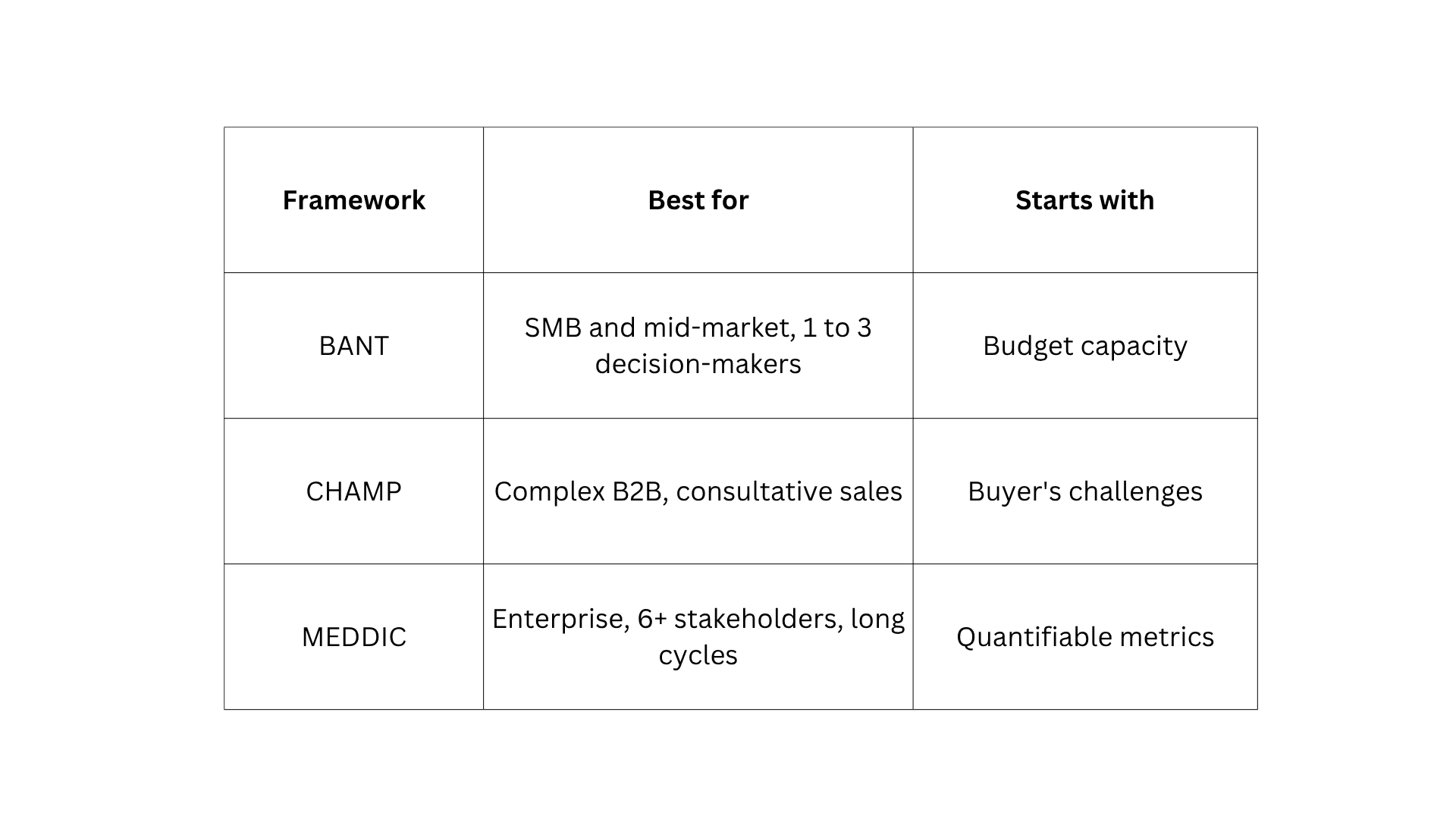
Three frameworks structure how sales teams qualify sales leads in B2B. Each works best in a different sales context, and choosing the right one for your deal type is the first structural decision in building a repeatable qualification process. Understanding which framework to apply is essential to qualifying sales leads at the right speed and depth for your deal type.
BANT: Budget, Authority, Need, Timeline
BANT is the most widely used B2B qualification framework and works best for SMB and mid-market deals where one to three people make the purchase decision and budget cycles are predictable.
The four BANT dimensions are:
- Budget: funds allocated and available for this type of initiative
- Authority: decision-maker identified and engaged, not just a user-level contact
- Need: a confirmed business problem exists and has been quantified
- Timeline: a defined evaluation window rather than an open-ended "someday."
BANT works best for high-volume deals under $25,000 with short sales cycles where a binary qualification decision is needed quickly. Companies using BANT consistently report higher conversion rates than teams without a structured framework.
The limitation is that opening with a budget creates friction with prospects in early-stage evaluation. When the budget is not yet formally allocated, starting with need or timeline surfaces context that leads naturally to the budget conversation.
Running the company intelligence brief prompt before any BANT conversation surfaces funding recency, headcount growth, and tech stack changes that answer the budget and timeline dimensions before you ask.
CHAMP: Challenges, Authority, Money, Prioritisation
CHAMP reorders BANT to start with the buyer's challenges rather than their budget, and it works best in complex B2B environments where the money conversation is more productive once the problem has been clearly articulated.
The four CHAMP dimensions are:
- Challenges: What specific problem are they facing, and what does it cost?
- Authority: Who makes the final decision?
- Money: Is the budget available, or can it be allocated?
- Prioritisation: How urgent is this relative to other competing initiatives?
CHAMP works best in consultative sales cycles where opening with challenges builds rapport before asking about budget, making the conversation feel like a peer discussion rather than a qualification interrogation.
Using the buyer profile brief prompt identifies how the prospect talks about the challenge publicly before the first call, revealing whether they are actively trying to solve it or simply acknowledge it exists.
MEDDIC: Metrics, Economic Buyer, Decision Criteria, Decision Process, Identify Pain, Champion
MEDDIC is an enterprise methodology designed for deals with six or more stakeholders, long sales cycles, and complex procurement processes where deals stall in committee rather than in individual conversations.
The six MEDDIC dimensions are:
- Metrics: quantifiable impact in revenue gained or cost eliminated
- Economic Buyer: the individual who controls the final budget decision
- Decision Criteria: the formal and informal factors that the buying committee evaluates
- Decision Process: the steps the organisation takes to make a purchase
- Identify Pain: the confirmed and quantifiable business problem with a cost attached
- Champion: an internal advocate who argues for the purchase when you are not in the room
MEDDIC works best for enterprise deals and procurement-heavy organisations where you cannot reach the economic buyer directly. Deals without a confirmed champion consistently stall at the late stage because no one advances the deal between calls.
How to Qualify Sales Leads
Every qualification conversation assesses the same four criteria, and the difference between reps who qualify sales leads efficiently and those who spend hours per prospect is that the efficient ones confirm as much as possible through research before the first call. AI compresses that research from 25 minutes to under five.
Criterion 1: Budget
Budget qualification means assessing whether funds are allocated, who controls them, and whether the procurement cycle is open and not simply asking "do you have a budget."
Three signals indicate budget posture before you ask:
- Recent GTM-focused funding means new capital with growth targets attached
- Rapid hiring in your target function means budget deployed on headcount typically precedes tool investment
- Active tech procurement means new tools appearing in the stack signal an open buying cycle
The company intelligence brief prompt surfaces funding recency, headcount growth rate, and tech stack changes in under 60 seconds, so the discovery call opens with specific context rather than a cold budget question.
Questions to confirm on the call:
- "Is there an allocated budget for this type of initiative this quarter?"
- "What does the approval process look like at this spend level?"
- "Has the budget been discussed internally, or would this be a new ask?"
Criterion 2: Authority
Every B2B deal involves three distinct roles, and confusing them wastes time and delays deals that should close.
- The champion feels the problem daily and is most likely to reply to outreach, but rarely has final purchase authority
- The economic buyer controls budget approval and evaluates ROI and risk, but may not be the first person to respond
- The technical evaluator assesses integration and security risk and can block a deal even when both other roles are aligned
The buyer profile brief prompt maps the contact's likely role before outreach begins by identifying whether they are the champion, economic buyer, or technical evaluator based on their title, LinkedIn activity, and what they have published about the problem. The prospect research tool for qualifying buying intent surfaces job description language that names the problem in the company's own words.
Questions to confirm on the call:
- "Who else would be involved in evaluating this decision?"
- "Who needs to sign off at this spend level?"
- "Is there a technical or security stakeholder who would need to evaluate fit?"
Criterion 3: Need
Interest means "this sounds useful," while need means "we are experiencing this problem and it is costing us." Qualification confirms the need rather than creating it.
Three things confirm a need is real:
- The prospect can quantify the problem in cost, time, or headcount
- They have tried to solve it before and can describe what failed
- They can name a specific business consequence of leaving it unresolved
Job descriptions that use your product's exact language to describe a problem are among the most underused qualification signals in outbound. When a company posts a role that names the challenge your product solves, it confirms the problem is active, and budget is being allocated to address it.
Questions to confirm on the call:
- "What has this been costing the team in time, revenue, or headcount?"
- "Have you tried to solve this before? What happened?"
- "What happens if this problem is still here in six months?"
Criterion 4: Timeline
"Maybe Q3" sitting in the pipeline for six months, is not a qualified opportunity but a forecast risk. Real timelines are driven by specific external events:
- A recent funding round with capital to deploy
- A new leader running a stack review in their first 90 days
- A quarter-end budget deadline
- An acute event, such as a rep leaving or a customer churning
When a prospect can name the specific event driving their timeline, the urgency is real. When they cannot name a specific event, the timeline is aspirational rather than committed.
Funding recency, leadership change timing, and hiring velocity each serve as timeline proxies before the call. Responding to a qualified lead within the first hour of identifying a signal multiplies qualification odds by 7x.
Questions to confirm on the call:
- "When does solving this become a must-have rather than a nice-to-have?"
- "Is there a specific quarter or event driving this evaluation?"
- "What would need to change for you to move forward in the next 60 days?"
The Four Buying Signals That Indicate a Lead Is Ready to Qualify Right Now
A buying signal is a recent, publicly visible change at a prospect's company that confirms they are in an active buying window now. Sales teams that know how to qualify sales leads efficiently use signals as the starting point for every research pass rather than relying on static ICP filters alone.
Qualification that starts with a signal starts with evidence rather than assumption. The real-time company signal research tool surfaces these signals across your target accounts without manually checking multiple sources.
Signal 1: Active Hiring in the Relevant Function
Rapid hiring in the team that uses or influences your product signals that a specific priority has been identified and budget is in motion. Three hiring patterns map to specific needs:
- Multiple SDRs posted signals scaling outbound with a need for tools to support volume
- A Head of Customer Success role signals a strategic shift toward retention
- Multiple enterprise AEs signal an onboarding consistency challenge incoming
To find this signal, check LinkedIn Jobs and the company's careers page for three or more similar roles posted in a short window, which indicates urgency rather than standard attrition. This research takes approximately three minutes.
AI prompt for this signal:
Based on these job postings from [company]: [paste descriptions],
what does their hiring pattern suggest about their current
operational priorities and the most likely challenges
they are facing right now?
Signal 2: Recent Funding Activity
New capital means an active spending cycle with growth targets attached. The key distinction is in how the announcement describes the use of funds. "Expanding go-to-market" or "building the sales team" signals immediate demand for sales tools. "Investing in product development" signals an internal build focus with lower near-term buying urgency.
Act within the first 60 to 90 days because the planning cycle closes quickly once capital is deployed. To find this signal, check Crunchbase, LinkedIn News, TechCrunch, and PitchBook. This research takes approximately two minutes.
Signal 3: Leadership Change in the Buying Role
New leaders evaluate their inherited stack within the first 90 days because they have authority, urgency, and a finite window to make changes before institutional inertia sets in. The optimal outreach window is weeks two to ten. Week one is too early while the new leader is still in orientation, and after day 90, the evaluation window has typically closed.
To find this signal, check the LinkedIn company page (People tab filtered by "started new role in last 90 days") or set Google Alerts for "[company] appoints" or "[company] hires." The real-time company signal tracker monitors these across your target accounts automatically. This research takes approximately two minutes.
Signal 4: Technology Change or Platform Migration
When a company is switching platforms in your category, buying discussions are already in motion, and adjacent needs are being evaluated at the same time as the primary switch. To find this signal, check:
- BuiltWith for tech stack changes over time
- G2 reviews for the recent migration mention
- LinkedIn posts from team members discussing the transition
- Job descriptions that explicitly name the platform being replaced
This research takes approximately three minutes.
ICP Fit vs Buying Readiness: The Distinction Most Reps Miss
ICP fit and buying readiness are not the same thing, and treating them as interchangeable is the most common reason strong-looking pipelines convert at below-average rates.
ICP fit means the company matches your ideal customer profile on paper: right industry, size, geography, and tech stack. Buying readiness means the company is in an active buying window right now, indicated by a recent and observable change at the company.
A company with an ICP fit but no recent signals might buy eventually, but the same company with an ICP fit and an active buying signal is the account to work on this week. Accounts with three or more active buying signals simultaneously convert at 2.4x the rate of single-signal accounts, and that multiplier comes from signal selection rather than email quality.
Why Lead Qualification Directly Determines Your Close Rate
When sales teams do not qualify sales leads systematically, two specific costs compound the longer the problem is ignored. Reps who skip the process of how to qualify sales leads before outreach consistently produce worse results than those who spend five minutes on research first.
The first cost is time. At 50 unresearched prospects per week, reps generate the same meeting volume as signal-based outreach to 20 prospects, which means five times the effort for the same output.
The second cost is pipeline accuracy. Deals that should have been disqualified in week one stay in the CRM for months, corrupting forecasts and distorting where the team thinks it stands each quarter.
Companies with structured lead qualification see 50% more sales-ready leads and up to a 28% boost in conversions. The advantage is not a better pitch but better qualification before the pitch begins. For the AI prompts that convert a qualified signal into a compelling first email, the guide to AI prompts for sales outreach and business writing covers framing patterns that work across different buyer personas.
Two AI Research Prompts That Replace 20 Minutes of Manual Work
AI replaces manual tab-switching but not qualification judgment. These two prompts compress 16 to 25 minutes of per-prospect research into under five minutes of structured intelligence, and 67% of organisations using AI in sales have seen direct revenue growth as a result.
Run both prompts as part of a single research pass before every outreach message or discovery call. The sales research and signal-finding tool runs both prompts in one workspace.
Prompt 1: Company Intelligence Brief
Use this prompt at the start of every research pass, before outreach and before call prep.
You are a B2B sales researcher.
Given this company name and website URL, produce a structured brief covering:
1. What the company does in one sentence
2. Current growth signals from the past 60 days:
   recent funding, hiring patterns, partnerships, or product launches
3. The most likely operational challenges for a company
   at their current stage and in their industry
4. Budget posture inference based on funding recency
   and headcount growth rate in the relevant function
5. One specific qualification angle to explore on the first call
Use only publicly available information.
Company: [name]. URL: [URL].
This prompt delivers pre-call intelligence across Budget, Need, and Timeline before the conversation begins and replaces approximately 15 minutes of manual research.
Prompt 2: Buyer Profile Brief
Use this prompt after the company research is complete, before reaching out to a specific contact.
Given this LinkedIn profile summary for [name, title, company], produce:
1. Their likely top three priorities in this role right now
2. Whether they are most likely the champion, economic buyer,
   or technical evaluator for a decision in this area
3. Any public content indicating how they think about
   [your product category] or the problem it solves
4. The most relevant angle to connect my solution
   to their specific situation
Profile content: [paste LinkedIn About section or recent posts].
This prompt delivers authority mapping and role-specific framing before first contact and replaces approximately five minutes of LinkedIn analysis.
For how to apply this research process across 50 prospects simultaneously, see how to do cold email personalisation at scale.
Three-Tier Lead Scoring System for Prioritising Who Gets Outreach First
Not every ICP-fit lead deserves the same research effort or outreach timing. Sales teams that qualify sales leads systematically use a tiered scoring system, and the core principle is to prioritise by signal strength so that Tier 1 accounts are always worked before Tier 2 or Tier 3.
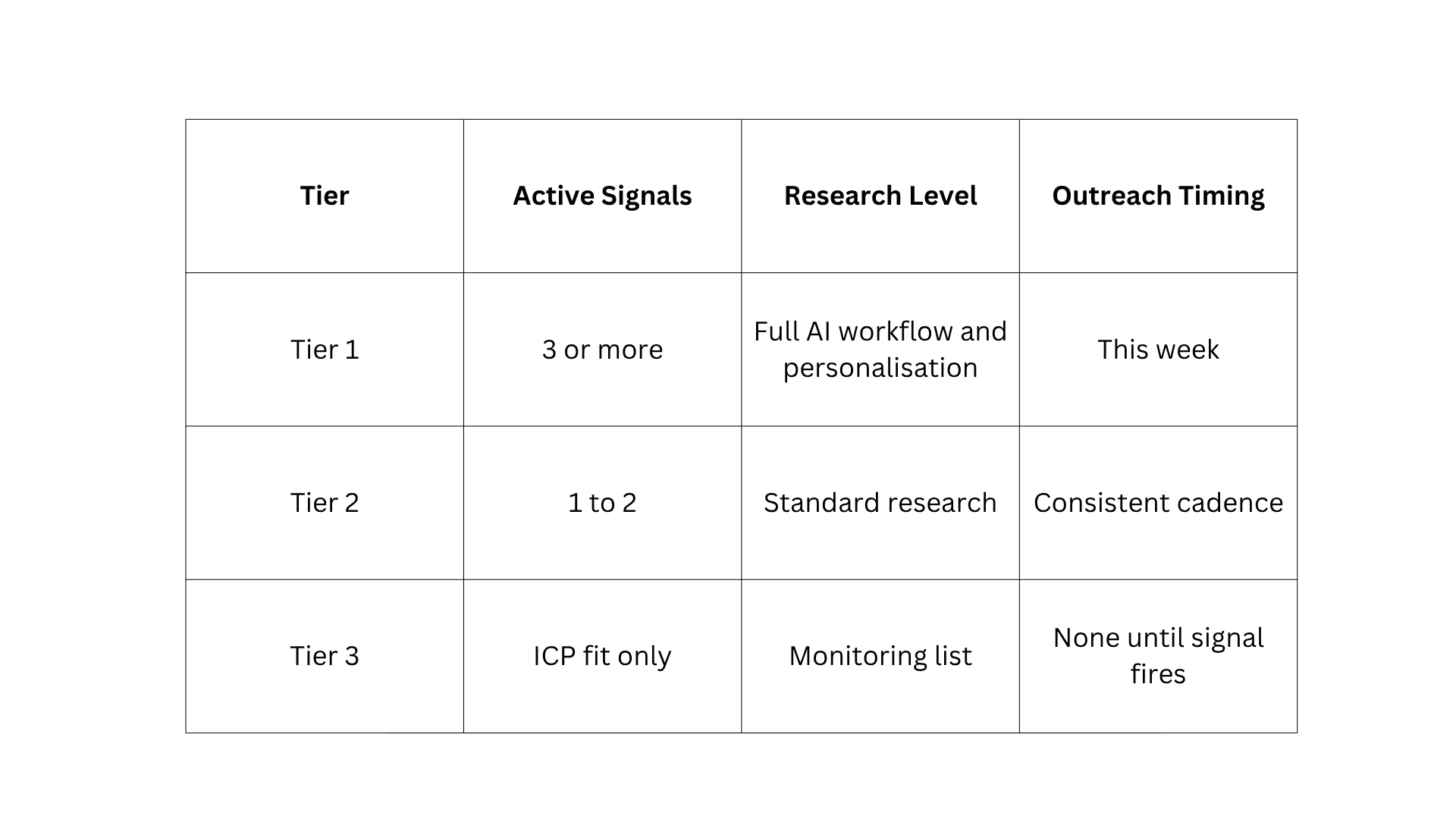
Tier 1 accounts receive full AI research, full personalisation, and multi-channel outreach this week because they represent the highest conversion probability.
Tier 2 accounts are worth pursuing on a consistent cadence with standard research, but not at the expense of Tier 1 time.
Tier 3 accounts go on a monitoring list only, with Google Alerts set to move them to Tier 2 when a signal fires and no outreach until that happens.
The practical math is that 100 ICP-fit prospects typically produce 10 to 15 Tier 1 accounts, and those accounts with signal-based outreach produce the same meeting volume as generic outreach to all 100.
The AI document generator for account research briefs converts your scored prospect list into organised briefs ready for the writing stage. For systematic signal monitoring across your target accounts, the guide to best system prompts for sales research and qualification covers reusable prompt templates that keep research consistent across the team.
Once your list is scored, see the step-by-step prospecting email guide for the writing framework that converts research into outreach.
Lead Qualification Checklist
Use this checklist every time you need to qualify sales leads before moving them from MQL to SQL status. Every item should be confirmed before a rep invests full research and outreach effort.
Company fit
- ICP match confirmed across industry, size, geography, and tech stack
- At least one active buying signal has been identified from the past 60 days
- Signal is current and acted on within 48 to 72 hours of discovery
Budget
- Funding recency checked to assess whether capital is available for this type of initiative
- Headcount growth in the target function was reviewed as a budget proxy
- Budget question framed and ready for the discovery call
Authority
- Champion is identified as the person who feels the problem daily
- The economic buyer is identified as the person who controls the final decision
- Org chart mapped at least partially from LinkedIn research
Need
- Problem confirmed through a signal, job description, or published content
- The problem has a quantifiable cost attached or can be surfaced on the call
- Previous attempts to solve the problem identified where possible
Timeline
- Specific event driving urgency identified such as a funding round, leadership change, quarter-end, or acute event
- Outreach timing window confirmed based on the signal type
Tier assignment
- Lead scored as Tier 1, Tier 2, or Tier 3 based on signal count
- Research level and outreach timing set accordingly
How to Measure Whether Your Qualification Process Is Working
Track these three metrics for two weeks before and two weeks after implementing the AI prompts to see the impact clearly.
- Time per prospect: before the AI workflow, manual research takes 16 to 25 minutes per prospect. After the AI workflow, the same research takes under five minutes. Track this by logging actual time for five prospects before and five after implementing the prompts.
- Signal-to-outreach ratio: the target is 80% or above, meaning at least 80% of prospects you research have at least one actionable signal. A ratio below 60% means the signal sources need to be expanded or the ICP definition needs tightening.
- For the PDF tool that extracts qualification benchmarks from industry research documents without reading them in full, the PDF querying tool for sales research documents keeps the research pass focused and fast.
- Qualification-to-meeting rate by signal type: track meetings booked per signal type separately over 90 days across hiring, funding, leadership change, and tech migration signals. This reveals which signals convert best for your ICP and where to concentrate research effort. The AI chat for sales performance analysis processes tracking data and surfaces which signal types are driving the most meetings for your specific market.
Conclusion
Qualification is not a step you complete before selling. It is the discipline that makes everything else in your sales process more effective. When you know who to call, why they are ready, and what they care about before the first email goes out, you stop burning time on the wrong accounts and start spending it where it actually converts.
Frequently Asked Questions
Learn more about lead qualification with AI.
More topics you may like

How to Write a Sales Prospecting Email That Gets Replies

Arooj Ishtiaq

How to Make AI Cold Emails Sound Human
Arooj Ishtiaq
B2B Sales Email Templates, Sequences, and Multi-Channel Outreach Guide
Arooj Ishtiaq

Salesforce Turns Slackbot Into a Full Enterprise AI Agent With 30 New Capabilities

Aqsa Nazir Kayani