How to Write a Sales Prospecting Email That Gets Replies
In 2026, the average cold email reply rate across major platforms sits at 3.43%. For generic, untargeted campaigns, it drops to 1.7%. That number will not improve with better subject lines or longer lists. It improves when your email contains a specific reason why this particular person, at this particular company, should reply today.
If your sales prospecting emails are getting no replies, the problem is often not the writing itself. Most emails fail because they sound generic and give buyers no clear reason to respond. When an email feels like it was sent to thousands of people at once, buyers usually ignore or delete it.
This guide covers that system from start to finish:
- How to find the right signal?
- How to write the email around it?
- How to structure subject lines and CTAs?
- How to track whether any of it is working?
What Is a Sales Prospecting Email?
A sales prospecting email is a short, targeted cold outreach message sent to a potential B2B buyer with no prior relationship. Its only purpose is to earn a reply, not to pitch the product or close the deal. It works when it gives the reader one specific, verifiable reason why this message is relevant to their business right now.
What separates a prospecting email from spam is specificity and a single ask. It is not a newsletter, not a product pitch, and not a mass blast to a purchased list. The goal is one reply that leads to one conversation, nothing more.
How to Write a Sales Prospecting Email That Gets a Reply
Every prospecting email that earns a reply is built from the same nine steps. Skipping any one of them is the most predictable reason they get deleted.
Here are the nine steps:
- Research the prospect
- Define the email's single objective
- Identify the ICP and personalisation angle
- Write the subject line
- Write the opening line
- Write the body (bridge and value claim)
- Write the CTA
- Set the length and format
- Edit for human tone before sending
Step 1: Research the Prospect Before Writing a Single Word
Never write a sales prospecting email without one specific, recent, verifiable fact about the prospect's company. Research is not an optional context. It is the raw material from which the entire email is built.
Four types of signals to look for:
- A recent company announcement like funding round, product launch, or strategic partnership
- A hiring pattern in the relevant function, like multiple roles posted in a short window
- A leadership change in the buying role: new VP, Director, or Head of a relevant function
- A technology adoption or migration: switching platforms, adopting a new tool
Where to find them (approximately 2 minutes each):
- LinkedIn: company page for announcements and job postings, prospect profile for recent activity
- Crunchbase: funding status, round size, stated use of capital
- Google News: press releases, announcements, coverage
Time investment should be 5 minutes per prospect. This research is what makes the email feel written for this person today rather than generated for a list. AI replaces manual tab-switching with a structured brief in under 60 seconds.
AI prompt to use:
You are a B2B sales researcher. Given this company name and URL, produce a structured brief covering:
1. What the company does in one sentence
2. Any growth signals from the past 60 days
   (funding, hiring, launches, partnerships)
3. The most likely current challenges
   for a company at this stage
4. One specific outreach angle
Use only public information.
Company: [name]. URL: [URL].
The prospect research tool for finding buying signals handles this research pass directly. Paste the company name and URL and get a structured brief in under 60 seconds.
For the complete AI-powered research and qualification workflow, see how to find a buying signal before writing. The AI search engine for researching prospect signals and company intelligence surfaces recent hiring patterns, funding announcements, and leadership changes across your target accounts without opening multiple tabs.
Step 2: Define the Single Objective of This Email
Every sales prospecting email has exactly one objective. The objective of email 1 is always to earn a reply that leads to a conversation. Not to close the deal, not to explain the product, not to book a 30-minute demo.
When the objective is clear, every sentence either serves it or gets cut. When the objective is vague, the email tries to do too much and does none of it. A rep who writes with the demo in mind writes a longer, product-focused email that gets deleted. A rep who writes to earn a reply writes something short, specific, and effective.
AI prompt to use:
Review this email draft. The only objective is to earn a reply that leads to a 10-minute conversation. Flag every sentence that does not directly serve that objective.
Email: [paste draft].
The AI document generator for creating structured email review outputs formats this review pass clearly so you can act on each flagged sentence directly.
Step 3: Identify the Right ICP Segment and Personalisation Angle
The personalisation angle must come from the research in Step 1, not from the prospect's job title or name. Before you write a sales prospecting email, answer two questions: who exactly is this person, and what does their role care about above everything else?
The same signal produces a completely different email depending on the role receiving it:
- CFO: frames everything as cost and ROI
- VP of Sales: frames everything as pipeline and rep performance
- CTO: frames everything as integration risk and engineering overhead
- Head of RevOps: frames everything as process consistency and stack fit
A hiring surge at a Series B SaaS company means ramp time to a VP of Sales, delayed quota attainment cost to a CFO, new tooling requirements to a CTO, and CRM data quality pressure to a Head of RevOps. The observation is identical. The implication changes with the role.
AI prompt to use:
Given this observation: [signal], write one sentence describing what this typically means for a [job title] at a company of this stage. Do not mention our product.
Write from the buyer's perspective.
For role-specific email framing by job title, see role-based sales email personalisation.
For writing personalised emails across 50 or more prospects at once, see how to write 50 personalised emails at once.
Step 4: Write a Cold Email Subject Line That Gets Opened
The subject line has one job, which is to get the email opened. If it fails, nothing else matters. 47% of prospects decide to open an email based on the subject line alone.
What works in 2026 is that email should be under 7 words, ideally 4 to 6, tied to something real and specific about this prospect's company today. There should be no spam triggers, no ALL CAPS, no exclamation marks.
There are four formats that consistently produce opens, each with one example:
- Signal-based observation: "Saw your AE expansion last month." Why it works: proves research happened. Cannot be written without looking at this company.
- Direct question: "Quick question about [their initiative]." Why it works: signals relevance and low commitment. Creates curiosity without overselling.
- Transparent sender: "[Your name] / [Your company]" Why it works: honest, lower raw open rate but higher positive reply rate.
- Referral (only when accurate): "[Name] suggested I reach out" Why it works: the highest open rate category. Use only when accurate. Never fabricate.
Apple Mail Privacy Protection makes open rates unreliable by pre-loading tracking pixels, so track positive reply rate instead by dividing interested replies by total replies sent.
AI prompt to use:
Write 5 subject lines for a B2B prospecting email.
Signal: [paste what you found in research].
Recipient: [title] at [company name]. Keep each under 7 words.
Use these formats: signal-based, direct question, transparent sender.
No exclamation marks. No phrases like "quick question" or "touching base". Output only the 5 subject lines.
Step 5: Write an Opening Line That Proves the Email Was Written for Them
The opening line is one sentence. One specific, verifiable fact about this company. Not a compliment. Not "I noticed." The fact is stated directly.
The single most reliable sign that an email was written for one person is a detail that required the sender to actually look at this company today.
Good example: "Your team posted 5 enterprise AE roles in the last 3 weeks." Why it works: specific, dated, verifiable. Could not have been written without research.
Bad example: "I noticed your company seems to be experiencing significant growth." Why it fails: could be sent to any company in any industry without looking at this one.
What "I noticed" signals to the reader is a scraped variable, not a human who looked. What to write instead: the observation itself, without the self-referential prefix. "Your team posted 5 enterprise AE roles" is stronger than "I noticed your team posted 5 enterprise AE roles." One fewer word and the template signal disappears.
AI prompt to use:
Write 3 opening lines for a B2B prospecting email.
The observation: [signal you found in research].
Recipient: [title] at [company].
State as a plain fact. No, "I noticed." No "I saw that."
No "I wanted to reach out because." Just the fact, stated directly. Output only the 3 sentences.
Step 6: Write the Email Body with Bridge and the Value Claim
When you write a sales prospecting email, the body contains exactly two sentences. These are not guidelines. They are the entire body.
Sentence 1: The Relevance Bridge
The bridge connects the signal to a business challenge the prospect is likely facing. No product mentioned. No hint at a product. Just the implication of the observation.
Example: "That kind of expansion usually raises questions about onboarding consistency and how long it takes new reps to hit quota."
What it is not: do not describe your product, do not hint at your solution, do not use the words "solution," "platform," "tool," or "streamline."
AI prompt for the bridge:
Given this observation: [signal], write one sentence describing the business challenge this typically creates for a [job title].
Do not mention any product or company. Write from the buyer's perspective.
Under 20 words.
Sentence 2: The Value Claim
The value claim states what you help companies achieve in measurable outcome terms. Real numbers with no features and no product descriptions.
Example: "We help SaaS teams cut new-rep ramp from 90 to 45 days using structured onboarding workflows."
What it is not: "Our AI-powered platform enables revenue teams to leverage synergistic improvements across their outbound motion." Never use: "streamline," "leverage," "synergise," "best-in-class," "revolutionary," "cutting-edge."
AI prompt for the value claim:
What never belongs in the body is more than two sentences, product descriptions, pricing, feature lists, company background, multiple value claims, or case studies. All of it belongs on the call, not in email 1.
For framing patterns that produce strong value claims across different product categories, the guide to AI prompts for business writing and sales messaging covers the input formats that consistently produce usable output.
The AI chat for writing sales emails handles both the bridge and value claim prompts in a single session. Context carries forward, so you can iterate without re-pasting the signal each time.
Step 7: Write a CTA That Makes It Easy to Say Yes
You need to add one ask which is one small, specific, easy thing. Don't add two options, a demo request or a 30-minute product walkthrough from a stranger.
The CTA is not a closing courtesy. It is the entire point of the email. Every word before it exists to make this ask feel reasonable.
Best-performing formats in 2026:
"Worth a quick call this week? most open, works across all ICPs "Would you have a few minutes over the next few days?: slightly more specific "Open to a 10-minute call Thursday?: time-bound, highest response specificity
What kills CTAs:
- Asking for a demo in email 1
- Giving two options ("or we could also...")
- "I'd love to connect sometime."
- Including a calendar link before they say yes
- Formal closings: "At your earliest convenience" or "Please advise."
AI prompt to use:
Write 3 CTA options for a B2B cold email.
All ask for a short conversation.
Vary from very open to slightly more specific.
All under 10 words each.
Conversational tone.
No exclamation marks.
No calendar links.
Step 8: Set the Right Email Length and Format Before Sending
The target length of email should be 50 to 125 words. Emails in this range achieve reply rates roughly 50% higher than longer formats. The PDF tool for querying platform documentation extracts specific format and compliance guidance from your email sequencing platform's documentation without reading the full guide.
Formatting rules before sending:
- No bullet points in body copy. Bullets signal a pitch deck, not a person.
- No bold text in the body. Bold reads as a template
- Plain text outperforms HTML formatting for cold outreach
- Clean signature only with name, company, phone number; no logos, no social icons
Structure check before sending:
- Subject line: present
- The opening line (observation) should be one sentence
- The bridge should be one sentence
- Value claim should be one sentence
- CTA should be one sentence
- The total body of the email should be four sentences, 50 to 125 words
AI prompt to use:
Review this email for format compliance.
Check: under 125 words total, no bullet points, no bold text, one CTA only, no hedge phrases. Report what passes and what fails.
Email: [paste draft].
Step 9: Edit for Human Tone Before You Hit Send
This step applies whether you wrote the email yourself or AI generated the draft. Run these five checks before sending.
Check 1: Delete the first sentence if it is about you, your company, or begins with "I" or "We." The email should open with the prospect, not the sender.
Check 2: Remove every qualifier. Strip "often tend to," "may be experiencing," "potentially," "in some cases." Direct claims consistently outperform hedged ones.
Check 3: Convert formal constructions to contractions. "We can" becomes "we can." "I would like to" becomes "I'd like to." This single change removes a significant portion of the robotic feel.
Check 4: Read it aloud. Any phrase you stumble on, the reader mentally stumbles on too. Rewrite it.
Check 5: You need to ask if this could have been sent to any company without changing a word? If yes, replace the opening line with the specific signal from Step 1.
For the complete system for making AI-generated drafts sound like a person wrote them, see how to make AI cold emails sound human.
All 9 Steps in One Complete Example
Here is how all 9 steps to write a sales prospecting email.
Prospect: VP of Sales at a Series B SaaS company, 80 employees Signal found in Step 1: 5 enterprise AE roles posted in the last 3 weeks Role lens from Step 3: VP of Sales: ramp time and quota attainment
Subject: Saw your AE expansion last month
Opening: Your team posted 5 enterprise AE roles in the last 3 weeks.
Bridge: That kind of expansion usually raises questions about onboarding consistency and time-to-quota.
Value: We help SaaS teams cut new-rep ramp from 90 to 45 days.
CTA: Worth a quick call this week?
47 words. Four body sentences. One ask. Signal-based. Role-specific.
For copy-paste B2B sales email templates for every scenario, see copy-paste B2B sales email templates.
Draft this email in the AI chat for writing and assembling sales emails. You can paste your signal, recipient role, and value claim, and get each component written in seconds.
When to Send Your Prospecting Email for Maximum Reply Rate
The best days for B2B cold email are Tuesday and Thursday, which consistently show the highest engagement. The best windows are 9:30 to 11:30 AM in the recipient's local time zone. For the full technical setup that ensures emails reach the inbox before timing becomes relevant, see cold email deliverability for sales teams.
Avoid Monday (inbox backlog from the weekend), Friday (weekend mindset setting in), and anything outside normal business hours.
Timing improves performance but does not substitute for relevance. A well-timed generic email still gets deleted. Get the signal and personalisation right first, then optimise timing. Test timing only after the first 100 sends; before that, the sample size is too small to conclude.
Eight Prospecting Email Mistakes That Kill Your Reply Rate
Each of these mistakes appears regularly in emails that are technically well-structured but still get deleted when you write a sales prospecting email:
- Opening with "I" or "We." This puts focus on the sender before earning the prospect's interest. You should open with the prospect's company using the signal from Step 1.
- Fake personalisation. Variables like [First Name] and [Company Name] signal a mass send. Buyers identify it in the first line. Keep in mind that company-level observation from real research outperforms profile-level scraping every time. The prospect research tool for finding buying signals produces the current observation that makes personalisation genuine rather than performed.
- No clear single ask. Multiple options or a vague invitation create decision paralysis. Fix: one specific ask per email, stated as a direct question.
- Describing the product in email 1. Shifts the email from a relevance test to a sales pitch that buyers delete immediately. Remember that the first email earns a reply. The product conversation happens on the call.
- Asking for too much. Requesting a 30-minute demo from someone who has never heard of you signals high effort for low return. You can ask for a 10-minute conversation. Offer the demo on the call.
- Lengthy email. Every sentence beyond 125 words reduces the chance of the email being fully read. You should cut any sentence that talks about your company rather than the buyer's situation.
- Acting on stale signals. B2B data decays at 22.5% to 70% annually. A signal from 6 weeks ago may already be resolved. You need to act within 48 to 72 hours of finding a signal. The AI search engine for finding real-time prospect signals surfaces current signals without manually checking multiple sources.
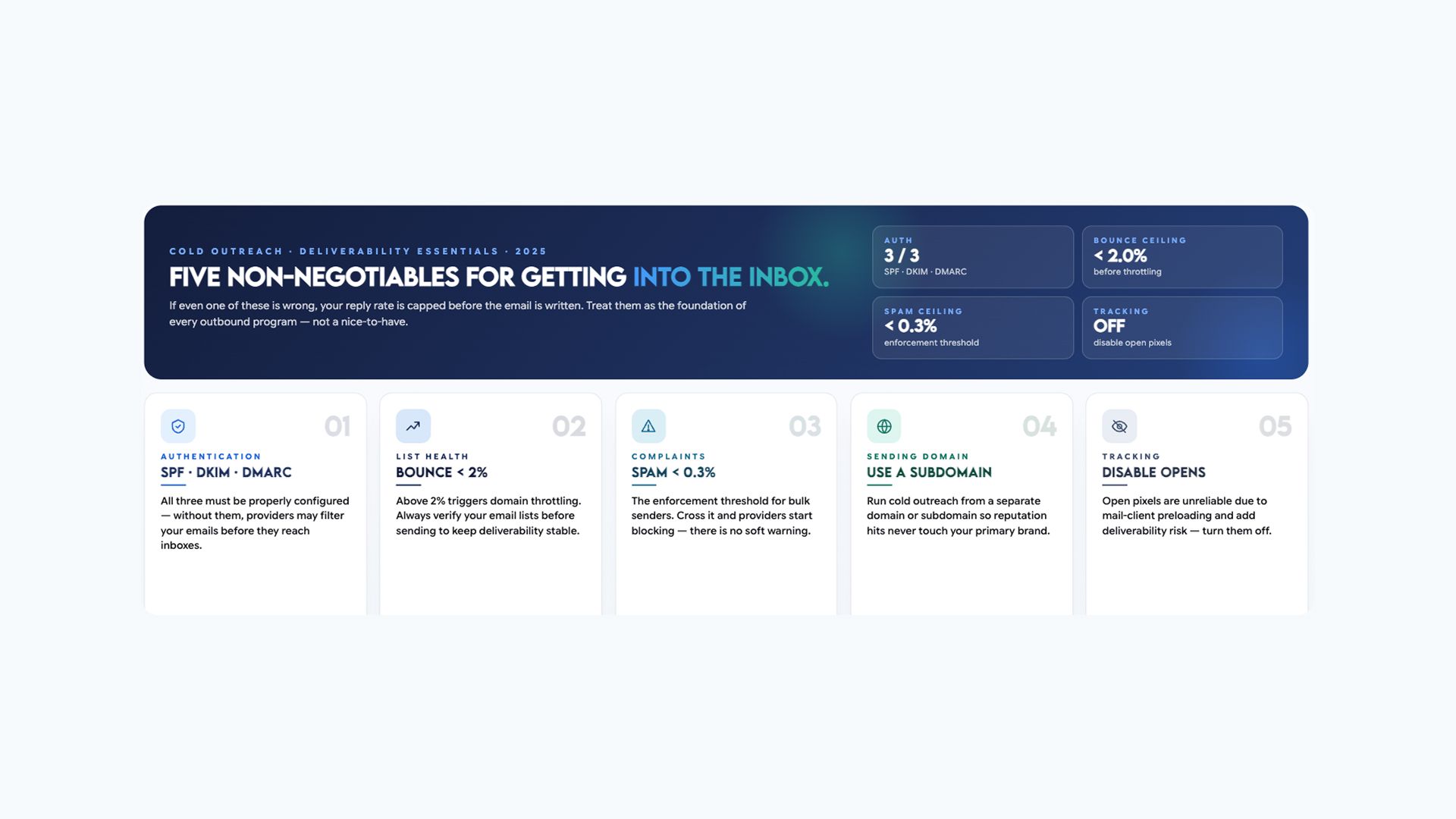
- Sending emails from a misconfigured domain hurts deliverability. Without Sender Policy Framework (SPF), DomainKeys Identified Mail (DKIM), and Domain-based Message Authentication, Reporting, and Conformance (DMARC) properly configured, providers like Gmail and Microsoft often mark emails as spam before anyone sees them. Always verify domain authentication before launching a campaign.
If AI drafted your email and the output still sounds robotic after these edits, see how to make AI cold emails sound human.
What Bad Prospecting Emails Look Like vs What Good Ones Do
The fastest way to understand what makes a prospecting email work is to see both versions side by side. The bad versions below are composites of patterns that appear constantly in real inboxes. The good versions follow the four-part framework from this guide: signal, bridge, value claim, one ask.
Example 1: The Generic Opener
Bad version:
Subject: Partnership opportunity
Hi Sarah,
I hope this email finds you well. I am reaching out because I think there could be a great opportunity for us to work together. At Acme Corp, we provide industry-leading solutions for B2B sales teams looking to improve their performance and grow revenue. Our platform has helped many companies like yours achieve significant results. I would love to schedule a call to discuss how we can help you. Please let me know your availability for a 30-minute demo next week.
Best regards, Tom
What is wrong with it:
- Opens with "I hope this email finds you well": a phrase that signals the sender has nothing specific to say
- "I think there could be a great opportunity": vague and non-committal
- "Industry-leading solutions": a claim that cannot be verified and signals no research
- No signal, no bridge, no specific outcome
- Asks for 30 minutes from a stranger
- Could be sent to any company on earth without changing a word
Good version:
Subject: Saw your AE expansion last month
Hi Sarah,
Your team posted 5 enterprise AE roles in the last 3 weeks.
That kind of expansion usually raises questions about onboarding consistency and time-to-quota before the new cohort contributes.
We help SaaS sales teams cut new-rep ramp from 90 to 45 days. Lattice and Gong both used this approach at the same growth stage.
Worth a quick call this week?
Tom
Why it works: The opening line is a fact that could only have been written after looking at this company today. The bridge names the challenge without mentioning the product. The value claim uses a real metric. The CTA asks for one small thing.
Example 2: The Feature Dump
Bad version:
Subject: Introducing [Product] — built for teams like yours
Hi James,
I wanted to introduce you to [Product], our AI-powered sales enablement platform. We offer real-time coaching, CRM integration, automated follow-up sequences, email analytics, pipeline forecasting, and a native mobile app. Our platform is trusted by over 500 companies and has a 4.8-star rating on G2. We offer flexible pricing including monthly and annual plans. I would love to show you around. Are you free Thursday at 2 PM or Friday at 10 AM?
Regards, Emma
What is wrong with it:
- Subject line announces the sender, not a reason for the reader to care
- "Wanted to introduce you to" puts the product before the buyer's situation
- Feature list in a cold email signals that the rep does not know what matters to this person
- "Trusted by 500 companies": a number that means nothing without context
- Offering two specific time slots before establishing any interest is presumptuous
- No signal, no bridge, no specific outcome tied to this company
Good version:
Subject: [Company]'s RevOps stack — one question
Hi James,
[Company] recently migrated from Salesforce to HubSpot. That transition usually creates reporting gaps and pipeline visibility questions before the new CRM data stabilises.
We help RevOps teams at Series B companies get consistent pipeline reporting within 30 days of a CRM migration. [Similar company] reduced their reporting cycle from 2 weeks to 48 hours using this approach.
Open to a 10-minute call to see if it applies to your setup?
Emma
Why it works: The signal is specific and verifiable. The bridge connects the migration to a challenge the Head of RevOps owns. The value claim is a concrete time-based outcome. One ask, not two time slots.
Example 3: The Compliment Without Substance
Bad version:
Subject: Your content is amazing
Hi Priya,
I have been following your work for a while and just wanted to say your content is fantastic — really insightful stuff. I especially love your posts about leadership and company culture. It is clear you are doing incredible things at [Company].
I work at [Your Company] and we help businesses like yours grow faster. I would love to connect and explore potential synergies between our companies.
Let me know if you would be open to a chat!
Best, Alex
What is wrong with it:
- "Your content is amazing": flattery without specifics reads as template filler
- "Incredible things": empty praise that could be sent to anyone
- "Synergies": a word that signals no real preparation
- "Businesses like yours grow faster": a claim with no metric and no relevance anchor
- No signal, no bridge, no value claim, no defined objective
Good version:
Subject: Your piece on sales onboarding — quick thought
Hi Priya,
We actually built our onboarding product around that exact constraint. Companies using it typically see new reps contribute pipeline 6 weeks earlier than before.
Alex
Why it works: The compliment references a specific argument, not a vague quality. The bridge connects the prospect's own published thinking to the product's core value. The CTA removes pressure entirely, which makes replies more likely.
Example 4: The Wall of Text
Bad version:
Subject: How we help companies like [Company] scale their sales team
Hi David,
Kind regards, Rachel
What is wrong with it:
- 163 words: well over the 125-word threshold where reply rates decline
- Subject line announces the sender's value claim, not a reason for the prospect to care
- "I hope you are having a great week" consumes the opening slot with nothing
- "A wide range of industries" signals no specialisation and no research
- "Results may vary" undermines the only specific claim in the email
- "Next couple of weeks" is too vague to create urgency
- No signal, no role-specific framing, no bridge
Good version:
Subject: Saw [Company] hired 4 SDRs this month
Hi David,
[Company] brought on 4 SDRs in the last 3 weeks. At that scale-up pace, meeting volume targets usually arrive before sequencing and onboarding processes are ready to support them.
We help B2B sales teams hit meeting targets 40% faster in the first 90 days using structured SDR onboarding. [Similar company] used this at the same growth stage.
Worth 10 minutes this week?
Rachel
Why it works: 67 words. Signal-based. Bridge names the operational tension without the product. One specific metric. One ask.
How to Measure Whether Your Prospecting Emails Are Working
Three numbers tell you whether your prospecting emails are working. Track all three, not just reply rate.
Reply Rate of Email
Total replies divided by emails delivered. The Benchmark is 3.43% for generic outreach, 15 to 25% for signal-based outreach. Consistently below 5% means the opening line is not specific enough or the signal is too weak.
Positive Reply Rate
Interested replies divided by total replies. The target should be 60 to 70%. Below 40% means the right people are opening the email, but the wrong signal type is attracting responses from people outside the buying window.
For prompt structures that help you analyse which signal types are driving the best results, the guide to AI prompts for outreach analysis and performance tracking covers the formats that produce useful output from tracking data.
Signal-to-Meeting Rate
Meetings booked are divided by emails sent using a specific signal type. Track separately by signal type: hiring, funding, leadership change, technology migration, over 90 days. Different signal types convert at different rates for different ICPs.
The AI chat for analysing outreach performance processes, tracking data, and surfaces which signal types are driving the most meetings for your specific market.
Sales Prospecting Email Checklist
Use this checklist before sending any prospecting email. Every item should be confirmed before hitting send.
Research
- Signal found: one specific, verifiable fact about this company from the last 60 days
- Signal is current: acted on within 48 to 72 hours of discovery
- Role identified: the bridge connects the signal to what this specific job title cares about
Subject line
- Under 7 words
- References the specific signal or observation, not the product
- Could not be sent to any other company without changing it
Opening line
- States the signal as a fact, not a question, and not a compliment
- Does not begin with "I" or "We."
- Could only have been written after researching this company today
Body
- Bridge sentence: one sentence connecting the signal to a business challenge the recipient owns
- Value claim: one sentence with a real, measurable outcome (no features)
- No product description in the first email
- Under 125 words total
CTA
- One asks only
- Phrased as a direct question
- Asks for 10 to 15 minutes, not a 30-minute demo
- Easy to say yes without implying a large commitment
Tone and format
- No qualifiers: "just", "quickly", "I hope", "I was wondering."
- No exclamation marks
- Plain text format, no images or HTML
- Read aloud test passed: sounds like a human wrote it, not a template
Conclusion
Sales prospecting emails get replies not because of clever writing, but because they arrive at the right moment with a clear reason to connect. They work when you use a real signal, link it to a specific business challenge in one line, keep the email under 125 words, and ask for one simple action.
Real personalisation is not using a name in a template. It is a specific observation tied to what is actually happening in that company right now. When you get that right, the email stops feeling like outreach and starts feeling relevant.
Frequently Asked Questions
Learn more about sales prospecting emails.
More topics you may like