Claude Opus 4.7 vs GPT-5.4: Benchmarks, Pricing & Which to Use
GPT-5.4 launched on March 5, 2026. Claude Opus 4.7 followed six weeks later on April 16. Both are frontier models with 1 million token context windows, native computer use, and serious agentic capabilities.
But which of these models wins? Which one should you use?
The answer is not a straightforward one or the other.
Opus 4.7 leads on coding benchmarks, multi-tool orchestration, and vision-heavy workflows. GPT-5.4 leads on web research and costs roughly half as much per token. If you are choosing between them, those two facts are where the decision lives for most teams.
This article covers what the benchmarks actually show, what each model costs in practice, where each one genuinely wins, and how to decide which is right for your specific workload.
What Each Model Is
Claude Opus 4.7 is Anthropic's most capable generally available model. It is built for:
- production coding
- long-horizon agentic work
- vision-heavy workflows
- multi-session memory tasks
The model ID is claude-opus-4-7, pricing is $5 per million input tokens and $25 per million output tokens, and it supports a 1 million token context window with 128k maximum output tokens.
GPT-5.4 is the first general-purpose OpenAI model with native computer use built in, and it merges the coding capabilities that previously lived in GPT-5.3-Codex with reasoning depth into a single unified architecture.
Where Opus 4.6 had already demonstrated that a single model could handle coding, reasoning, and knowledge work together, GPT-5.4 is OpenAI's direct answer to that approach.
Pricing is $2.50 per million input tokens and $15 per million output tokens at the standard tier, with a Pro variant at $30/$180 for maximum performance. Context window is 1 million tokens (922K input, 128K output).
Benchmark Comparison
Both companies report their own benchmark numbers, and the picture is not one-sided. Opus 4.7 leads on coding and tool use. GPT-5.4 leads on web research and terminal-based work. Here is what the data actually shows.
1. Coding Performance
On the benchmarks that matter most for real-world software engineering, Opus 4.7 holds a clear lead.
- SWE-bench Verified: 87.6% vs. 80% (different sources report different score for GPT-5.4)
- SWE-bench Pro (harder multi-language variant): 64.3% vs. 57.7%
- CursorBench (real-world IDE performance): Opus 4.7 at 70%. OpenAI has not published a comparable GPT-5.4 score on this benchmark.
- Terminal-Bench 2.0: 69.4% vs. 75.1% GPT-5.4’s score is self-reported)
SWE-bench Pro is the harder, less gameable benchmark and the one that best reflects production-grade software engineering on novel codebases. The gap there is the most meaningful coding signal in this comparison.
Terminal-Bench is where GPT-5.4 pulls ahead, which reflects better command-line and terminal-based agentic work.
Verdict: Opus 4.7 leads on the hardest repository-level and multi-file engineering tasks. GPT-5.4 leads on terminal and command-line workflows.
2. Tool Use and Agentic Reliability
This is where the gap between the two models is most pronounced, and it matters most for teams building production agents.
- MCP-Atlas (scaled multi-tool orchestration): Opus 4.7’s 77.3% against GPT-5.4’s 68.1%
- On complex multi-step workflows, Opus 4.7 delivered a 14% lift over Opus 4.6 at a third of the tool errors. Directionally confirmed by multiple early-access partners
- Task budgets, introduced in Opus 4.7 as a public beta, give developers an advisory token cap across an entire agentic loop. GPT-5.4 has no direct equivalent.
MCP-Atlas is the closest thing to a real production agent benchmark, testing how well a model coordinates across many tools in a single workflow. A 9.2-point lead is not marginal.
Verdict: Opus 4.7 is the stronger model for multi-tool orchestration, long-running agents, and workflows where loop resistance and tool error recovery matter.
3. Computer Use and Vision
Both models are serious competitors on computer use, but they reach similar scores through different strengths.
- OSWorld-Verified (computer use in a live OS): Opus 4.7 leads with 78.0% vs. 75.0%
- Opus 4.7 vision: 2,576px / 3.75MP resolution with 1:1 coordinate mapping, eliminating scale-factor math in computer-use deployments
- GPT-5.4: First general-purpose OpenAI model with native computer use built in. Its 75.0% on OSWorld surpasses the human expert baseline of 72.4%.
Opus 4.7's visual-acuity improvement is significant. XBOW, which builds autonomous penetration testing tools, saw visual-acuity jump from 54.5% on Opus 4.6 to 98.5% on Opus 4.7. For agents that read dense screenshots, diagrams, or data-rich interfaces, that resolution upgrade opens workflows that were previously impractical.
Verdict: Opus 4.7 leads on vision-heavy tasks and screenshot reading. GPT-5.4 was first to reach human parity on desktop automation and remains competitive. Both are production-ready for computer use.
4. Web Research and Knowledge Work
This is GPT-5.4's clearest win and the single most important factor for teams whose primary use case involves web-connected research.
- BrowseComp (agentic web search): Opus 4.7’s 79.3% vs. 89.3%
- Finance Agent v1.1 (multi-step financial analysis): 64.4% vs. 61.5%
- GPQA Diamond (graduate-level reasoning): 94.2% vs. 94.4%
- OpenAI reports 33% fewer factual errors in GPT-5.4 vs. GPT-5.2. Worth noting this is vendor-reported, not independently verified.
The BrowseComp gap is real and consistent across multiple independent analyses. For any workflow that involves web research, information synthesis, or browse-heavy agents, GPT-5.4 Pro holds a meaningful advantage.
Verdict: GPT-5.4 is clearly the better model for web research and information retrieval. Opus 4.7 leads on structured financial analysis and scientific reasoning.
Claude Opus 4.7 vs GPT-5.4 Pricing
The pricing gap between these two models is significant and compounds at scale in ways the headline numbers do not fully capture.
- GPT-5.4 costs $2.50 per million input tokens and $15 per million output tokens.
- Opus 4.7 costs $5 input and $25 output.
That is 2x cheaper on input and 1.67x cheaper on output at the standard tier. On high-volume workloads, that difference is not trivial.
The gap widens further when you factor in Opus 4.7's updated tokenizer, which processes the same text as up to 35% more tokens than its predecessor. Teams migrating from Opus 4.6 to 4.7 already need to account for this in their cost models. When comparing directly against GPT-5.4, the effective cost difference is larger than the per-token figures suggest.
GPT-5.4's variant lineup adds further cost flexibility.
- GPT-5.4 Mini scores 54.38% on SWE-bench Pro at roughly 6x lower cost than the standard model, making it viable for lighter tasks in a routing strategy.
- Nano is available for edge and embedded use cases.
Opus 4.7 offers effort-level controls (high, xhigh, max) and task budgets to manage spend, but within a single model rather than across distinct tiers.
The one partial offset: Opus 4.7's task budgets let you set an advisory token cap across an entire agentic loop, which GPT-5.4 lacks. For long-running agents where cost per completed task matters more than cost per token, that control can make a meaningful difference.
GPT-5.4 Pro at $30/$180 is worth separating from this comparison. It is a significantly more expensive product aimed at maximum performance on the hardest tasks, and its BrowseComp score of 89.3% reflects that. If web research at the frontier is your primary use case, GPT-5.4 Pro is the relevant comparison point for Opus 4.7, not the standard tier.
Developer Tools and Ecosystem
Most benchmark comparisons skip this, but the tooling difference is real and affects daily developer experience.
Claude Code runs on Opus 4.7.
- It is a terminal-based agent that reads your entire repository, plans changes, executes them, reads error output, and iterates. The experience is synchronous and interactive.
- The new
/ultrareviewcommand spawns multiple sub-agents that independently explore your codebase, surface bugs, and verify findings before reporting back.
It is built for the kind of deep, sustained engineering work where you want the model in the loop with you.
OpenAI Codex runs on GPT-5.4. The philosophy is different:
- asynchronous task submission,
- sandboxed execution
- results returned when complete
You submit a task, walk away, and review the output. This suits teams who want background execution rather than an interactive session. GPT-5.4 Thinking also introduces mid-response plan adjustment, letting you redirect the model after it outlines its approach but before it finishes. That is a meaningful usability improvement for long, complex tasks.
Both models support xhigh effort as a reasoning depth setting. Both are available on major cloud platforms. Opus 4.7 is on Amazon Bedrock, Google Cloud Vertex AI, and Microsoft Foundry. GPT-5.4 is natively on Azure alongside the other major providers.
Which Should You Use?
The right answer depends entirely on what you are building. There is no overall winner here. These are two strong models with different strengths at meaningfully different price points.
Use Opus 4.7 if:
- Production coding, multi-file engineering, or automated code review is your primary use case
- You run multi-tool orchestration agents across MCP servers
- Your workflows involve dense screenshots, technical diagrams, or vision-heavy document processing
- Your prompts regularly exceed 272K tokens or you need consistent 1M context performance
- You are already working in Claude Code, Cursor, Replit, or Devin
Use GPT-5.4 if:
- Web research, browse-heavy synthesis, or information retrieval at scale is your primary use case
- Cost is a primary constraint and your workloads stay under 272K tokens
- You want explicit multi-model cost routing across Mini, Standard, and Pro tiers
- You prefer asynchronous, background task execution over interactive sessions
- You are already on the OpenAI ecosystem with existing integrations and prompt investments
Consider routing both if:
- Your workflows split between autonomous coding and web research synthesis. Sending coding and tool-use tasks to Opus 4.7 while routing browse-heavy research to GPT-5.4 is a reasonable production strategy that teams across the frontier model landscape are already running.
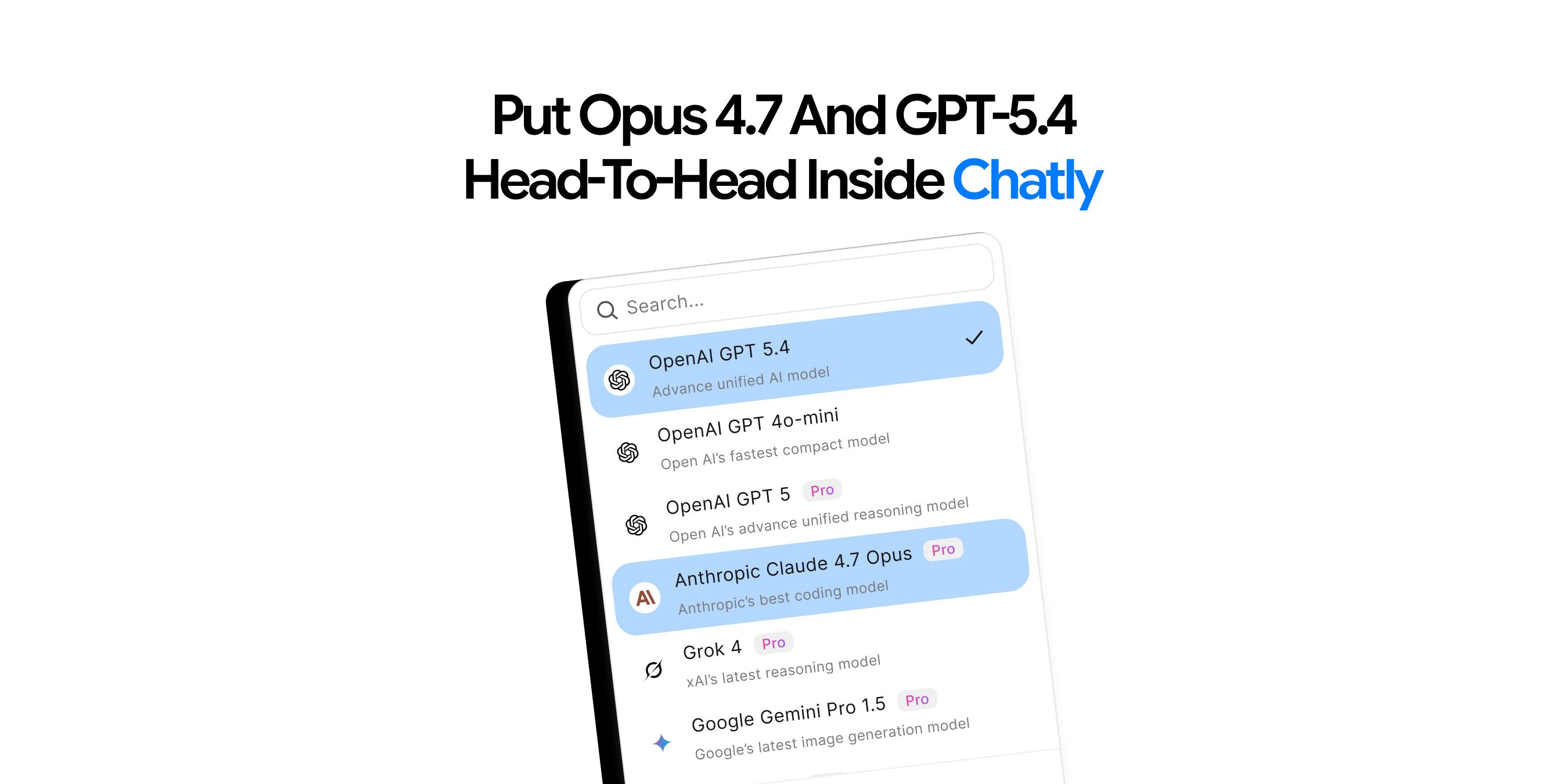
- You want to test both models on your actual workflows before committing to one. Chatly gives you access to Opus 4.7, GPT-5.4, and other frontier models without managing separate API integrations or billing accounts. Free access options are also available if you want to run the comparison before committing.
Conclusion
Opus 4.7 wins coding and tool use. GPT-5.4 wins web research and cost flexibility. Both are production-ready for computer use, agentic work, and knowledge-intensive workflows at the frontier.
The cost gap is real and should factor into any decision at scale. At $2.50/$15 versus $5/$25 per million tokens, GPT-5.4 is meaningfully cheaper before the Opus 4.7 tokenizer increase is even considered. If your workloads do not consistently hit the benchmarks where Opus 4.7 leads, that cost gap is hard to justify.
For teams doing serious production coding and multi-tool agent work, Opus 4.7's benchmark advantages in those areas are real enough to justify the price difference. For teams whose primary value comes from web research and information synthesis, GPT-5.4 Pro is the stronger choice at a lower total cost than Opus 4.7 on equivalent tasks.
Frequently Asked Question
Learn what other users have been asking about this comparison.
More topics you may like
11 Best ChatGPT Alternatives in 2026 (Tested, Compared & Priced)

Muhammad Bin Habib

GPT-5.1 Pricing Explained: How Much Does It Cost?

Faisal Saeed
Claude Haiku 4.5 vs Claude Sonnet 4.5: The Ultimate Comparison Guide
Faisal Saeed

GPT-5.2 Is Here: What Changed, Why It Matters, and Who Should Care
Faisal Saeed
GPT-5.3 ("Garlic") Release Timeline & Expected Features: What We Know So Far

Daniel Mercer
Claude Opus 4.6: New Features, Improvements, and Benchmark Performance

Elena Foster