GPT-5.1 Pricing Explained: How Much Does It Cost?
OpenAI released GPT-5.1 in November 2025, bringing improved reasoning capabilities and adaptive intelligence to both individual users and enterprises. Even though it was soon followed by the release of GPT-5.2, it remains significant considering the issues it fixed.
It’s never a done deal with users. People are not going to abandon a previous model just because a newer version exists. Just look at what happened with GPT-5.
People expect a certain behavior from their tool of choice and train their LLM to respond to their specific needs. The tone, speed, and accuracy matters to them. When GPT-5 came out, people complained about the tone issues and preferred older models.
GPT-5.1 significantly improved those issues and added additional functionality. GPT-5.2 is not ground-breakingly different; it’s just an extension of GPT-5.1 in many ways.
So, should people really make the change from GPT-5.1 to GPT-5.2?
Understanding the pricing structure is crucial to find an answer to this question. This comprehensive guide breaks down every cost associated with GPT-5.1, from API usage to enterprise subscriptions.
What Makes GPT-5.1 Different?
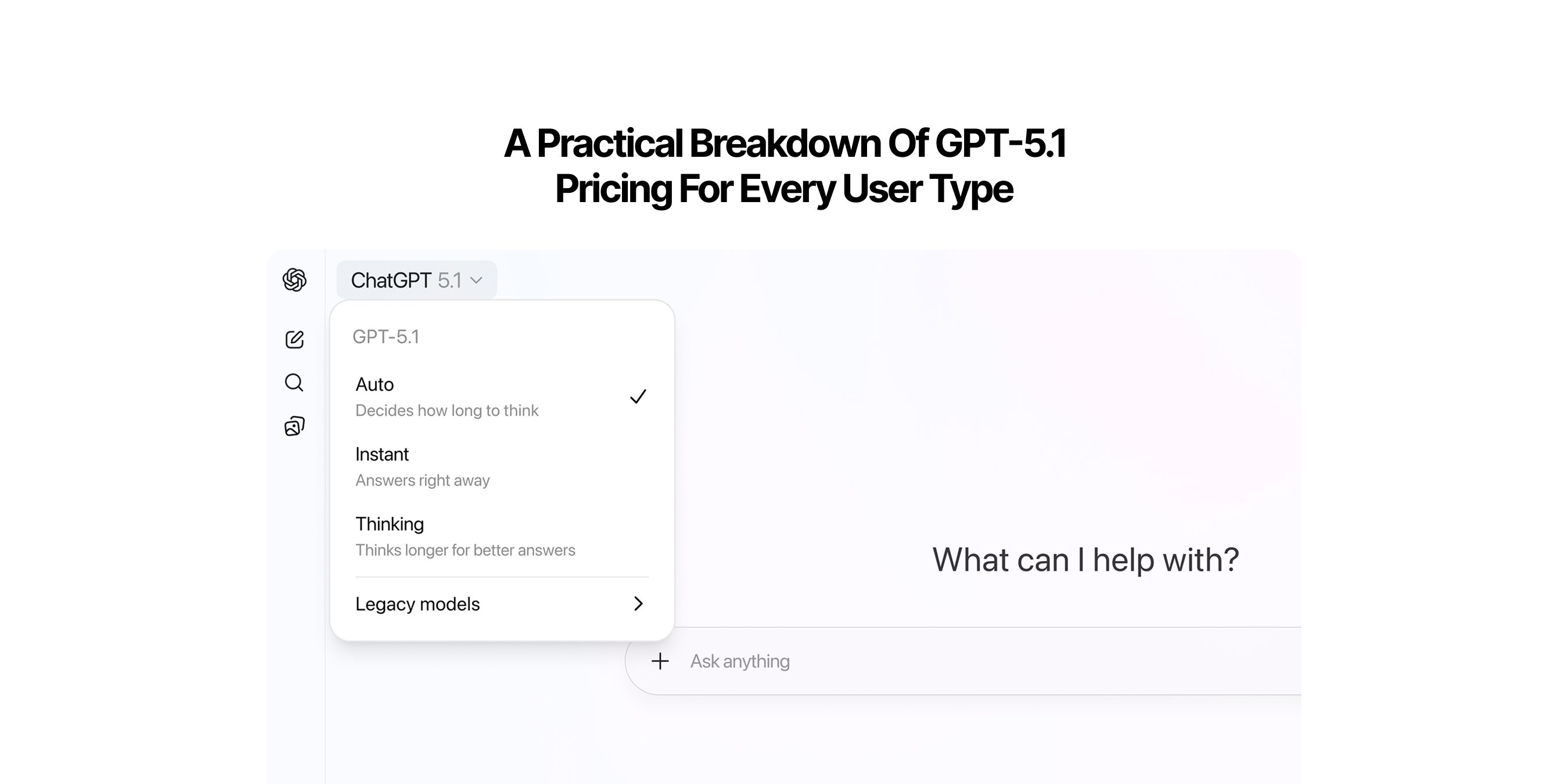
GPT-5.1 represents a significant upgrade over its predecessor with two distinct operational modes.
- GPT-5.1 Instant delivers fast, conversational responses for everyday tasks
- GPT-5.1 Thinking provides deep reasoning which automatically adjusts its computational effort based on query complexity.
The context window expanded dramatically to 400k total context with 128,000 output tokens. This expansion eliminates the need for document chunking in most use cases.
OpenAI launched GPT-5.1 on November 13, 2025, through the API, with ChatGPT interface access arriving one day earlier. The rollout began with paid subscribers and gradually expanded to free users. This phased approach ensured stable performance during the initial high-demand period.
GPT-5.1 API Pricing Structure
Understanding the token-based pricing model is essential for estimating your costs accurately.
OpenAI charges separately for input tokens (text you send) and output tokens (text the model generates). One million tokens roughly equals 750,000 words. However, actual token counts vary based on formatting and language complexity.
The standard pricing for GPT-5.1 is straightforward and competitive:
- Input tokens: $1.25 per 1 million tokens
- Output tokens: $10 per 1 million tokens
- Context window: 272,000 input / 128,000 output tokens
To put this in practical terms, processing a 1,000-word article typically consumes approximately 1,300 tokens including metadata. At current rates, analyzing such an article costs roughly $0.0016 for input and $0.013 for a detailed 1,000-word response.
These costs make GPT-5.1 cheaper than several older versions of output and input tokens.
Prompt Caching
Prompt caching offers a massive 90% discount on cached input tokens, dropping the cost from $1.25 to just $0.125 per million tokens.
The cache retains your prompts for 24 hours, making it ideal for applications with repeated queries. This feature proves especially valuable for chatbots, customer service applications, or any system that repeatedly uses the same system prompts or context.
Developers should structure their applications to maximize cache hits by maintaining consistent system messages and context structures. The savings compound quickly at scale as processing 10 million cached input tokens costs $1.25 instead of $12.50.
Processing Tiers and Batch Options
OpenAI offers multiple processing tiers to balance cost and speed according to your needs.
Flex processing offers lower costs in exchange for higher latency, suitable for non-urgent background tasks. The Batch API provides the most significant savings at 50% off standard pricing, perfect for processing large datasets overnight or during off-peak hours.
These options give developers granular control over the cost-performance trade-off.
Reasoning Tokens
One technical detail catches many developers off guard: reasoning tokens in GPT-5.1 Thinking mode. These tokens represent the model's internal thought process and are billed as output tokens at $10 per million, even though they're invisible to users. They also consume part of your 128,000 output token limit.
ChatGPT Subscription Plans
For users who prefer predictable monthly costs over usage-based billing, ChatGPT subscriptions provide unlimited access within reasonable usage limits. These plans suit individuals and teams who need regular AI assistance without tracking token counts.
ChatGPT Plus: The Standard Option
ChatGPT Plus remains at $20 per month, offering extended access to GPT-5.1 for regular users. This tier provides significantly higher message limits compared to the free tier, though exact caps fluctuate based on demand.
During peak times, users typically face limits around 40 messages per three hours.
Plus subscribers get access to both GPT-5.1 Instant and Thinking modes, along with GPT-5.1 Auto which automatically selects the optimal mode. Additional features include:
- 32,000-token context window (vs. 8,000 for free users)
- Priority access during high-traffic periods
- DALL-E 3 image generation
- Advanced data analysis capabilities
- Custom GPTs creation and access
- Basic Sora 1 video generation
- File upload and processing
The Plus plan suits students, professionals, and regular users who need reliable daily AI assistance without enterprise-level demands. OpenAI occasionally offers 7-day free trials, particularly during promotional periods.
ChatGPT Pro: Unlimited Power Users
The value proposition becomes clear for users who would otherwise exceed hundreds of dollars in API costs. Pro includes exclusive features like full Sora video generation capabilities and Codex agent access for advanced development tasks.
The predictable monthly billing eliminates usage anxiety and budgeting uncertainty that comes with pay-per-token models.
Business Plans
The Team plan includes all Plus features plus workspace collaboration tools and basic admin dashboards. A 14-day free trial allows teams to evaluate the service before committing. Annual plans offer approximately 17% savings compared to monthly billing.
Enterprise Pricing and Custom Solutions
Large organizations require specialized pricing structures and enterprise-grade features. OpenAI structures enterprise pricing based on organization size, usage requirements, and feature needs.
These custom agreements provide predictable costs at scale while ensuring compliance and security requirements are met.
ChatGPT Enterprise offers unlimited GPT-5.1 usage with advanced security and compliance features including:
- SOC 2 Type 2 compliance
- GDPR and CCPA alignment
- SAML SSO and multi-factor authentication
- Data encryption at rest and in transit
- Zero training on business data by default
- Dedicated account support
- Priority API access options
- Custom model fine-tuning capabilities
Enterprise pricing requires direct contact with OpenAI's sales team for custom quotes. Organizations should prepare usage estimates, user counts, and specific feature requirements before engaging in pricing discussions. Nonprofits receive 20% discounts on Business plans ($20 per user per month annually) and 25% off Enterprise pricing for qualified organizations.
Complete OpenAI Model Pricing (January 2026)
Understanding the full OpenAI model pricing helps developers select the right tool for each task. OpenAI maintains multiple models at different price points, each optimized for specific use cases. Strategic model selection can reduce costs by 60-90% depending on task complexity.
GPT-5 Series Models
The GPT-5 family offers options from budget-friendly to maximum capability:
- GPT-5.1 Standard: $1.25 input / $10 output per 1M tokens (balanced performance)
- GPT-5 Mini: $0.25 input / $2 output per 1M tokens (high-volume simple tasks)
- GPT-5-nano: $0.05 input / $0.40 output per 1M tokens (massive-scale operations)
- GPT-5.2: $1.75 input / $14 output per 1M tokens (latest flagship for agentic tasks)
GPT-5 Mini delivers remarkable value at just 20% of standard pricing while maintaining solid performance for straightforward tasks. One developer reported processing 10,000 emails for classification at a total cost of $0.08 using nano.
These budget tiers make previously cost-prohibitive use cases economically viable.
Legacy and Specialized Models
OpenAI maintains previous generation models for compatibility and specific use cases:
- GPT-4.1: $2 input / $8 output per 1M tokens
- GPT-4.1-mini: $0.4 input / $1.60 output per 1M tokens
- o3 (Reasoning): $2 input / $8 output per 1M tokens
- o4-mini: $1.1 input / $4.4 output per 1M tokens
The o3 model received an 80% price cut, making advanced reasoning capabilities accessible to more developers. This aggressive pricing positions OpenAI competitively against Anthropic's Claude and Google's Gemini models.
Cost Optimization Strategies
Smart developers implement multi-tier strategies to minimize costs without sacrificing quality. The key lies in routing requests to the most appropriate model based on task complexity.
API User Strategies
Maximizing cost efficiency requires understanding and leveraging all available optimization features:
- Implement prompt caching for repeated contexts to achieve 90% savings on input tokens
- Use GPT-5-nano or Mini for high-volume simple tasks like classification or data extraction
- Reserve standard GPT-5.1 for complex problem-solving and creative tasks
- Leverage Batch API for non-urgent processing at 50% discount
- Set spending limits and email alerts in your OpenAI dashboard to prevent overages
- Monitor token usage patterns weekly to identify optimization opportunities
Individual and Team Optimization
Subscription users should evaluate their usage patterns before committing to paid tiers. Start with the free tier to understand your actual usage levels and feature needs. Upgrade to Plus only if you consistently hit rate limits or need priority access.
Calculate whether API usage or subscriptions make more financial sense based on your patterns. Light users with sporadic needs often save money with pay-per-use API access. Heavy daily users benefit from Plus or Pro subscriptions with predictable monthly costs. Track your usage for one month to make an informed decision.
Conclusion
GPT-5.1 pricing accommodates everyone from casual users to enterprise organizations through flexible options. The key is understanding your usage patterns, feature requirements, and budget constraints before selecting a pricing tier.
Start small and scale up based on actual needs rather than anticipated ones.
For casual users exploring AI capabilities, the free tier provides sufficient access to evaluate GPT-5.1's capabilities. Professionals requiring daily assistance find ChatGPT Plus at $20 monthly offers excellent value and predictability.
Power users and researchers justify Pro subscriptions at $200 monthly when their usage would exceed that amount through API calls.
Remember that pricing and features remain subject to change as the AI market matures. Always verify current rates on OpenAI's official pricing page before making long-term commitments or budget allocations. The democratization of AI through competitive pricing makes powerful capabilities accessible to individuals and organizations of all sizes.
Frequently Asked Question
You are not the only one confused about the prices. Here is what users are searching online about GPT-5.1 prices.
More topics you may like

GPT-5.2 Is Here: What Changed, Why It Matters, and Who Should Care

Faisal Saeed
What Is GPT-5.1? A Complete Breakdown of Features and Benchmarks
Faisal Saeed
Gemini 3 Pro Overview: Features, Pricing, and Use Cases
Faisal Saeed
Claude Opus 4.5: The Definitive Guide to Features, Use Cases, Pricing
Faisal Saeed
Cost Efficiency in Claude Opus 4.5: Understanding Tokens, Effort Levels & When It’s Worth It
Faisal Saeed