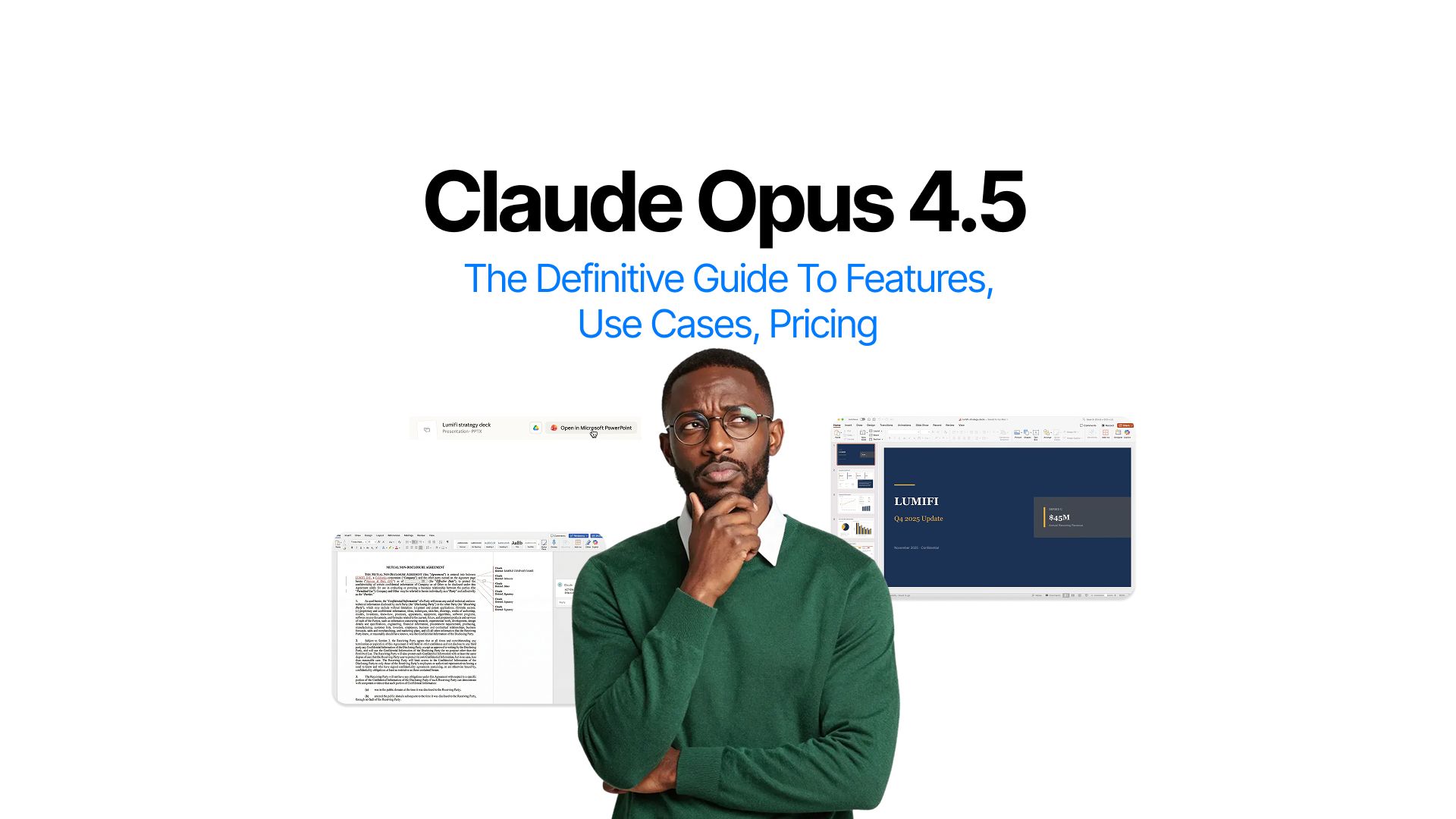
Claude Opus 4.5: The Definitive Guide to Features, Use Cases, Pricing
Released on November 24, 2025, Claude Opus 4.5 model completed what Anthropic calls a "trilogy" of releases that reshaped the competitive landscape for frontier AI models.
But here's what makes Opus 4.5 particularly interesting.
It's not just more capable than its predecessor but it's also dramatically cheaper. This combination of enhanced capability and reduced cost has made frontier-level AI accessible to a much broader range of developers and enterprises.
In this comprehensive guide, we'll explore everything you need to know about Claude Opus 4.5:
- Technical specifications
- Standout features
- Pricing structure
- How it compares to both Sonnet 4.5 and Google's Gemini 3 Pro
- Specific use cases where it excels.
Whether you're a developer evaluating AI tools or an enterprise architect designing intelligent systems, this guide will give you the complete picture.
Anthropic Claude Opus 4.5 Announcement
After releasing Claude Sonnet 4.5 in late September and Claude Haiku 4.5 in October 2025, Anthropic completed its model family refresh just days after Google unveiled Gemini 3 Pro and OpenAI released GPT-5.1-Codex-Max.
The announcement highlighted several remarkable achievements.
Testers consistently found that Opus 4.5 handles ambiguity and reasons about tradeoffs without requiring hand-holding, a quality that distinguishes truly advanced models from those that excel only on well-defined problems.
More impressively, the model's performance on Anthropic's internal engineering exam surpassed every human candidate who had taken it, demonstrating genuine technical depth.
This release also addressed what some called the "pricing paradox" of the Claude 4 family. Earlier in 2025, users discovered that Claude Sonnet 4.5 sometimes outperformed the more expensive Opus 4.1 on certain tasks, creating confusion about which model to use. Opus 4.5 restored the natural hierarchy: Sonnet for everyday tasks, Opus for when you need the absolute best.
Core Features & Technical Specifications
Let’s break down the foundational capabilities that define Claude Opus 4.5 at a technical level. Rather than focusing on benchmarks alone, we must examine the architectural decisions, context handling, and system-level features that directly impact real-world performance, scalability, and developer control.
Architecture and Context
Claude Opus 4.5 operates with a 200,000 token context window and can generate up to 64,000 tokens in a single output. This context size strikes a balance between practicality and capability. It is large enough for most real-world applications without the overhead costs associated with million-token contexts.
The model's reliable knowledge cutoff date is March 2025, making it current enough for most technical applications while still having undergone thorough safety testing. One subtle but important feature is that thinking blocks are preserved across conversations, allowing the model to build on previous reasoning in multi-turn interactions.
The Effort Parameter
Perhaps the most distinctive feature of Claude Opus 4.5 is its effort parameter, which allows developers to tune the model's computational intensity for each request. The parameter accepts three settings:
- Low
- Medium
- High
This isn't just about speed versus quality.
At medium effort, Opus 4.5 matches Sonnet 4.5's best performance while using 76% fewer output tokens. This efficiency gain translates directly into cost savings and faster response times.
Low effort is suitable for straightforward tasks where the model's baseline capabilities are more than sufficient. High effort engages the model's deepest reasoning capabilities for complex, multi-faceted problems where getting the answer right the first time matters more than speed or cost.
The effort parameter effectively gives you three models in one, each optimized for different scenarios. A production system might use low effort for simple queries, medium effort for standard operations, and high effort only for critical-path decisions or complex analytical tasks.
Enhanced Computer Use
Computer use capabilities received significant upgrades in Opus 4.5.
The model can now perform a new "zoom" action that inspects specific screen regions at full resolution, enabling more precise interaction with desktop applications and web browsers. This seemingly small enhancement has major implications for automation.
The model can now read small text, verify button states, and interact with complex interfaces that previous versions struggled with.
On the OSWorld benchmark, which measures a model's ability to complete realistic desktop tasks, Opus 4.5 scored 66.3%. While that might sound modest, it represents a significant lead over competing models and reflects the difficulty of these tasks.
Real-world desktop environments are messy, inconsistent, and filled with edge cases that pure benchmark training doesn't capture.
Coding Excellence
The coding capabilities of Opus 4.5 set a new standard.
- On SWE-bench Verified, Opus 4.5 achieved 80.9% that indicates the model can successfully resolve the vast majority of real GitHub issues from popular open-source projects.
- Opus 4.5 writes better code across 7 out of 8 programming languages on SWE-bench Multilingual.
- The model handles Python, JavaScript, TypeScript, Java, C++, Go, and Rust with equal proficiency.
- The model excels at autonomous multi-hour coding sessions, maintaining context and making consistent architectural decisions across dozens of files. Developer Simon Willison's real-world testing resulted in 20 commits, 39 files changed, 2,022 additions and 1,173 deletions over two days.
This kind of sustained, coherent output represents a qualitative leap from earlier models that could write good code but struggled to maintain consistency across large changes.
Agentic Capabilities
Opus 4.5 shows a 9.3% improvement over Sonnet 4.5 on Terminal Bench, a benchmark that measures a model's ability to execute complex command-line workflows. This improvement might seem incremental, but in practice, it's the difference between an agent that can handle 80% of tasks autonomously and one that can handle 92%.
A meaningful reduction in human intervention.
The model's long-horizon task execution capabilities allow it to break down complex objectives into subtasks, execute them in sequence, verify results, and adjust course when needed. This is genuine problem-solving that adapts to changing circumstances and unexpected obstacles.
Office Productivity & Document Creation
Beyond coding, Opus 4.5 excels at creating professional documents, spreadsheets, and presentations. The model understands document structure, formatting conventions, and can maintain consistency across complex files.
Better memory utilization means the model can track information across multiple documents, making it suitable for creating comprehensive reports that synthesize information from various sources.
Safety & Security
Opus 4.5 demonstrates industry-leading resistance to prompt injection attacks, where malicious users try to trick the model into ignoring its instructions or revealing sensitive information. Comprehensive safety testing with external experts preceded the release, addressing potential misuse scenarios and ensuring the model could be deployed safely in production environments.
Claude Opus 4.5 Pricing & Value Proposition
Claude Opus 4.5 pairs its performance gains with a pricing model that significantly lowers the barrier to adoption. The cost structure reflects a clear emphasis on efficiency at scale, allowing developers to run larger contexts and generate longer outputs without the steep expense traditionally associated with top-tier models.
API Pricing Structure
Claude Opus 4.5 pricing represents a dramatic shift from its predecessor.
- Opus 4.1 cost $15 per million input tokens and $75 per million output tokens
- Opus 4.5 cost $5 per million input tokens and $25 per million output tokens
This makes Opus 4.5 roughly 67% cheaper while being measurably more capable.
To put these numbers in context, processing a 200,000-token context (the full window) costs $1, while generating a comprehensive 10,000-token response costs $0.25. For most applications, these rates are highly competitive, especially considering the quality of output.
The pricing story gets even better with optimizations.
Prompt caching can reduce costs by up to 90% for applications that repeatedly use the same context or system prompts. Batch processing, where you queue multiple non-urgent requests, provides a 50% discount.
Subscription Plans
Opus 4.5 is available through multiple subscription tiers.
- Claude Pro
- Claude Max
- Team Plan
- Enterprise Plan
All of these plans provide instant access, with Opus 4.5 serving as the default model for Pro, Max, and Enterprise subscribers. This means individual developers and small teams can access frontier capabilities without enterprise-level commitments.
Usage quotas vary by plan, but the key point is that Opus 4.5 isn't locked behind enterprise-only access. A single developer with a Pro subscription can build sophisticated applications using the same model that Fortune 500 companies deploy at scale.
Cost-Effectiveness Analysis
Real-world testing shows that Opus 4.5 uses 19.3% fewer total tokens than comparable implementations, meaning the already-reduced pricing understates the true cost savings. The model is more concise and efficient, requiring fewer tokens to accomplish the same tasks.
For enterprise use cases, the ROI calculation is straightforward: if Opus 4.5 can autonomously handle tasks that previously required senior engineer time, the model pays for itself almost immediately. A complex refactoring task that might take a developer three days can be completed by Opus 4.5 in hours, at a cost of perhaps $50-100 in API calls versus thousands in labor costs.
Platform Availability
Opus 4.5 is available across major platforms using the model identifier claude-opus-4-5-20251101:
- Claude API (direct from Anthropic)
- Amazon Bedrock
- Google Cloud Vertex AI
- Microsoft Azure Foundry
- GitHub Copilot (with promotional pricing through December 2025)
This broad availability means developers can use Opus 4.5 regardless of their existing cloud infrastructure commitments.
Claude Opus 4.5 vs Sonnet 4.5
Understanding the difference between Claude Opus 4.5 vs Sonnet 4.5 is crucial for making smart model selection decisions. Both are excellent models, but they excel in different scenarios.
Performance Comparison
Opus 4.5 beats Sonnet 4.5 on internal benchmarks while using fewer tokens to achieve those results. However, the performance gap isn't uniform across all tasks.
- On coding tasks, Opus 4.5's superior architectural reasoning and ability to handle complex refactors make it the clear choice for large-scale software engineering.
- In testing, Sonnet 4.5 tends to produce more features and comprehensive navigation in applications, while Opus 4.5 delivers cleaner architecture and better organization.
If you're prototyping and want to see lots of functionality quickly, Sonnet might actually be preferable. If you're building production systems where maintainability matters, Opus 4.5's cleaner approach pays dividends.
When to use Opus 4.5:
- Complex, high-stakes enterprise tasks where accuracy is non-negotiable. Financial modeling, legal document analysis, and compliance workflows benefit from Opus 4.5's deeper reasoning and reduced error rates.
- Autonomous long-horizon coding projects that span multiple files and require consistent architectural decisions. The model's ability to maintain context and make principled design choices across hours of work justifies the higher cost.
- Multi-step reasoning requiring absolute correctness. When the cost of an error exceeds the cost difference between models, Opus 4.5 is the obvious choice.
- Critical-path workflows where the application's most important functionality depends on AI reasoning. Use your best model for the most important decisions.
Sonnet 4.5 delivers 90-95% of Opus performance at significantly reduced cost, making it ideal for:
- High-volume production workloads where you're processing thousands or millions of requests. The cost difference adds up quickly at scale, and Sonnet's performance is more than adequate for most tasks.
- Routine coding, summarization, and content generation where the tasks are well-defined and don't require deep reasoning. Sonnet excels at these common operations.
- Budget-conscious projects where cost matters more than marginal performance improvements. For startups and individual developers, Sonnet provides frontier-level capabilities at manageable prices.
Context Window Considerations
Both models support the standard 200,000-token context window, which is sufficient for most applications. However, Sonnet 4.5 offers a 1-million-token context in beta for higher-tier customers, enabling applications like entire codebase analysis or comprehensive document processing.
Opus 4.5 prioritizes reasoning quality over maximum window size, betting that 200k tokens of well-utilized context beats 1M tokens of less sophisticated processing. For most use cases, this trade-off makes sense. If you're routinely hitting 200k tokens, you probably need better information architecture rather than a larger context window.
Claude Opus 4.5 vs Gemini 3 Pro
The Claude Opus 4.5 vs Gemini 3 Pro comparison matters because these models represent the current frontier. Choosing between them isn't about finding a clear winner; it's about matching model strengths to your specific requirements.
Benchmark Battle
On software engineering benchmarks, Opus 4.5 beats both Gemini 3 Pro and OpenAI's GPT-5.1-Codex-Max.
Claude Opus 4.5 posts state-of-the-art scores on SWE Bench Verified and Terminal Bench, typically landing slightly ahead of Gemini 3 Pro. These aren't crushing victories but they're consistent across multiple benchmarks.
- Claude Opus 4.5: 80.9% and 59.3%
- Gemini 3 Pro: 76.2% and 54.2%
Head-to-head on real-world tasks, the results are more mixed. Both models can handle complex coding projects, conduct sophisticated analysis, and engage in multi-step reasoning. The difference often comes down to style rather than capability.
Strengths of Claude Opus 4.5
Opus 4.5 is outstanding at strategy and design, though its solutions tend to be elaborate.
When faced with a complex problem, Opus 4.5 builds comprehensive solutions that account for edge cases and future extensibility. This approach results in more maintainable code but can feel like overkill for simpler tasks.
The model excels at deep debugging and complex refactors, showing particular strength in untangling legacy code and modernizing outdated systems. Better consistency on multi-step reasoning tasks means Opus 4.5 is more reliable when the workflow involves dozens of interdependent steps.
Architectural reasoning is perhaps Opus 4.5's strongest suit. The model makes principled design decisions, chooses appropriate patterns, and creates systems that experienced engineers would approve of.
Strengths of Gemini 3 Pro
Gemini 3 Pro offers a 1-million-token context window by default, a significant advantage for applications that need to process entire books, large codebases, or comprehensive document collections in a single request.
Multimodal capabilities are where Gemini truly shines.
- Superior vision
- Image understanding
- Document processing
These features make Gemini the better choice for applications that mix text, images, and structured data. If your workflow involves analyzing diagrams, processing scanned documents, or understanding visual content, Gemini has a clear edge.
Gemini 3 Pro is lean, fast, and cost-efficient for prototyping.
At $2 per million input tokens and $12 per million output tokens (or $4/$18 for contexts over 200k tokens), it's cheaper than Opus 4.5. For rapid prototyping where you're iterating quickly and cost sensitivity matters, Gemini can be the more practical choice.
Strong integration with Google's ecosystem means Gemini works seamlessly with Google Cloud services, Google Workspace, and other Google products. If you're already invested in Google's platform, Gemini offers native integration advantages.
Decision Framework
Choose Opus 4.5 for:
- Frontier coding performance where quality matters more than cost
- Long-horizon autonomous agents that need sustained reasoning
- Deep architectural decisions and system design
- Applications where consistency and reliability are critical
Choose Gemini 3 Pro for:
- Multimodal applications involving images, documents, or mixed media
- Very large contexts exceeding 200k tokens
- Integration with Google's tool ecosystem
- Budget-sensitive prototyping and rapid iteration
Top Use Cases for Claude Opus 4.5
Claude Opus 4.5 is particularly well suited to tasks that require sustained reasoning, long-term context retention, and precise execution across multiple steps. Its strengths become most apparent in workflows where consistency, autonomy, and deep understanding of complex systems are essential.
Software Engineering & Development
- Large-scale codebase migrations are where Opus 4.5 truly excels. The model can maintain consistency across hundreds of files while making appropriate adjustments for each context.
- Complex refactoring projects benefit from Opus 4.5's ability to understand the big picture while handling implementation details. The model can restructure code to improve maintainability, extract reusable components, and apply design patterns consistently.
- Autonomous debugging means pointing the model at an error and letting it trace through the codebase, identify root causes, and implement fixes.
- Multi-repository coordination allows Opus 4.5 to manage changes across multiple connected projects, ensuring that updates in one repository don't break dependent systems.
- Code review and optimization workflows benefit from Opus 4.5's ability to spot potential issues, suggest improvements, and explain trade-offs between different approaches.
Agentic Workflows
- Multi-step autonomous task execution lets you describe a complex objective and have Opus 4.5 break it down, execute the steps, and verify results without constant supervision.
- Browser and desktop automation powered by Opus 4.5's enhanced computer use capabilities can handle complex web interactions, form filling, data extraction, and process automation that traditionally required specialized RPA tools.
- Complex business process automation spanning multiple systems becomes feasible when Opus 4.5 can reason about workflow logic, handle exceptions, and make decisions about how to proceed when circumstances change.
- Long-running projects requiring sustained reasoning, such as comprehensive research projects or multi-day coding tasks, play to Opus 4.5's strengths. The model maintains focus and consistency even when working on the same project for hours.
Enterprise Applications
- Financial modeling and analysis workflows benefit from Opus 4.5's numerical reasoning and ability to explain complex financial concepts. The model can build detailed models, conduct sensitivity analysis, and present results in business-friendly formats.
- Analyzing or writing legal document case studies and synthesis tasks that involve reading contracts, identifying relevant clauses, comparing terms, and producing summaries are well-suited to Opus 4.5's deep reading comprehension.
- Technical documentation creation is dramatically accelerated when Opus 4.5 can examine codebases, understand architecture, and generate comprehensive documentation that explains both what the code does and why design decisions were made.
- Compliance and regulatory workflows involving policy interpretation, rule application, and documentation of decision-making processes can be partially automated with Opus 4.5, reducing the burden on compliance teams.
- Policy environment navigation, such as understanding airline change rules, hotel cancellation policies, or complex regulatory frameworks, shows Opus 4.5's ability to extract and apply rules from dense policy documents.
Research & Analysis
- Multi-document synthesis tasks where you need to read dozens of papers, articles, or reports and produce coherent summaries benefit from Opus 4.5's large context window and strong reasoning capabilities.
- Complex data analysis involving multiple datasets, statistical techniques, and interpretation requires the kind of sustained reasoning that Opus 4.5 provides.
- Academic research assistance ranging from literature review to experimental design to paper writing is enhanced by Opus 4.5's ability to engage with technical material at a graduate level.
- Deep research with multiple sources, fact-checking, and synthesis into comprehensive reports demonstrates Opus 4.5's ability to handle information-dense workflows.
Content & Productivity
- Professional presentations and reports created by Opus 4.5 demonstrate appropriate structure, compelling narratives, and polished formatting. The model understands how to organize information for maximum impact.
- Spreadsheet creation and manipulation, including formula development, data organization, and chart creation, benefit from Opus 4.5's understanding of data relationships and business logic.
- Document generation with consistency across large documents or document sets ensures that terminology, formatting, and style remain uniform throughout.
- Technical writing and documentation produced by Opus 4.5 balances thoroughness with readability, making complex topics accessible without oversimplifying.
Getting Started with Claude Opus 4.5
The easiest way to try Opus 4.5 is through Claude.ai's web interface, where it's available to Pro, Max, and Enterprise subscribers as the default model. Simply select Opus 4.5 from the model picker and start a conversation.
Claude mobile and desktop apps provide the same access with the convenience of native applications. The desktop app is particularly useful for workflows involving computer use capabilities, as it can interact with your local environment more seamlessly.
API integration requires an Anthropic API key and a few lines of code. The API follows standard REST conventions, making it straightforward to integrate into existing applications. Documentation at docs.anthropic.com provides comprehensive examples in multiple languages.
Cloud platform deployment through AWS Bedrock, Google Cloud Vertex AI, or Microsoft Azure Foundry allows you to use Opus 4.5 within your existing cloud infrastructure, simplifying billing, security, and compliance.
You can also try it on platforms like Chatly’s AI Chat where you get access to not just Claude Opus 4.5 but other Anthropic, Open AI and Gemini models as well.
Conclusion
Claude Opus 4.5 represents a clear maturation of frontier AI, combining deeper reasoning, stronger autonomy, and improved efficiency into a model that is both more capable and more accessible than its predecessors.
Its strength lies not in any single benchmark, but in its ability to sustain complex thinking across long contexts, make principled architectural decisions, and execute multi-step workflows with minimal human intervention. The result is a model that feels less like a reactive assistant and more like a reliable collaborator for high-stakes work.
For developers and enterprises alike, Opus 4.5 offers a compelling balance of performance, cost, and practical usability. Whether you’re modernizing large codebases, building autonomous agents, or designing systems where correctness and consistency matter, it sets a new baseline for what “best-in-class” means.
While alternatives like Sonnet 4.5 and Gemini 3 Pro excel in specific scenarios, Opus 4.5 stands out when quality, depth, and long-horizon reasoning are non-negotiable._
Frequently Asked Question
Learn more about Claude Opus 4.5 and it's capabilities through common queries on the internet.
More topics you may like
Anthropic Launched Claude Opus 4.5 — New Flagship Model for Coding and Complex AI Workflows

Faisal Saeed

GPT-5.2 Is Here: What Changed, Why It Matters, and Who Should Care
Faisal Saeed

Gemini 3 Pro Overview: Features, Pricing, and Use Cases
Faisal Saeed
Cost Efficiency in Claude Opus 4.5: Understanding Tokens, Effort Levels & When It’s Worth It
Faisal Saeed
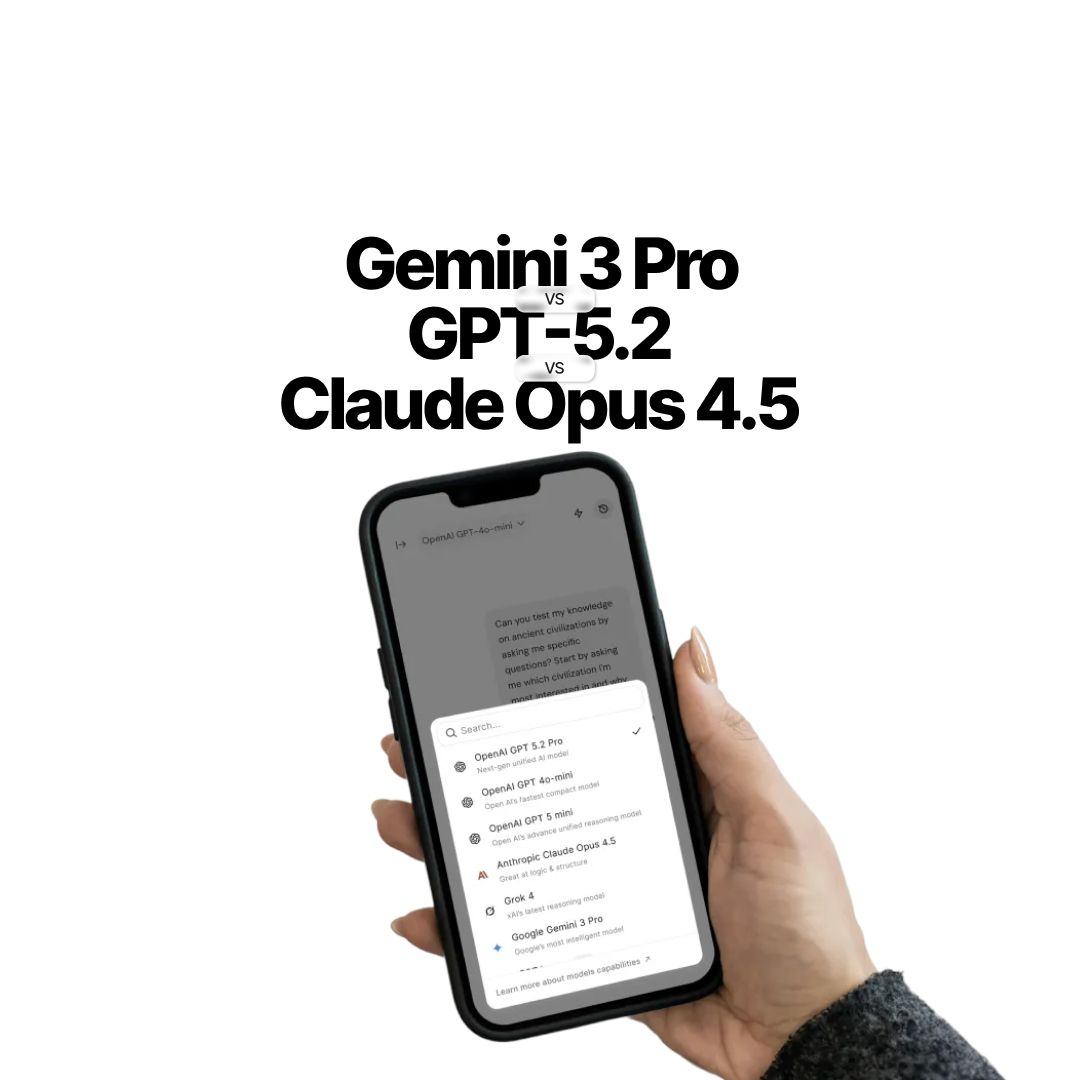
Gemini 3 Pro vs GPT-5.2 vs Claude Opus 4.5: Benchmark Performance Breakdown
Faisal Saeed