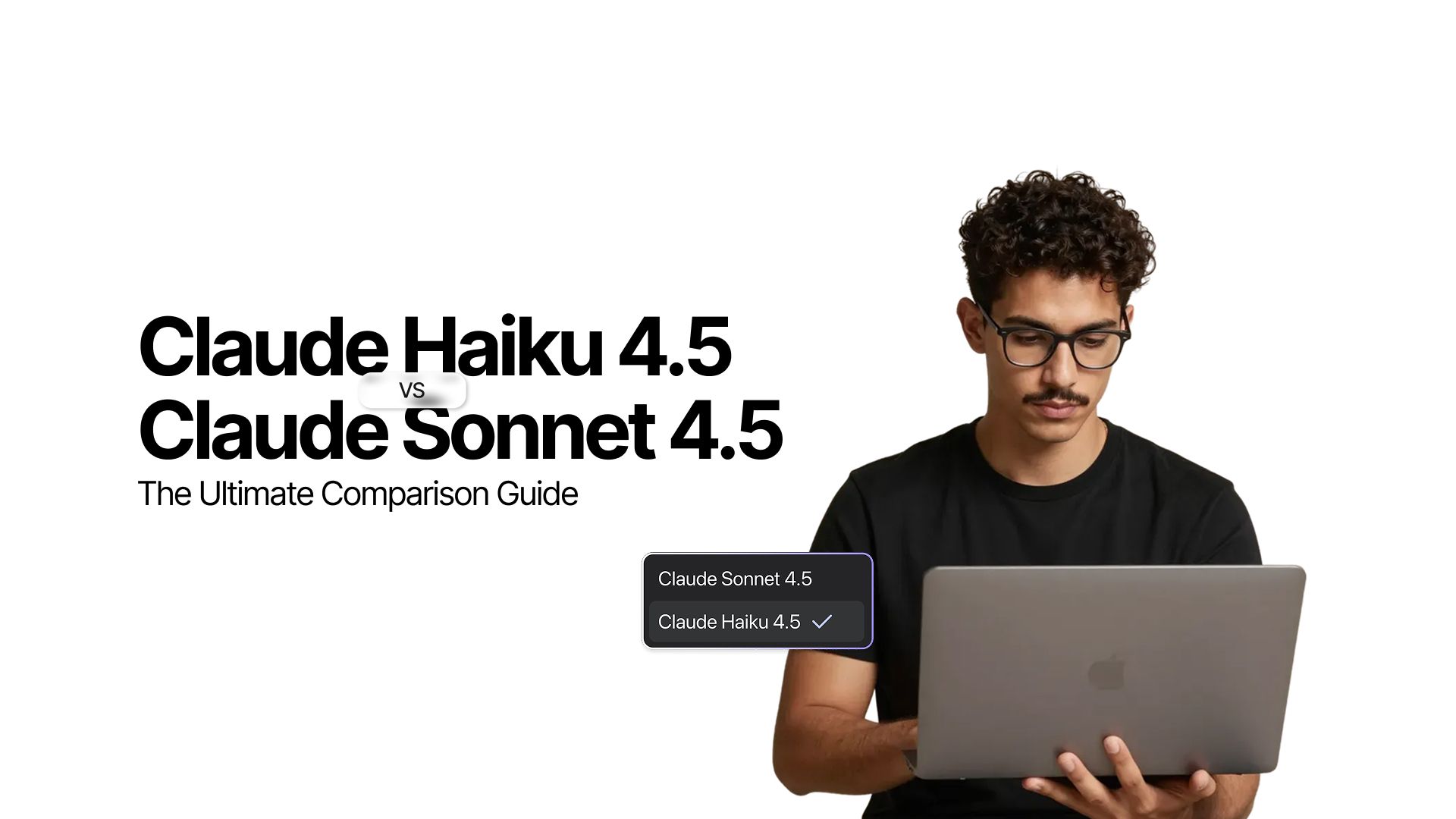
Claude Haiku 4.5 vs Claude Sonnet 4.5: The Ultimate Comparison Guide
Imagine choosing between a Formula 1 race car and a Tesla Model S. Both can take you from one place to another. But one delivers raw speed and efficiency, while the other offers luxury and maximum performance.
It’s the same while choosing between models like Claude Haiku 4.5 versus Sonnet 4.5. While Haiku 4.5 will get tasks done quicker, there is a lot more you can do with Sonnet 4.5 and its extended features.
Anthropic released Claude Sonnet 4.5 on September 29, 2025, branding it as "the best coding model in the world." Just two weeks later, on October 15, 2025, Claude Haiku 4.5 arrived with a promise of near-frontier performance at a fraction of the cost.
This guide breaks down everything you need to know about both models. We'll compare performance benchmarks, pricing structures, coding capabilities, and real-world use cases to help you make an informed decision.
Understanding the Claude 4.5 Family
Before diving into the comparison, let's establish where these models sit within Anthropic's ecosystem.
The Claude 4.5 family currently includes three models: Opus 4.5, Sonnet 4.5, and Haiku 4.5. Sonnet 4.5 was designed for developers who need cutting-edge intelligence and are building sophisticated applications. Haiku 4.5 targets teams prioritizing speed, cost-efficiency, and high-volume deployments.
Anthropic's strategy reflects a broader industry shift toward specialized models. Rather than one-size-fits-all AI, developers now have tools optimized for specific workflows. This approach lets you match model capabilities directly to task requirements.
Claude Sonnet 4.5 uses the model ID claude-sonnet-4-5-20250929. Claude Haiku 4.5 uses claude-haiku-4-5-20251001. Both models support a 200,000-token context window, though Sonnet 4.5 offers an experimental 1 million token option in beta.
One significant upgrade in Haiku 4.5 is the maximum output capability. The model can now generate up to 64,000 tokens in a single response, a massive leap from the 8,192 token limit in Claude 3.5 Haiku. This makes Haiku 4.5 viable for generating complete codebases, extensive documentation, or long-form content.
Both models are available through multiple channels. You can access them via Anthropic's API, Amazon Bedrock, and Google Cloud Vertex AI. This multi-platform availability ensures flexibility regardless of your existing cloud infrastructure.
Pricing Difference
Claude pricing is where the differences between these models become immediately apparent.
Claude Haiku 4.5 Pricing:
- $1 per million input tokens
- $5 per million output tokens
Claude Sonnet 4.5 Pricing:
- $3 per million input tokens
- $15 per million output tokens
That makes Haiku exactly three times cheaper across both input and output operations.
For high-volume applications, this difference compounds quickly. Consider a customer support chatbot handling 100,000 conversations monthly, with each conversation averaging 1,000 input tokens and 500 output tokens:
- Haiku 4.5 monthly cost: ~$350
- Sonnet 4.5 monthly cost: ~$1,050
Additional Cost Savings:
- Batch processing discounts: 50% off output tokens for async workloads
- Ideal for content generation, data processing, or nightly analysis runs
- Prompt caching available for both models to reduce repeated input costs
When the Cost Difference Matters Most:
- Free-tier products where you absorb API costs
- High-volume internal tools and automation
- Startups and small teams with tight budgets
- Applications requiring millions of API calls monthly
Benchmark Performance: Numbers That Matter
Now let's examine how these models actually perform when put to the test.
Coding Benchmarks
On SWE-bench Verified, a rigorous test of real-world software engineering tasks, Haiku 4.5 achieves 73.3% accuracy. Sonnet 4.5 scores 77.2%. That's less than a 4-point gap for a model that costs three times less.
Augment's agentic coding evaluation tells a similar story. Haiku 4.5 delivers approximately 90% of Sonnet 4.5's performance on autonomous coding tasks. This suggests that for many coding applications, the intelligence gap is narrower than the price gap.
Perhaps most interesting are real-world pull request tests. When both models were tasked with actual GitHub contributions, Haiku 4.5 won 55% of blind comparisons versus Sonnet 4's 45%. Reviewers rated Haiku's code quality at 6.55 out of 10 compared to Sonnet 4's 6.20.
Computer Use Capabilities
Haiku 4.5 achieves a 50.7% success rate on computer use benchmarks. This actually outperforms Sonnet 4's 42.2% success rate. The combination of speed and reliability makes Haiku particularly effective for automation tasks requiring rapid iteration.
Speed and Latency
Speed is where Haiku 4.5 truly dominates. The model runs four to five times faster than Sonnet 4.5 on typical workloads. For small prompts, Haiku delivers responses in under 200 milliseconds.
This speed advantage matters tremendously for user-facing applications. Real-time chatbots, IDE code completions, and interactive tools all benefit from sub-second response times. When users are waiting for AI assistance mid-workflow, every millisecond counts.
Breakthrough Features and Capabilities
Beyond raw performance numbers, several new capabilities differentiate these models from their predecessors.
Extended Thinking
Claude Haiku 4.5 is the first Haiku model to support extended thinking. This feature allows the model to reason through complex problems step-by-step before responding. You control the token budget allocated to this internal reasoning process.
The impact on quality is measurable. In coding tests with extended thinking enabled, Haiku 4.5's win rate jumped to 58% with code quality scores of 7.29 versus 6.60. This suggests that when you give Haiku time to "think," it can match or exceed larger models on complex tasks.
Extended thinking works particularly well for debugging, architectural decisions, and multi-step problem solving. The trade-off is slightly higher latency and token consumption, but the quality improvement often justifies the cost.
Enhanced Context Management
Both models excel at managing their 200,000-token context windows efficiently. They include real-time token budget tracking, helping developers understand exactly how much context they're consuming. This prevents unexpected truncation or cost overruns.
The large context window enables entirely new workflows. You can include multiple files, extensive documentation, conversation history, and examples in a single prompt. This context awareness translates to better continuity across long coding sessions or complex analysis tasks.
Safety and Alignment
Safety classifications reveal an interesting distinction between the models.
Haiku 4.5 is rated ASL-2 (Anthropic Safety Level 2) while Sonnet 4.5 is ASL-3. Despite the lower safety level rating, Haiku 4.5 demonstrates statistically lower misaligned behaviors than both Sonnet 4.5 and Opus 4.1 in testing. This makes it particularly suitable for customer-facing applications where safety and reliability are paramount.
When to Choose Each Model
Selecting the right model depends entirely on your specific use case and constraints. Here's how to think about the decision.
Ideal Scenarios for Haiku 4.5
Choose Haiku 4.5 when speed and cost matter more than absolute maximum capability.
Best Use Cases:
- High-volume customer support chatbots handling thousands of daily conversations
- Code completion and IDE integrations requiring sub-200ms response times
- Real-time chat applications where users expect instant responses
- Single-file refactoring and quick code modifications
- UI scaffolding and rapid prototyping
- Generating boilerplate code and screen layouts
- Free-tier products where you absorb API costs
- High-volume internal tools and automation workflows
Key Benefits:
- 3x cost savings adds up quickly at scale
- Sub-200ms latency keeps workflows fluid
- GitHub Copilot integration shows comparable quality to Sonnet 4
- Delivers "instantly responsive" experience for developers
Ideal Scenarios for Sonnet 4.5
Sonnet 4.5 shines when dealing with complex, high-stakes work requiring maximum accuracy.
Best Use Cases:
- Multi-file refactoring where changes must propagate correctly across codebases
- Complex cross-file logic and state management
- Long-context reasoning with extensive documentation
- Analyzing large codebases requiring deep understanding
- Production-critical code reviews and security audits
- Architectural decisions affecting system design
- High-stakes applications where bugs are costly
- Tasks requiring maximum accuracy over speed or cost
Key Benefits:
- Superior reasoning for complex, interconnected problems
- Better at holding complex mental models across vast information
- 4% better accuracy on coding benchmarks
- Excels at maintaining context across elaborate conversations
The Hybrid Approach
The smartest teams don't choose one model exclusively—they use both strategically.
Effective Hybrid Strategies:
- Use Sonnet 4.5 to break down complex problems into subtasks, then orchestrate multiple Haiku 4.5 instances for parallel execution
- Start with Haiku for initial setup and scaffolding, switch to Sonnet for complex business logic
- Deploy Haiku during exploratory and iteration phases, use Sonnet for final implementation
- Route simple queries to Haiku, escalate complex requests to Sonnet based on complexity detection
This approach combines Sonnet's architectural thinking with Haiku's speed and cost efficiency. You balance rapid iteration with production-quality output while optimizing your API spend.
Real-World Developer Experiences
Beyond benchmarks, how do these models perform in actual development workflows?
GitHub Copilot's integration reveals telling insights. Developers report that Haiku brings comparable quality to Sonnet 4 but with noticeably faster response times. The speed improvement makes the development experience feel more fluid and natural.
Multi-agent orchestration has emerged as a powerful use case. Teams build systems where multiple Haiku instances collaborate on different aspects of a project, coordinated by a single Sonnet instance. This architecture maximizes throughput while keeping costs manageable.
Making Your Migration Decision
If you're currently using other models or considering switching between Haiku and Sonnet, here's what to consider.
API integration is straightforward. Both models use the same API format, differing only in the model ID parameter. Switching between models requires changing a single string in your code. This makes A/B testing trivial.
Prompt optimization might need adjustment when switching models. Haiku responds better to concise, specific instructions. Sonnet can handle more implicit reasoning and ambiguous requests. Test your existing prompts with both models before full deployment.
Start with a small pilot deployment. Run 5-10% of your traffic through the new model while monitoring quality metrics. This de-risks the transition and helps you identify any edge cases where one model significantly outperforms the other.
Conclusion
Claude Haiku 4.5 and Sonnet 4.5 represent two sides of the same coin. Speed and efficiency versus maximum intelligence and capability. Haiku delivers 90% of Sonnet's performance at one-third the cost with four to five times faster response times, making it ideal for high-volume applications and real-time interactions.
Sonnet excels when absolute accuracy matters most, particularly for complex multi-file refactoring and architectural decisions.
The real power lies in using both models strategically rather than choosing one exclusively. Deploy Haiku as your default for speed-sensitive workloads and reserve Sonnet for high-stakes tasks requiring maximum reasoning capability.
This hybrid approach lets you optimize both performance and cost while maintaining quality across your entire application.
Start testing both models with your actual workloads to determine the right fit for your specific needs. The API makes switching between models as simple as changing a single parameter, so experimentation is risk-free. Your choice ultimately depends on your unique balance of budget, latency requirements, and task complexity.
Frequently Asked Question
Learn more about the difference between Claude's top performing AI models through these online questions.
More topics you may like

11 Best ChatGPT Alternatives in 2026 (Tested, Compared & Priced)

Muhammad Bin Habib

GPT-5.1 Pricing Explained: How Much Does It Cost?

Faisal Saeed
Claude Opus 4.5: The Definitive Guide to Features, Use Cases, Pricing
Faisal Saeed

Cost Efficiency in Claude Opus 4.5: Understanding Tokens, Effort Levels & When It’s Worth It
Faisal Saeed
Gemini 3 Pro Overview: Features, Pricing, and Use Cases
Faisal Saeed