How to Use Claude Opus 4.7 for Free – 5 Ways in 2026
Anthropic recently launched Claude Opus 4.7 and benchmark results are impressive.
However, it is priced at $5 per million input tokens and $25 per million output tokens. On top of that, the new tokenizer uses up to 35% more tokens than Opus 4.6 for the same content. Real costs add up fast on anything beyond light testing.
But free access exists. Not unlimited, not forever, but substantial enough to run real experiments, build a working prototype, or evaluate the model properly before committing to a paid plan.
This article covers five legitimate paths, what you actually get from each, and how to pick the right one for your situation.
What "Free" Actually Means for Opus 4.7
There is no tool that offers unrestricted free access to Opus 4.7. What you can get falls into three categories:
- Rate-limited UI Access: use the model through a chat interface with daily or monthly caps
- New-account Trial Credits: one-time credit from Anthropic or a cloud platform, valid for a limited period
- Program-based Credits: larger grants for startups and builders, requires an application
The five methods below cover all three. Stack two of them and you have a meaningful runway.
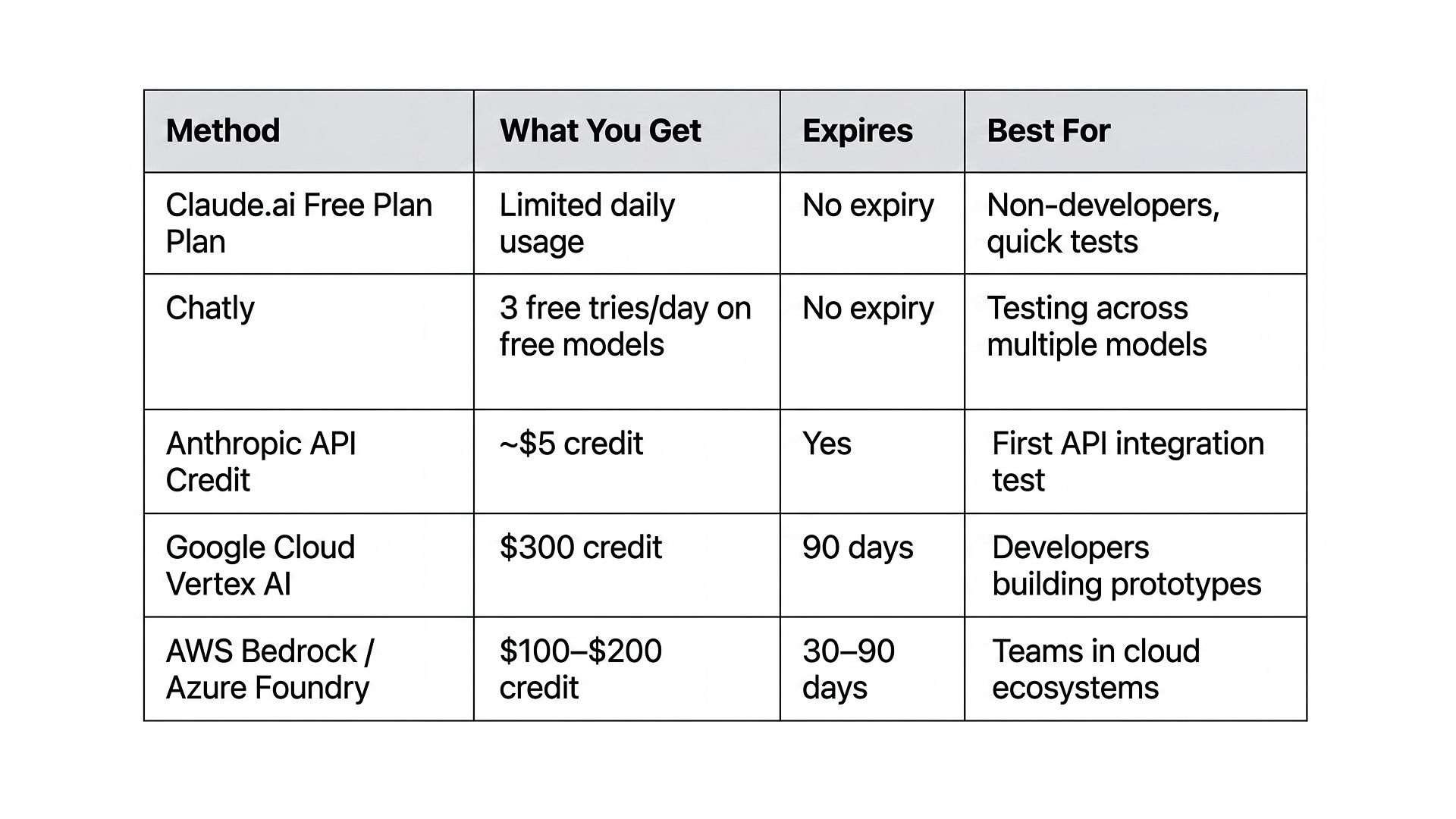
Quick Comparison
Method 1: Claude.ai Free Plan
The lowest-friction path. No credit card, no API key, no setup of any kind.
Go to claude.ai, create a free account, and you can start using Claude Opus 4.7 immediately through the chat interface. The free plan includes limited access to Opus 4.7 with daily usage caps, after which the interface prompts you to upgrade.
Best for: Non-developers who want to test Opus 4.7 for writing, research, document analysis, or general tasks without touching an API.
Honest limit: Not suitable for automated workflows, high-volume testing, or anything that requires consistent availability. Once you hit the daily cap, you wait or upgrade.
Method 2: Chatly
Chatly gives you access to Claude Opus 4.7 and other frontier models through a single AI chat interface. Free users get 3 tries per day on free models.
Opus 4.7 is a pro model, meaning full access requires a subscription, but individual plans start at $7.5 per month, which is significantly cheaper than running comparable usage directly through the Anthropic API.
Where Chatly earns its place on this list is the no-setup advantage. No API configuration, no cloud billing, no token management. For anyone evaluating Opus 4.7 against GPT-5.4 or Gemini 3.1 Pro before making a decision, Chatly lets you run that comparison in minutes rather than setting up separate API integrations for each provider.
Best for: Teams and individuals who want to test Opus 4.7 across real tasks, compare it to other models, or use it for everyday work in a single AI workspace without managing API infrastructure.
Honest limit: Free tier access is limited to 3 tries per day. For heavier usage, the $7.5/month plan is the practical entry point.
Method 3: Anthropic API Signup Credit
Every new Anthropic account receives a small amount of free API credit, typically $5, applied automatically when you verify your account.
How to claim it:
- Go to console.anthropic.com
- Sign up with your email or Google account
- Verify your phone number
- Credit lands in your account balance automatically
What $5 actually gets you on Opus 4.7:
- ~1 million input tokens, which is the full context window used once
- Or ~200,000 output tokens, roughly 150,000 words of generated content
- Or a practical mix: 20 to 30 medium-sized coding or analysis sessions
Best for: Developers running their first API integration, verifying that prompts behave as expected, and benchmarking Opus 4.7 against their current setup before committing to paid usage.
Honest limit: Credits expire. New accounts sit at Tier 1 rate limits: 50 requests per minute and 20k input tokens per minute on Opus. Do not plan production traffic on this tier.
Method 4: Google Cloud Vertex AI — $300 Free Credit
This is the highest-value free path available for developers.
Claude Opus 4.7 runs natively on Google Cloud's Vertex AI. New Google Cloud customers receive $300 in free credits valid for 90 days, and every dollar of that works with Opus 4.7.
How to claim it:
- Go to cloud.google.com/free
- Sign up with a Google account that has not previously used GCP
- Add a payment method for identity verification (not charged during the trial)
- Enable the Vertex AI API in the console
- Request access to Claude models in the Model Garden
What $300 buys on Opus 4.7:
- ~60 million input tokens, or
- ~12 million output tokens, or
- A realistic mix of 30M input and 5M output, which covers weeks of serious agent development, full codebase reviews, and multi-session prototyping
Best for: Developers building a real product or running a multi-week evaluation who need sustained access, not just a quick test.
Method 5: AWS Bedrock or Microsoft Azure Foundry Trial Credits
Both platforms offer new-account credits that work with Opus 4.7 through the same mechanism: sign up, verify payment, access Claude through the platform's model catalog.
AWS Bedrock:
- Standard new-account credit: $100–$200
- Startups accepted into AWS Activate: $1,000–$5,000
- Apply at aws.amazon.com/activate through your accelerator or directly
Microsoft Azure Foundry:
- New Azure accounts receive $200 in credit valid for 30 days
- Claude Opus 4.7 is available through the Azure AI Foundry model catalog
- Sign up at azure.microsoft.com/free
Best for: Teams already operating in AWS or Azure ecosystems who want to deploy Opus 4.7 within their existing cloud infrastructure without introducing a new provider relationship.
Honest limit: The 30-day Azure window is tight. If you do not use the credit within the trial period, it expires. AWS credits are more generous on timeline but require startup status for the higher tiers.
How to Make Your Free Credits Last Longer
Once you have access, how you use it matters as much as how much you have. A few adjustments can significantly extend your runway across any of the five methods above.
- Drop to
higheffort on non-critical tasks: Claude Code defaults toxhigheffort, which burns more tokens per request. For summarization, formatting, or simple Q&A,higheffort reduces token usage without a meaningful drop in quality. - Tighten your system prompts: Opus 4.7's new tokenizer counts up to 35% more tokens than Opus 4.6 for the same text. A bloated system prompt that was cheap on 4.6 is noticeably more expensive on 4.7.
- Use task budgets on agentic runs: Opus 4.7 introduced task budgets in public beta, letting you set an advisory token cap across an entire agentic loop. Without one, a long-running agent can consume far more tokens than the task required.
- Develop prompts on Sonnet 4.6 first: Sonnet 4.6 costs a fraction of Opus 4.7. Iterate and refine on Sonnet, then switch to Opus for final runs. On complex workflows, this alone can cut your Opus token usage significantly.
Which Method Is Right for You?
Each method and the usage that comes with it is suitable for different audiences. You do not want to spend too much time figuring out the wrong method if you do not really need it. So here is a little guide:
- No technical setup, just want to try the model → Claude.ai free plan or Chatly
- Want to compare Opus 4.7 against other frontier models quickly → Chatly
- Developer running a first API test → Anthropic API signup credit
- Building a prototype and need real runway → Google Cloud Vertex AI ($300)
- Startup or team in AWS or Azure → Bedrock or Foundry trial credits
- Want maximum free usage → Stack the Anthropic API credit with the Vertex AI trial. Both are separate accounts and both apply independently.
The stacking point is worth emphasizing. Nothing stops you from claiming the Anthropic API credit and the Vertex AI credit simultaneously. That combination gives you $5 direct API credit plus $300 in cloud credits, enough for a thorough multi-week evaluation without spending anything.
Start Using Opus 4.7 in Chatly While Others Wait
Free access to Claude Opus 4.7 is real, but it is finite and method-dependent. For most people, the right starting point is either Claude.ai or Chatly for zero-setup access, followed by the Vertex AI trial if you need more volume for a real build. Developers integrating the API directly should claim the Anthropic signup credit first, then layer Vertex AI on top.
For a full breakdown of what Opus 4.7 costs across effort levels and how the new tokenizer affects real-world API spend, the Opus 4.7 pricing guide covers it in detail.
Frequently Asked Question
Struggling to get started? Here is information you might find useful in accessing Claude Opus 4.7.
More topics you may like
Claude Haiku 4.5 vs Claude Sonnet 4.5: The Ultimate Comparison Guide

Faisal Saeed
Claude Opus 4.5: The Definitive Guide to Features, Use Cases, Pricing
Faisal Saeed
Claude Opus 4.6: New Features, Improvements, and Benchmark Performance

Elena Foster
Claude Sonnet 4.6: A Deep Dive into Anthropic's Latest Model

Lucas Reinhardt

Claude Sonnet 5 "Fennec" – What We Know & Expect

Daniel Mercer