How to Use Claude Opus 4.8 for Free (Honest Methods and Their Limits)
If you are looking for a platform that provides free access to Claude Opus 4.8, know one thing: No platform allows unlimited access to Opus 4.8 for free.
What does exist is a short list of ways to run 4.8 free for a while, free if you qualify, or cheaper than paying full freight. Each one has a catch.
If you want the background on why this model is worth chasing, its honesty and judgment gains are covered in our Opus 4.8 overview. This post is about getting your hands on it without paying full price.
TL;DR
- No truly free, unlimited Opus 4.8 exists. claude.ai's free tier runs Sonnet, not Opus.
- Free for a while: new-account credits on Google Vertex AI, AWS Bedrock, or Azure, where 4.8 is already live.
- Free if you qualify: Anthropic's Claude for Open Source program, which gives eligible maintainers six months of Claude Max.
- Free to start: a small one-time Anthropic API trial credit.
- Free for developers: Puter.js, where your app's users cover the usage instead of you.
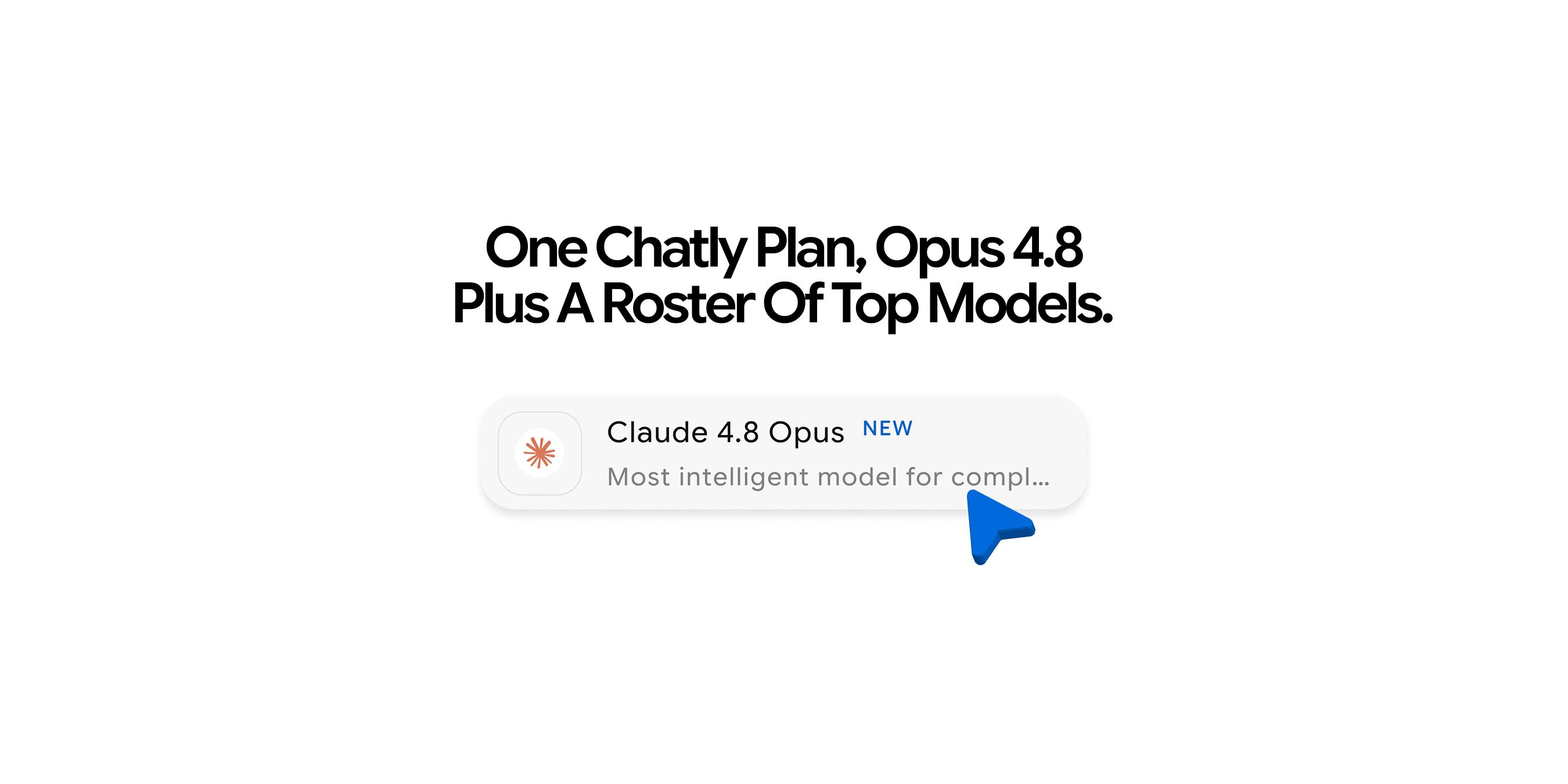
- Cheaper than stacking subscriptions: Chatly bundles Opus 4.8 with many other recent top models under one plan.
1. Free Credits on Google Vertex AI, AWS Bedrock, or Azure
Opus 4.8 went live on all three big cloud platforms at launch, and all three give new accounts starting credits. Point those credits at the model and you're running full Opus 4.8 at no cash cost until they expire.
This is the most generous free Opus going, in raw capability. You get the real model, not a trimmed-down free-tier substitute, with no daily message cap beyond what your credit balance allows.
The path looks like this:
- Open a new account on Google Cloud, AWS, or Azure to claim the starting credits.
- In the model catalog (Vertex AI Model Garden, the Bedrock catalog, or Azure Foundry), request or enable access to Claude Opus 4.8.
- Call it with the model ID
claude-opus-4-8from the console playground or your own SDK. - Track the credit balance and stop before it expires, so nothing quietly rolls into a charge.
The catch is that it's temporary and technical. You're spinning up a cloud project, enabling the model, and calling it through an SDK or console rather than chatting in a finished app. Credits run out on a clock, and once they're gone you're on pay-per-token like everyone else.
2. A Free Anthropic API Credit to Start
New Anthropic API accounts come with a small one-time credit you can spend on any model, Opus 4.8 included. It's enough to run real prompts against your own tasks and judge the model honestly.
Getting started:
- Sign up for a new account at the Anthropic Console.
- Check the starter credit sitting in your billing balance.
- Send a request to
claude-opus-4-8from the Console's Workbench or through the API. - Lead with the prompts you most want to test, since Opus spends the credit quickly.
Anthropic runs no free API tier, so the credit is a starter rather than an allowance, and Opus is the priciest model in the lineup at $5 and $25 per million tokens. A handful of long agentic runs will burn through it. Treat it as a test drive.
3. The Claude for Open Source Program
For the right person, this is the closest thing to genuinely free Opus 4.8 with no compromise on capability. Anthropic's Claude for Open Source program gives qualifying maintainers six months of Claude Max, its top consumer plan, at no cost, and Max includes full Opus access.
How to apply:
- Confirm you maintain a qualifying open-source project against the criteria on the program page.
- Submit the application on Anthropic's Claude for Open Source page before the deadline.
- After approval, your account picks up six months of Claude Max.
- Choose Opus 4.8 from the model selector in Claude, exactly as a paid subscriber would.
The catch is eligibility.
You have to maintain a qualifying open-source project, the spots are capped at roughly 10,000, and applications close ona given deadline. If you're an OSS maintainer, it's the best deal on this page by a distance. If you're not, maybe one of the other options on this list will work for you.
4. Puter.js, Free for Developers
Puter.js turns the usual billing model around. Rather than you paying for API calls in an app you build, each end user covers their own usage from a Puter account, so the Claude models, Opus among them, cost you nothing as the developer. There's no Anthropic key and no server-side billing to manage.
Wiring it up:
- Drop the Puter.js script into your web page with a single tag, no key required.
- Call Claude through
puter.ai.chat(), passing the Opus model name. - Ship the app; each visitor signs into their own Puter account, which carries their usage.
- Check which Opus version Puter currently exposes before you depend on 4.8.
However, it's built for apps you ship to other people, not for your own daily chatting, and because Opus 4.8 is only days old, Puter's lineup may still top out at Opus 4.7 until they add the newer model. Check what's actually live before you build around it.
5. Chatly: Cheaper than Stacking Subscriptions
Opus 4.8 isn't free in Chatly. It sits behind a paid Pro plan. What Chatly changes is the math around it.
Pay Anthropic for Opus, then a second bill for a GPT tool, then a third for Gemini, and the costs stack. One Chatly subscription instead puts Opus 4.8 beside a roster of other recent top models, including Claude's own Sonnet and Haiku tiers, under a single price.
The per-model cost drops toward zero, because you're no longer buying access one model at a time. For anyone who'd otherwise juggle several paid AI tools, that comes out cheaper than the sum of the parts, which is the honest version of "as good as free."
To use it:
- Create a Chatly account and start a Pro plan, which is where Opus 4.8 lives.
- Select Claude Opus 4.8 from the model picker.
- Drop to the other bundled models for work that doesn't need Opus, at no extra charge.
If your reason for wanting free access is really about cost rather than principle, that bundle math is worth running. We laid out the value case for Opus-class models in our cost-efficiency writeup, and the short version holds here too: paying once for many models beats paying many times for one.
What Free Access Won't Get You
Before you pick a route, it's fair to know where the ceilings are:
- Rate caps: Free chat tiers limit how many messages you send per day, with multi-hour resets when you hit the wall.
- Expiring credits: Cloud and API credits are a clock, not a plan; when they run out, the meter starts.
- Your data as training fuel: Consumer free tiers may use your conversations to train future models unless you opt out.
- No Opus on free chat: The free claude.ai plan tops out at Sonnet, so the easiest free route never touches 4.8 at all.
None of these make the free routes useless. They just mean "free" usually buys you a taste of Opus 4.8, not a seat at the table.
Which Route Fits You
A quick way to match the method to the need:
- Trying 4.8 once or twice: a cloud trial credit or the Anthropic API starter credit.
- Building an app on it: Puter.js, so your users carry the cost.
- Maintaining open source: the Claude for Open Source program, no contest.
- Coding most of the day: a Claude Max plan with Claude Code, the one route that reliably caps heavy-use spend below the metered API.
- Wanting dependable Opus 4.8 plus many other models without stacking bills: Chatly.
Still on the previous model? Some of these routes worked there too, and our Opus 4.7 free-access guide covers that version specifically.
Frequently Asked Question
Find out more nuances about Claude Opus 4.8 and free access.
More topics you may like
Claude Opus 4.8: Faster, More Efficient, and More Honest with Better Judgment

Faisal Saeed
Claude Opus 4.7 Overview: Capabilities, Migration Challenges, & Pricing
Faisal Saeed
Claude Opus 4.7 vs GPT-5.4: Benchmarks, Pricing & Which to Use
Faisal Saeed
Claude Opus 4.7 vs Opus 4.6: Should You Switch?
Faisal Saeed
How to Use Claude Opus 4.7 for Free – 5 Ways in 2026
Faisal Saeed