OpenAI Releases GPT-5.5 — A New Class of Intelligence Aimed Directly at Anthropic and Google
OpenAI just released GPT-5.5, rolling out today to Plus, Pro, Business, and Enterprise subscribers across ChatGPT and Codex. API access is coming very soon.
The model, internally codenamed Spud, follows GPT-5.4 by six weeks. OpenAI president Greg Brockman described it as "a new class of intelligence" and "a big step towards more agentic and intuitive computing."
GPT 5.5 is smarter than GPT 5.4, uses fewer tokens to complete the same tasks, and runs at the same speed. Getting more capability without sacrificing speed or driving up token cost is rare. Bigger models are almost always slower. GPT 5.5 is not.
What GPT-5.5 Is Actually Better At
OpenAI says the biggest gains are in four areas: agentic coding, computer use, knowledge work, and scientific research. Here is what each of those means in plain terms.
Knowledge work: On GDPval, a benchmark testing performance across 44 real occupations including finance, legal research, and product management, GPT 5.5 matches or beats industry professionals in 84.9% of comparisons. This is the benchmark that answers the question most people actually care about: can it do real office work?
It Can Build a Game While You Watch
One of the most striking demos from the GPT 5.5 briefing: the model built a playable maze game in real time, applied textures, and modified gameplay mechanics mid-session, all from natural language instructions inside a live computer environment. This is not a code generator writing a script for you to run later. It is an AI operating a computer, building something, and iterating on it autonomously. That is what OSWorld measures and GPT-5.5 is currently the top scorer.
The Efficiency Story Nobody Is Talking About
GPT 5.5 completes the same Codex tasks with fewer tokens than GPT 5.4. Sam Altman addressed the pricing concern directly on X: even though the per-token rate is higher, the token efficiency gains mean most real-world runs cost the same or less than GPT 5.4.
On the Artificial Analysis Intelligence Index, which averages performance across a wide range of tasks, GPT 5.5 ranks as the most intelligent model available right now.
On BrowseComp, which tests a model's ability to track down hard-to-find information across the live web, GPT 5.5 Pro scores 90.1%, ahead of Gemini 3.1 Pro at 85.9%.
GPT-5.5 Pro
A separate GPT 5.5 Pro tier, for harder, higher-accuracy work, is rolling out to Pro, Business, and Enterprise users. This is the version scoring 90.1% on BrowseComp and delivering peak performance on complex reasoning benchmarks. API pricing for Pro: $30 per million input tokens and $180 per million output tokens.
Pricing
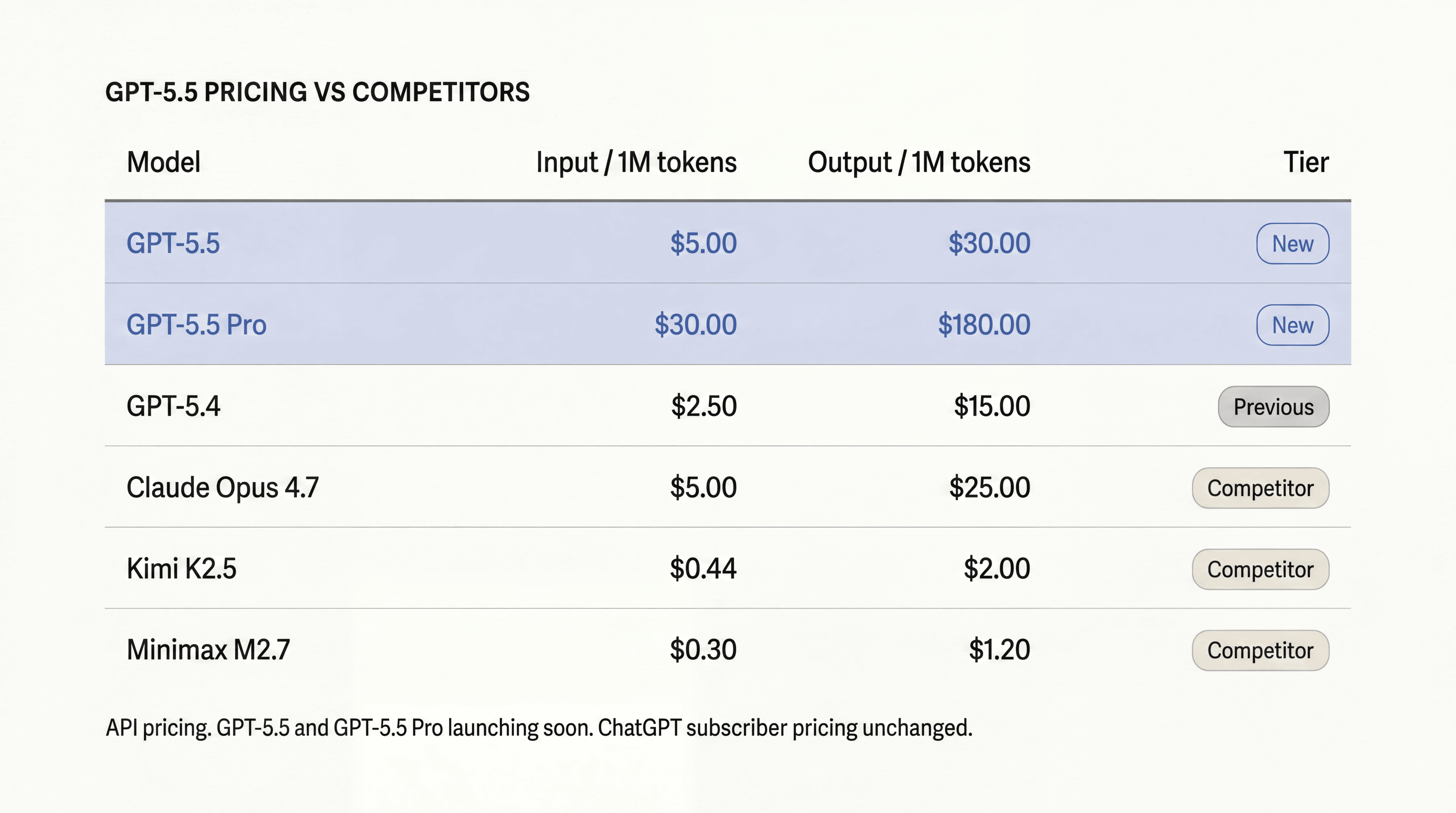
GPT 5.5 costs $5 per million input tokens and $30 per million output tokens. GPT 5.5 Pro costs $30 per million input tokens and $180 per million output tokens. For context, GPT-5.4 was priced at $2.50 input and $15 output per million tokens. The per-token rate is higher but OpenAI argues token efficiency on real workloads offsets the difference.
For comparison: Kimi K2.5 costs $0.44 input and $2.00 output per million tokens. Minimax M2.7 costs $0.30 and $1.20. GPT-5.5 sits in a different price tier entirely, built for enterprise use cases where accuracy and autonomy matter more than raw cost per token.
Who Can Use It Right Now
GPT-5.5 is live today in ChatGPT and Codex for Plus, Pro, Business, and Enterprise subscribers. GPT 5.5 Pro is rolling out to Pro, Business, and Enterprise. Free tier users do not get access. API is coming very soon.
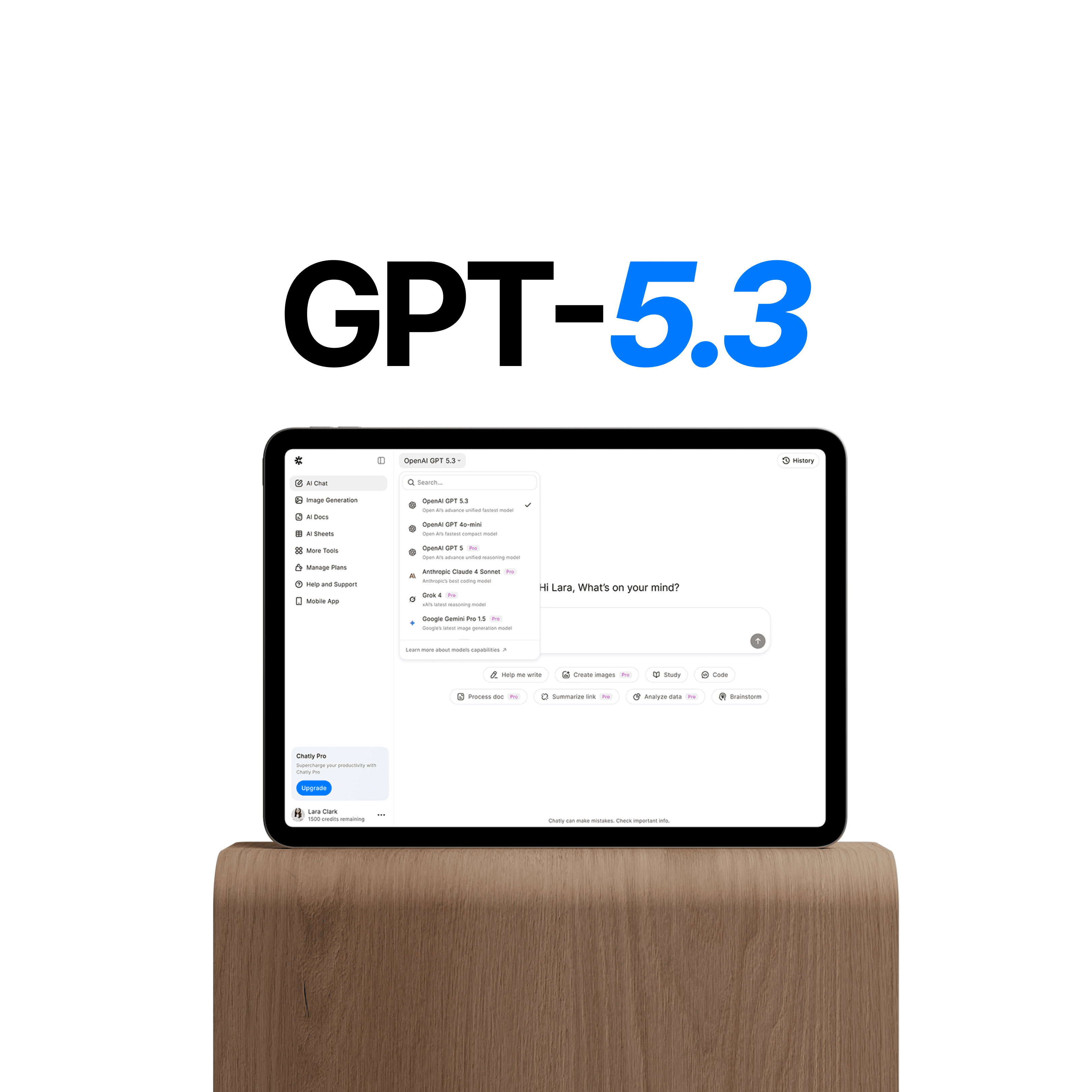
You can try GPT-5.5 and compare it against every major model on Chatly right now from one workspace, no separate accounts needed.
The Bigger Picture
GPT-5.4 arrived two days after GPT-5.3. GPT-5.5 followed six weeks later. OpenAI's chief scientist Jakub Pachocki put it plainly: "I think the last two years have been surprisingly slow." The pace is accelerating, not slowing. OpenAI now has 900 million weekly active ChatGPT users, 50 million subscribers, and 9 million paying business users. GPT-5.5 is a direct response to competitive pressure from Anthropic's Claude Opus 4.7 and Mythos and a signal that OpenAI is building toward a single "superapp" combining ChatGPT, Codex, and an AI browser into one unified platform.
Read More
- OpenAI Introduces Workspace Agents in ChatGPT — Build AI Automations Without Writing a Single Line of Code
- OpenAI Launches ChatGPT Images 2.0 — The Image Model That Thinks Before It Draws
- Moonshot AI Open-Sources Kimi K2.6 — A Coding Model That Runs Autonomously for Days
- Anthropic Launches Claude Opus 4.7 — New Flagship Model for Coding and Complex AI Workflows
- Google Launches Gemma 4, Its Most Capable Open Model Family
Frequently Asked Questions
Everything you need to know about OpenAI's most capable model, explained simply.
More topics you may like