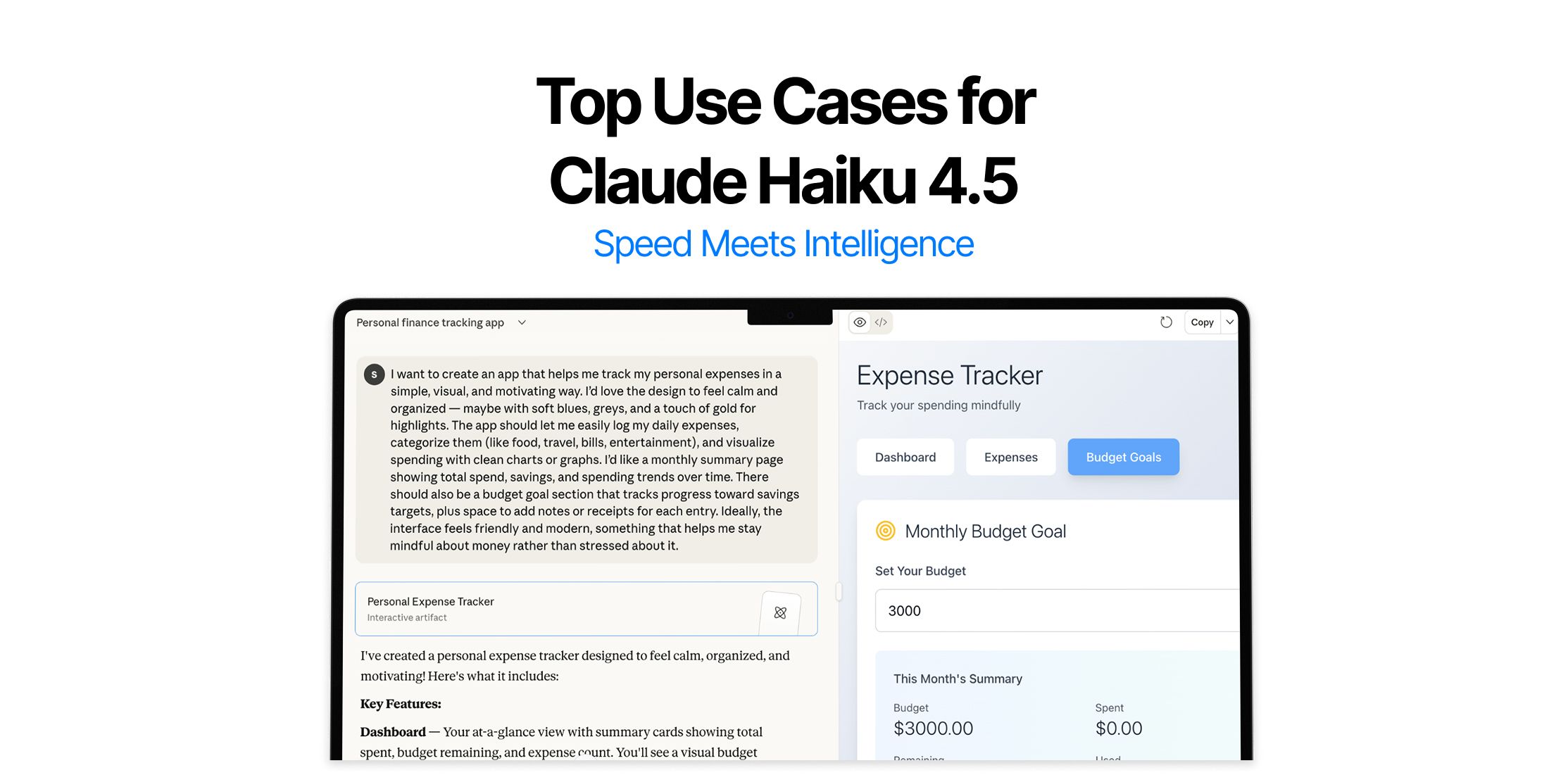
Top Use Cases for Claude Haiku 4.5: Speed Meets Intelligence
Anthropic released Claude Haiku 4.5 in October 2024, delivering sub-second latency and fewer input tokens costs. This makes it one of the fastest and most affordable options in the Claude family.
Reddit communities and developer forums quickly praised its ability to handle high-volume tasks without breaking the bank.
Haiku 4.5 is designed for scenarios where speed, cost efficiency, and consistent performance matter most. From coding assistance to customer support automation, this model opens new possibilities for developers and teams working with practical, scalable AI applications.
Where Claude Haiku 4.5 Excels (Top Use Cases)
Claude Haiku 4.5 has quickly established itself across different domains where speed and cost efficiency create tangible business value. These use cases span from individual developer productivity to enterprise-scale automation.
1. Coding Assistance: Fast Iterations for Developers
Claude Haiku 4.5 achieves 82% accuracy in issue detection during code reviews, significantly reducing the time developers spend on routine quality checks. Teams report saving approximately 5 minutes per pull request, which compounds into substantial productivity gains across large projects.
Developers on various forums have described Haiku 4.5's performance as "insane" for building simple applications.
One user on reddit reported creating a complete finance tracking app in no time and some learning curve. This highlights how the model handles straightforward development tasks without rate limit concerns.
The speed advantage becomes particularly noticeable during refactoring sessions, where developers need rapid feedback across multiple files.
Claude Code, Anthropic's command-line tool, leverages Haiku 4.5 for file editing and test generation. The model excels at generating unit tests that cover edge cases developers might overlook. Users appreciate that Haiku produces fewer false positives compared to Haiku 3.5, meaning less time spent validating AI-generated suggestions.
Key coding applications include:
- Automated code reviews with detailed issue reports
- Unit test generation for new features
- Refactoring assistance across multiple files
- Quick prototype development for simple apps
The model's performance in coding tasks makes it ideal for development teams using tools like Chatly, where rapid response times enhance the developer experience.
2. Customer Support Automation
Customer support teams have found Haiku 4.5 particularly valuable for managing high-volume ticket queues.
The model achieves 89% accuracy in ticket triage, correctly categorizing and routing inquiries with minimal human oversight. This accuracy reduces the need for manual review by 25%, allowing support staff to focus on complex customer issues.
Teams processing thousands of tickets daily report doubling their productivity after integrating Haiku 4.5. The model handles urgency assessment, response drafting, and preliminary troubleshooting steps before escalating to human agents.
Reddit users working in support roles consistently praise its reliability for routine customer interactions.
One particularly compelling use case involves automated first-response generation. Haiku 4.5 analyzes ticket content, checks knowledge bases, and drafts responses that maintain brand voice and accuracy. Support managers report that these drafts require minimal editing before sending, dramatically reducing response times.
Common support automation tasks:
- Ticket categorization and routing
- Urgency level assessment
- Initial response drafting
- FAQ matching and knowledge base queries
3. Data Processing and Extraction
Haiku 4.5 demonstrates exceptional capability in extracting structured data from unstructured sources. The model achieves 94% validity when converting PDF invoices to JSON format, making it reliable for financial and administrative workflows.
This accuracy rivals more expensive models while processing documents in a fraction of the time.
Retrieval-augmented generation (RAG) systems benefit significantly from Haiku's efficiency. The model quickly processes large document collections, extracts relevant information, and summarizes key points without the context window limitations that plague other approaches.
Teams report successfully using Haiku for batch processing thousands of documents overnight.
Content moderation represents another high-value application. The model analyzes text, images, and user-generated content to flag policy violations at scale. Reddit users note its efficiency for token-heavy tasks like dataset labeling, where processing costs can quickly spiral with more expensive models.
Data processing applications:
- Invoice and receipt extraction to structured formats
- Document summarization for large collections
- Content moderation across platforms
- Dataset labeling and annotation
Organizations can leverage Haiku 4.5 for backend data processing while reserving conversational bandwidth for user interactions. The model's speed enables real-time processing pipelines that would be prohibitively expensive with some Sonnet or Opus models.
4. Real-Time Interactions
Low-latency responses make Haiku 4.5 ideal for conversational applications. Chat assistants powered by the model deliver sub-second response times, creating natural-feeling interactions that keep users engaged.
Reddit communities particularly appreciate its performance for roleplay scenarios and quick information queries where speed matters more than deep reasoning.
Pair programming applications benefit from Haiku's rapid feedback loop. Developers receive instant suggestions, explanations, and code completions without noticeable lag. This responsiveness maintains flow states that slower models interrupt, making the development experience more enjoyable and productive.
Live customer service implementations showcase Haiku's conversational strengths. The model handles multiple simultaneous conversations without degradation, maintaining consistent response quality even under load.
Users report that Haiku's performance suits scenarios where immediate feedback trumps exhaustive analysis.
Real-time use cases include:
- Chat-based customer assistants
- Interactive coding companions
- Quick fact-checking and information retrieval
- Conversational games and entertainment
5. Agentic Coding and Multi-Agent Systems
Haiku 4.5 excels in hierarchical multi-agent architectures where a master coordinator delegates tasks to specialized workers. Development teams use this pattern for code migrations, where a Sonnet-powered orchestrator assigns specific file transformations to pools of Haiku agents.
This approach combines strategic oversight with cost-effective execution.
Task farming patterns leverage Haiku's speed and reliability.
Teams generate hundreds of unit tests simultaneously by distributing work across multiple Haiku instances, achieving throughput impossible with sequential processing. Reddit users report that this architecture avoids rate limit issues that arise during extended coding sessions with more expensive models.
Swarm-based testing frameworks demonstrate particularly impressive results. Developers use Claude Haiku 4.5 for agentic coding, where a lead model delegates to parallel Haiku workers for tasks like codebase validation, integration checks, and edge cases. Hybrid Sonnet-Haiku setups yield 2-3x speed and ~1/3 costs vs. pure Sonnet, per user reports.
Multi-agent patterns include:
- Master-worker hierarchies for large migrations
- Parallel test generation and execution
- Distributed code analysis swarms
- Task farming for repetitive operations
6. Log and Data Analysis
Large-scale log analysis represents one of Haiku 4.5's most practical enterprise applications. The model processes sharded log files in parallel, identifying patterns, anomalies, and potential issues across distributed systems.
Teams report that Haiku handles extended analysis sessions reliably, maintaining accuracy even when processing gigabytes of log data.
Dataset validation workflows benefit from Haiku's consistent performance.
Data engineers use the model to verify data quality, check for missing values, and flag statistical anomalies across large datasets. Reddit users working with Claude Code specifically mention Haiku's reliability for these marathon processing tasks.
Hybrid workflows combining Haiku with more powerful models prove particularly effective. Haiku performs initial filtering and summarization, then passes interesting findings to Sonnet for deeper investigation. This pattern reduces overall costs while ensuring complex issues receive appropriate analytical depth.
Analysis applications include:
- Distributed log file processing
- Dataset quality validation
- Pattern detection in time-series data
- Preliminary investigation for detailed analysis
The model quickly surfaces insights from unfamiliar datasets, helping analysts understand data structures and relationships before committing to expensive deep dives.
Benchmarks and Comparisons
Understanding when to choose Haiku 4.5 over Sonnet or Opus requires examining performance across key dimensions. Haiku consistently outperforms its predecessor Haiku 3.5 in coding tasks, with users reporting 30-40% fewer errors and faster completion times. The model achieves this improvement while maintaining the same pricing structure.
- Haiku 4.5 averages 0.8 second response time at $0.25 per million tokens with 82% code accuracy
- Haiku 3.5 averages 1.2 seconds at $0.25 per million tokens with 73% code accuracy
- Sonnet 4.5 averages 2.5 seconds at $3.00 per million tokens with 94% code accuracy
- Opus 4 averages 4.2 seconds at $15.00 per million tokens with 97% code accuracy
Real-world usage data from Reddit shows teams doubling productivity when switching from manual processes to Haiku-powered automation. The model proves most valuable for high-volume, well-defined tasks where speed and cost matter more than perfect accuracy. For complex problem-solving or nuanced content creation, Sonnet or Opus remain superior choices.
Choose Haiku 4.5 when you need:
- Fast iteration cycles
- Process large volumes of similar tasks
- Operate under tight budget constraints
Select Sonnet when accuracy and reasoning depth outweigh speed concerns. Reserve Opus for mission-critical applications where errors carry significant consequences.
Conclusion
Claude Haiku 4.5 democratizes AI by making fast, reliable intelligence accessible at unprecedented cost efficiency. Its strengths in coding assistance, customer support, data processing, real-time interactions, agentic systems, and log analysis solve practical problems that teams face daily.
User reports consistently highlight productivity gains that justify even conservative AI investments.
Start experimenting with Haiku 4.5 through the Anthropic API today. Identify your highest-volume, most repetitive workflows and measure the impact. The combination of sub-second latency and minimal cost per token makes Haiku 4.5 an essential tool for modern AI-driven development.

Frequently Asked Question
Find out when and how other people use Claude Haiku 4.5.
More topics you may like
What is Claude Haiku 4.5? Overview, Key Specs & What Makes It Special

Faisal Saeed
Claude Haiku 4.5 vs Claude Sonnet 4.5: The Ultimate Comparison Guide
Faisal Saeed
Claude Opus 4.5: The Definitive Guide to Features, Use Cases, Pricing
Faisal Saeed

Cost Efficiency in Claude Opus 4.5: Understanding Tokens, Effort Levels & When It’s Worth It
Faisal Saeed

GPT-5.1 Pricing Explained: How Much Does It Cost?
Faisal Saeed