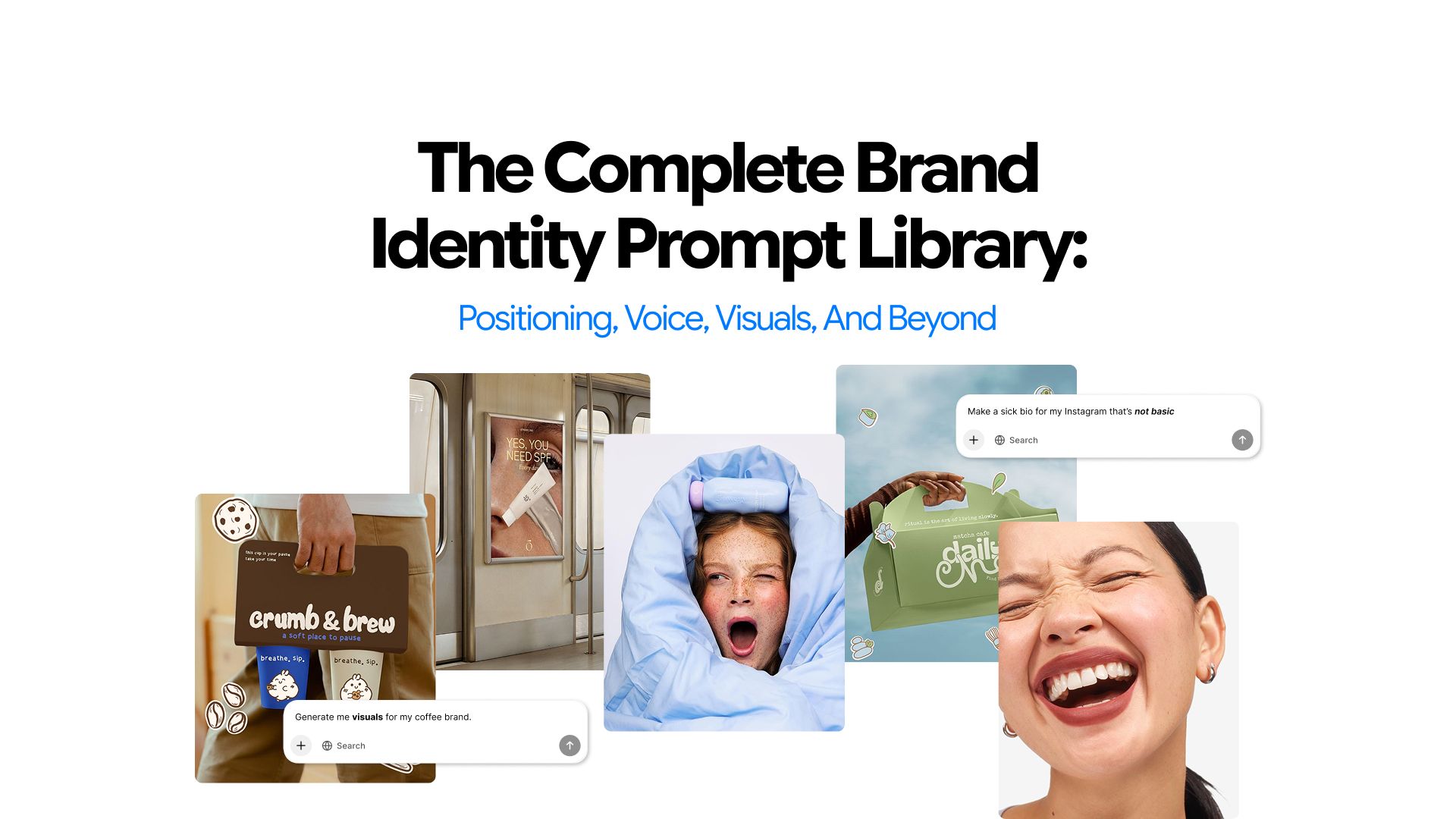
The Complete Brand Identity Prompt Library: Positioning, Voice, Visuals, and Beyond
Most AI prompts you find online are quite basic. They promise detail but fail at the first given opportunity. That’s because they are often too vague, too broad, and too disconnected from strategy to produce anything a real brand could use.
Building an effective prompt requires understanding of your audience, market, available resources, restraints, and much more. If you are vague about any of it, you are just burning through your tokens without achieving anything.
This library is different.
Every prompt below is built around a specific decision in the brand identity process, from foundational positioning to platform adaptation to documentation. If you want to understand the full system behind building a brand identity with AI before using these prompts, that context will make every output here significantly stronger.
How to Get the Most Out of These Prompts
AI works best with context. So, do not deprive it of it. You cannot just paste a prompt in your AI chat tool and expect it to produce what you want in isolation.
- Always paste your context before asking for output. The more specific your input, the more specific the result.
- Never accept the first answer. Push back, ask for alternatives, and request the AI argue against its own suggestion.
- Treat every output as a draft, not a deliverable. Refine it before it enters any document or guideline.
- Run related prompts in sequence. Positioning outputs feed voice prompts. Voice outputs feed platform prompts.
- When outputs feel generic, add a constraint. Tell the AI what you do not want as clearly as what you do.
Now let’s dive into some prompts that are going to transform your brand identity.
Positioning and Strategy Prompts
The foundation of any strong brand identity. These prompts produce the strategic decisions that every visual and verbal choice should connect back to.
Audience and market definition
"I am building a brand for [describe your product or service]. My target audience is [describe them, including their role, daily frustrations, goals, and how they currently solve the problem you address]. Describe this audience in depth, including what they read, how they evaluate tools in my category, and what language they use to describe their own problems."
Competitive gap analysis
"My three closest competitors are [list them]. Describe the positioning territory each one occupies across three dimensions: the audience they speak to, the emotional register they use, and the visual and verbal style they lead with. Then identify the positioning territory none of them are occupying that would be credible for a brand like mine."
Brand values extraction
"Based on this description of my product and audience [paste context], suggest five brand values. Each value must be specific enough to guide an actual content or design decision. Reject generic values like 'innovation' or 'trust' and replace them with values that have a concrete behavioral implication, for example 'radical transparency in pricing' or 'always written for the reader, never for the brand.'"
Emotional territory mapping
"What emotional state do I want my audience to feel immediately after encountering my brand for the first time? Give me five options across different emotional territories, from confident and empowered to relieved and understood. For each, explain what brand decisions would need to be true to produce that feeling consistently."
Full positioning statement
"Using this audience definition [paste], these brand values [paste], and this emotional territory [paste], write three versions of a positioning statement in this format: For [audience], [brand] is the [category] that [differentiator] because [reason to believe]. Make each version take a meaningfully different strategic angle and explain the trade-off of each."
Brand Voice and Verbal Identity Prompts
Verbal identity is where most brands lose coherence. These ChatGPT prompts for marketing cover every layer of voice definition, from characteristics to applied examples to messaging architecture.
Voice characteristic definition
"Based on my positioning [paste] and brand values [paste], define my brand voice in four distinct characteristics. Each characteristic should be a short phrase, not a single adjective. For each, write two sentences explaining what it means in practice."
Do and do not voice examples
"Take each of these voice characteristics [paste] and give me one example of copy that embodies it and one example of copy that violates it. Make the contrast sharp enough that a new team member could immediately understand the difference."
Tone matrix across contexts
"My brand voice is [paste characteristics]. Show me how the tone adapts across these six contexts without losing the underlying voice: a welcome email to a new user, an in-product error message, a response to a negative review, a LinkedIn post announcing a product update, a cold outreach email, and a homepage headline."
Messaging pillar development
"Based on my positioning and audience [paste both], define three messaging pillars for my brand. Each pillar should be a core strategic theme, not a tagline. For each pillar, write the central idea in one sentence, explain why it matters to my specific audience, and give two headline angles that express it."
Tagline and naming direction
"Using my positioning statement [paste] and brand voice [paste], generate ten tagline options. Group them into three strategic angles: outcome-focused, problem-aware, and identity-driven. Flag the two you consider strongest and explain why."
Visual Identity Prompts
Color palette strategy
"My brand is positioned as [paste]. My audience is [describe]. My competitors use these dominant colors [list them]. Recommend a primary, secondary, and accent color for my brand. For each color, explain the psychological association it carries, why it fits my positioning, and why it differentiates me from the competitive landscape I described."
Typography and personality
"My brand voice is [paste characteristics]. My visual direction should feel [describe]. Recommend two font pairings for headings and body text. For each pairing, describe the personality it communicates, the type of brand it typically signals, and whether that aligns with my positioning."
Logo concept direction
"I need to brief a designer on logo direction for my brand. My positioning is [paste]. My audience is [describe]. My visual references are [list any brands whose aesthetic territory I respect, with a note on what specifically I admire]. Write a logo direction brief covering: format approach, visual style, what the logo should communicate at a glance, and three things it must not look like."
Visual system coherence check
"I have made these visual decisions: color palette [paste], typography [paste], logo direction [paste]. Evaluate whether these decisions are internally coherent and aligned with my positioning [paste]. Identify any contradictions and suggest how to resolve them."
Platform-Specific Prompts
How to create a brand identity on social media requires more than applying your logo consistently. Each platform demands a different expression of the same underlying voice. These prompts build that adaptation layer deliberately.
LinkedIn brand voice adaptation
"My brand voice is [paste]. Write three LinkedIn post concepts that express this voice natively on the platform. Each post should lead with a strong first line, stay under 150 words, and connect to one of these messaging pillars [paste]. Avoid anything that reads like a press release or promotional announcement."
Instagram visual and copy direction
"My visual identity is [describe palette, style, and tone]. My brand voice is [paste]. Write a creative direction brief for my Instagram presence covering: the visual hierarchy of my feed, the role of copy in relation to visuals, caption length and style, and three content formats that would feel native to the platform while staying on brand."
X distilled brand voice
Website homepage positioning copy
"My positioning statement is [paste]. My primary audience is [describe]. Write three homepage headline and subheadline combinations. Each combination should establish who we are, who we are for, and why we are different, in under twenty words total. Then write a supporting paragraph of no more than fifty words that reinforces the headline without repeating it."
Pitch deck verbal register
"My brand voice is [paste]. I am writing a pitch deck for [describe investor type and stage]. Adapt my brand voice for this context, explaining how the tone should shift while staying recognizably mine. Then write the opening slide headline and the problem slide headline using this adapted register."
Product UI and onboarding copy
"My brand voice is [paste]. Write copy for these five product moments using this voice: empty state message when a user has no data yet, error message when a file upload fails, success message after completing onboarding, tooltip explaining a complex feature, and a re-engagement notification for inactive users."
Brand Documentation Prompts
An AI document generator turns scattered brand decisions into a single usable reference. These prompts feed that process directly, helping you structure and write the brand identity guide your team will actually use.
Full brand guide structure
"I have completed these brand decisions: positioning statement [paste], brand values [paste], voice characteristics [paste], tone matrix [paste], messaging pillars [paste], color palette [paste], typography [paste], logo direction [paste]. Generate a complete brand identity document using this information. Structure it with clear sections, concise language, and practical usage rules for each element."
Writing individual guideline sections
"Write the brand voice section of my brand identity guide using these voice characteristics [paste] and these do and do not examples [paste]. The section should be clear enough for a freelance copywriter with no prior context to apply it correctly on their first assignment."
Platform-specific guidance within the document
"Add a platform guidance section to my brand identity document covering LinkedIn, Instagram, X, website, and product UI. For each platform, include: the tone register, the content format approach, and two examples of on-brand copy. Base everything on my established voice [paste] and messaging pillars [paste]."
Stress-Testing and Refinement Prompts
These are the prompts most branding guides skip entirely. Use them after completing the layers above. Brands like Oatly and Stripe did not arrive at coherent, distinctive identities by accepting first drafts. They stress-tested decisions until the weak ones collapsed.
Argue against your own positioning
"Here is my current brand positioning [paste full positioning statement and values]. Now argue against it. What are the weakest assumptions behind this positioning? What would a skeptical competitor say about why this positioning will not hold? What audience segment would this positioning actively repel, and does that matter?"
Audit brand consistency across touchpoints
"Here is my brand voice [paste] and my positioning [paste]. I will give you copy from five different touchpoints [paste examples from website, social, email, product, and sales materials]. Evaluate the consistency of voice and positioning across all five. Identify where the brand drifts and suggest specific corrections."
Identify gaps between values and expression
"My stated brand values are [paste]. Here is a sample of my recent brand output across three channels [paste]. For each value, tell me whether the output actually demonstrates it, partially demonstrates it, or contradicts it. Be specific about which pieces of copy or content create the gap."
Use the Prompts. Build the System.
A prompt library is only as useful as the strategy behind it. These prompts produce strong outputs when they are fed strong context. Weak inputs produce weak brand identity, regardless of how sophisticated the AI is. Document every decision as you make it. That document is what makes the work compound over time.

Frequently Asked Question
Here is some more information on how you can create a perfect prompt for your brand identity.
More topics you may like
How to Create an Outstanding Resume Using AI Resume Builder (Secret Sauce = Chatly’s AI Docs)

Faisal Saeed
How to Build a Complete Brand Identity Using AI (A Practical System, Not Just Tools)
Faisal Saeed
How to Create a Presentation Using AI

Maya Collins
Brand Identity Examples: What the Best Brands Get Right and How to Replicate It With AI
Faisal Saeed
Why Document Creation Is Still Broken in 2026 — How AI Document Generators Are Fixing It
Faisal Saeed