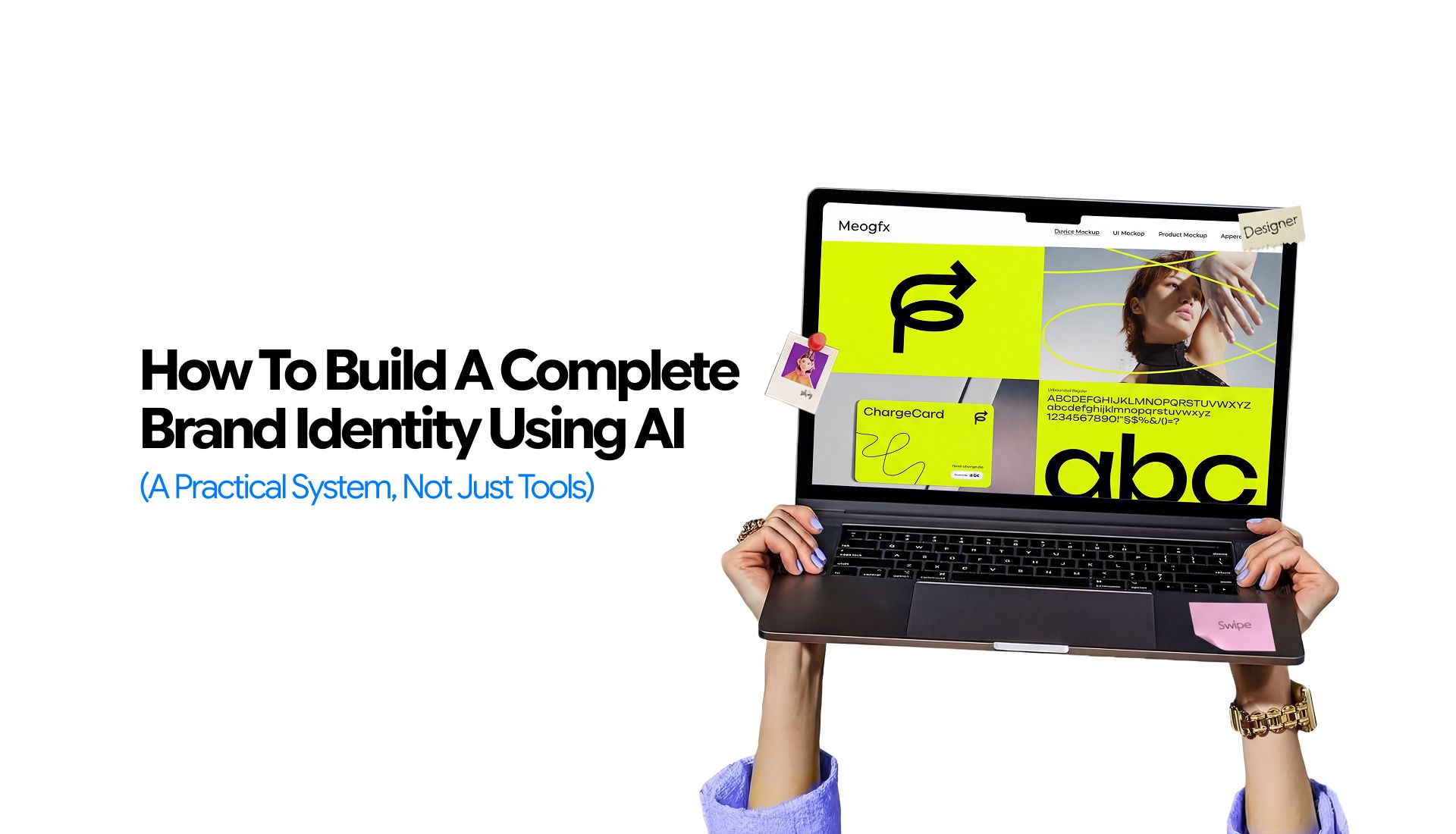
How to Build a Complete Brand Identity Using AI (A Practical System, Not Just Tools)
One of the biggest problems that professionals face with their brand identity is brand consistency.
They usually have everything ready.
The logo exists. The colors are picked. There might even be a font. But the voice shifts depending on who wrote the copy that week. The LinkedIn page feels corporate while the website feels casual. The pitch deck looks like it belongs to a different company entirely.
While it might not seem like a big issue, it confuses your target audiences and fails to build a level of trust that can earn brand loyalty.
When we say “use AI to build brand identity,” we do not mean replacing one or two processes and expecting landslide changes. We mean careful integration to build a comprehensive system that understands your brand and its values.
What Brand Identity Actually Covers
Before getting into the how, it is worth being precise about scope because most people underestimate it.
Brand identity is not just your logo or slogan. It is the complete set of decisions that determine how your brand looks, sounds, and positions itself across every touchpoint.
There are three layers.
Visual Identity
This is what most people start with, and sadly stop at. It includes logo, color palette, typography, iconography, and design style. This is the most visible layer but not the most important one.
Verbal Identity
This is where most brands fall apart. It covers brand voice, tone guidelines, messaging pillars, taglines, and the specific language patterns you use consistently. A brand can have a beautiful visual identity and completely lose people the moment they read a sentence.
Positional Identity
This is the strategic foundation underneath both. It defines who you are for, what you stand for, how you are different, and what emotional territory you own. Without this layer, visual and verbal decisions are just guesswork.
AI can help you build all three. But the order matters.
The AI-Powered Brand Identity System
The biggest mistake people make when figuring out how to create a brand identity with AI is jumping straight to visuals. They generate logos, pick color palettes, and then try to reverse-engineer a strategy to justify the choices they already made.
But the one thing AI is best at is strategy and executing your vision. So, instead of forcing your vision on it, work in collaboration and refine ideas.
Build the foundation first. The creative output becomes significantly stronger when it is anchored to clear strategic decisions.
Here is the full system, layer by layer.
Layer 1: Positional Foundation
This is the work most founders skip because it feels abstract. AI makes it faster and more concrete.
Start with a positioning prompt. The goal is to force clarity on four things: who you serve, what problem you solve, how you are different, and what you want people to feel when they encounter your brand.
Use a prompt like this:
"I am building a brand for [describe your product or service]. My primary audience is [describe them specifically, including their role, frustrations, and goals]. My three closest competitors are [list them]. What positioning territory is available to me that they are not occupying? What emotional and functional differentiation should I build my brand around?"
Do not accept the first output. Push back. Ask AI to argue against its own suggestion and offer an alternative positioning angle. The friction produces better thinking.
Once you have a positioning direction, extract three things from it.
- A single positioning statement in the format: "For [audience], [brand] is the [category] that [differentiator] because [reason to believe]."
- Three to five brand values that are specific enough to actually guide decisions. "Innovation" and "trust" are not brand values. "Radical transparency in pricing" is a brand value.
- The emotional territory you want to own. Not what you do, but how you want people to feel. Confident. Relieved. Empowered. Ambitious. Pick one or two and be deliberate.
This output becomes the brief for everything that follows.
Layer 2: Verbal Identity
Most AI branding guides skip straight from positioning to visuals. That is a mistake. Verbal identity deserves its own dedicated layer because it is what your audience reads and hears every single day.
Brand Voice vs. Tone
Voice is consistent. It is the personality of your brand and it does not change. Tone is contextual. It shifts depending on the situation, the platform, and the audience's emotional state.
Use AI to define both with precision.
For voice, use this prompt:
"Based on this positioning [paste your positioning statement and values], describe my brand voice in three to five distinct characteristics. For each characteristic, give me one example of what it sounds like in practice and one example of what it does not sound like. Make the contrast sharp."
The "does not sound like" column is critical. It prevents drift. When a new team member writes a copy, they need to know not just what the brand voice is but what it is not.
For tone, map it across contexts. Your brand voice does not change, but the way it expresses itself does.
Use AI to generate a tone matrix:
"How should my brand voice adapt when writing: a welcome email to a new user, an error message in the product, a LinkedIn post about a company milestone, a cold outreach message, and a response to a negative review?"
Each of these situations requires a different emotional register while staying anchored to the same underlying voice.
Messaging Pillars
Messaging pillars are the three to four core ideas your brand consistently communicates across all content. They are strategic themes that every piece of content should connect back to.
Use this prompt:
"Based on my positioning and brand values [paste them], what are the three to four messaging pillars I should build all my content around? For each pillar, give me the core idea, why it matters to my audience, and two example headline angles that express it."
Once these are defined, every blog post, ad, social caption, and sales email has a strategic anchor.
Layer 3: Visual Identity
With positioning and verbal identity established, visual decisions become much easier to make and much easier to defend.
Color Psychology
Do not just pick colors you like. Use AI to make the decision strategic.
Prompt:
"My brand is positioned as [paste positioning]. My target audience is [describe them]. My three brand values are [list them]. Based on this, recommend a color palette with a primary color, a secondary color, and an accent color. For each color, explain the psychological association it carries and why it fits my positioning. Also tell me what colors my competitors are using and why I should differentiate."
Research your competitors' palettes manually first, then feed that information into the prompt. AI will give you a more differentiated recommendation when it knows what territory is already occupied.
Typography
Typography carries more personality than most people realize. A serif font signals authority and tradition. A geometric sans-serif signals modernity and precision. A humanist sans-serif signals approachability.
Use AI to narrow down your choices:
"My brand voice is [describe it]. My visual direction is [describe it]. Recommend two to three font pairings for headings and body text. For each pairing, explain what personality it communicates and whether it aligns with my brand positioning."
Then test the shortlist using tools like Google Fonts or Fontpair before making a final decision.
Logo Direction
An AI design assistant that respects brand identity does not replace your designer. It sharpens your brief before you ever speak to one.
Use AI image generation tools like Chatly to explore visual directions quickly. Generate ten to twenty variations across different visual styles. Use that exploration to identify which aesthetic territory feels right, then brief a designer with that reference material. This cuts design rounds significantly and makes your brief much stronger.
Layer 4: Brand Documentation
This is where most brand identity efforts collapse. The positioning is defined. The voice is documented somewhere in a Google Doc. The visual assets live in a Figma file. But nobody is using any of it consistently because it is scattered, inaccessible, or too long to read.
Knowing how to create a brand identity guide is one thing. Having a system that actually produces and maintains it is another.
An AI document generator solves this directly. Instead of manually compiling decisions across scattered files, you use AI to consolidate everything into a single structured Brand Identity Document that is clear, concise, and built to be referenced.
The document should include:
- Positioning statement and brand values
- Voice characteristics with do and do not examples
- Tone matrix across key communication contexts
- Messaging pillars with example headlines
- Color palette with hex codes and usage rules
- Typography pairings with hierarchy guidelines
- Logo usage rules including spacing, background rules, and what not to do
- Platform-specific guidance for your key channels
This document becomes the single source of truth. Designers reference it. Copywriters reference it. New hires get it on day one. When you brief an agency or a freelancer, you send them this document and the quality of work you receive back improves immediately.
How to Create a Brand Identity on Social Media
Here is something most brand guides do not address: the same brand identity needs to express itself differently depending on where it appears. This is not an inconsistency but intelligence.
Your brand voice does not change. How it shows up does. Understanding this distinction is what separates brands that feel cohesive everywhere from brands that feel robotic or awkward on certain platforms.
The tone leans professional but not stiff. First-person works well. Short paragraphs perform better than long ones. Visual identity should be consistent but content format needs to match the platform's native style.
Instagram is visual-first. Your verbal identity takes a supporting role here. Copy is shorter, hooks are faster, and the visual language carries more of the brand weight.
Your color palette and visual style need to be immediately recognizable in a feed. Consistency across posts matters more here than on any other platform. This is where a well-defined visual identity pays off most directly.
X (Twitter)
X rewards sharp, opinionated, and fast thinking. Your brand voice here needs to distill down to its most confident and direct form. There is no room for nuance in 280 characters.
Use your messaging pillars to guide what you post about. Use your voice characteristics to guide how you say it. The constraint of the platform will force clarity that often improves your brand communication overall.
Website
Your website is where your full brand identity is expressed at its highest fidelity. Every layer is present: visual, verbal, and positional. This is where messaging pillars should be most explicitly expressed and where positioning should be clearest.
The homepage needs to do three things fast: establish who you are, establish who you are for, and establish why you are different.
Pitch Deck
A pitch deck is your brand in a persuasion context. The visual identity should be clean and consistent. But the verbal identity shifts toward a more confident, forward-looking register because you are writing for an investor who is pattern-matching against hundreds of other decks.
The voice remains yours. The density and intent changes.
Product UI and Onboarding
This is the most overlooked brand touchpoint. The copy inside your product, including button labels, empty states, error messages, tooltips, and onboarding flows, is a direct expression of your verbal identity.
Brands that have a warm, direct voice externally and then use cold, generic system language inside their product create a jarring disconnect. Use your tone matrix here. Define how your brand speaks in a product context specifically.
Your AI Brand Identity Toolkit
It’s time for you to start leveraging everything great about AI systems. Here is everything consolidated so you can start immediately.
Prompt Library
A predefined, detailed brand identity prompt library can be a powerful and time-saving asset.
- Positioning prompt: Define audience, problem, competitors, and differentiation
- Brand values prompt: Extract specific, actionable values from positioning
- Voice definition prompt: Three to five characteristics with do and do not examples
- Tone matrix prompt: Adapt voice across five to six key communication contexts
- Messaging pillars prompt: Three to four strategic themes with headline examples
- Color palette prompt: Strategic color selection tied to positioning and audience
- Typography prompt: Font pairing recommendations tied to brand personality
- Platform adaptation prompt: How voice and visuals adapt for LinkedIn, Instagram, X, website, pitch deck, and product UI
AI Tools That Ensure Consistent Brand Identity
Different tools handle different layers. Here is how to think about the stack.
- Strategic and verbal layer: Claude or ChatGPT for document analysis and positioning, voice definition, messaging pillars, and tone matrices. Use Chatly if you need more models on a tighter budget.
- Visual exploration layer: AI image generators like Chatly for logo direction and visual concept testing. Midjourney and Adobe can be other specialized tools.
- Color and typography layer: Khroma for AI-assisted color palette generation, Google Fonts for typography testing.
- Documentation layer: An AI document generator to consolidate all decisions into a structured, shareable brand guide. Chatly will help here as well.
No single tool covers every layer. The system works because each tool handles what it is best at, and documentation ties everything together.
Brand Identity Document Checklist
Before your brand guide is complete, confirm it includes:
- Positioning statement
- Brand values with definitions
- Voice characteristics with examples
- Tone matrix
- Messaging pillars
- Color palette with hex codes and usage rules
- Typography with hierarchy guidelines
- Logo usage rules
- Platform-specific guidance
Review Trigger
Set a reminder to review your brand identity document every six months or any time you enter a new market, launch a new product line, or shift your target audience. AI makes updating it fast. The discipline is showing up to do it.
Ready to Create Stunning Brand Identity With Chatly?
Brand identity built with AI is not a shortcut. It is a more structured, more deliberate way of making decisions that usually get made inconsistently or skipped entirely.
The system works because it moves in the right order. Positioning before visuals. Verbal identity before design. Documentation before distribution.
Every layer informs the next. And when everything is consolidated into a single brand document generated and maintained with AI, the output is not just a prettier brand. It is a brand that scales without losing coherence.
That document is the asset. Build it once, use it everywhere, and update it as you grow.
Frequently Asked Question
Still need more? Here is some information for you to master brand identity.
More topics you may like
What are AI Presentation Makers? How Are They Making a Bigger Impact With Better Slides?

Maya Collins
From Prompt to Deck in 30 Minutes – Winning AI Presentation Maker Workflow

Elena Foster

AI Presentation Maker vs PowerPoint: Why the Old Way Is Costing You More Than You Think

Lucas Reinhardt
Why Document Creation Is Still Broken in 2026 — How AI Document Generators Are Fixing It

Faisal Saeed
What Is Chat PDF? How to Chat With PDFs, Summarize Files, and Find Answers Faster
Elena Foster