Can You Ask AI to Predict Your Exam Questions?
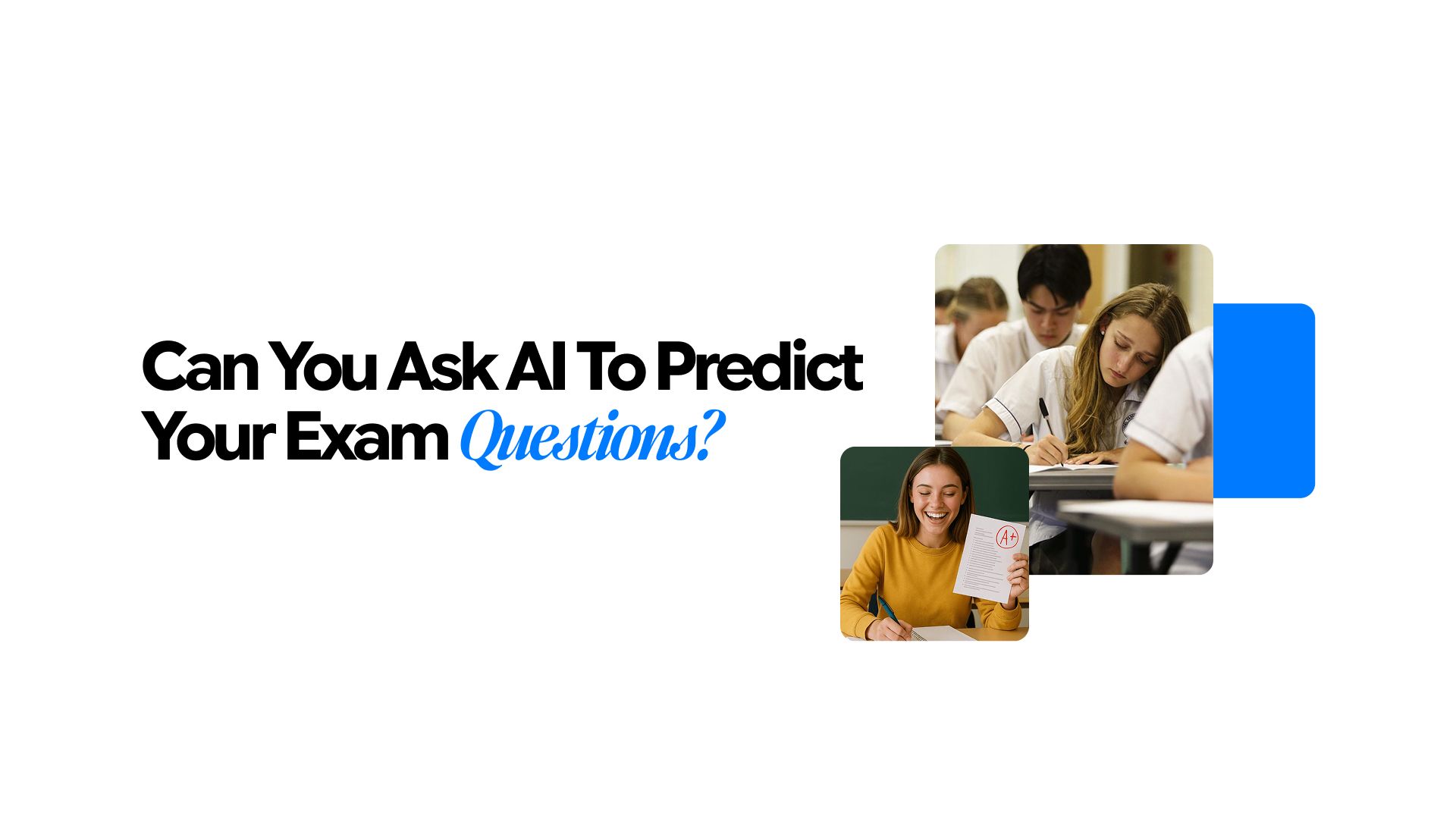
Exam season is here. You have more material than you can realistically cover, less time than you need, and the pressure of not knowing what will actually show up on the exam.
What to prepare and what to leave out?
Studying everything equally is inefficient. Guessing blindly is risky and a down right gamble.
So the question most students eventually ask is: what if there was a smarter way to figure out what matters most?
Now you can just ask AI. Not because it can read your professor's mind, but because it can do something genuinely useful. It can analyze your material, surface patterns, and help you study with direction instead of panic.
This article breaks down exactly what AI can and cannot do when it comes to exam prediction, and how to use it in a way that actually improves your results.
Why Students Are Looking at AI Differently Now
Exam prep has always involved some form of prediction. Students highlight recurring topics and dig through past papers to try and reverse-engineer what a professor finds important.
The process itself is not new. What is new is the scale at which AI can do it.
Where a student might spend two hours skimming through lecture notes looking for patterns, AI can process the same material in seconds. It can cross-reference topics, identify what appears repeatedly, and organize information by weight and relevance.
That is a meaningful shift in how preparation can work.
More students are now uploading syllabi, notes, and reading lists to AI tools and asking direct questions about what to prioritize. The results are not perfect, but they are often more useful than studying without any direction at all.
What AI Can Actually Do Well
Understanding the extent of what you can ask AI sets the right expectations.
Identifying High-Frequency Topics
When you feed AI your lecture notes, a course syllabus, or a set of past papers, it can identify which topics appear most frequently. Concepts that show up across multiple weeks, in different formats, or with varying levels of detail are almost always examinable.
AI does not guess at this. It reads the volume and repetition of information and reflects it back to you in a prioritized way.
Generating Practice Questions
This is one of the most underused applications. Once AI understands the subject and the material you have provided, it can generate practice questions that mimic the logic of real exam questions.
For conceptual subjects, this means essay prompts, case-based scenarios, and definition questions. For applied subjects, it means worked problems, application exercises, and multi-step reasoning questions.
Summarizing Dense Material Into Testable Concepts
Long academic texts often contain one or two genuinely examinable ideas buried inside pages of context. AI is good at pulling those out.
Instead of reading a lengthy research paper or chapter and hoping you identified the right things, you can ask AI to tell you what the core testable concepts are. That alone saves hours.
The Honest Limitations
AI prediction is useful. It is not magic, and treating it like magic is where students get into trouble.
It Does Not Know Your Specific Examiner
AI works with the material you give it. It does not know how your professor writes questions, what they emphasized in a lecture you skimmed, or what their personal academic interests are.
Pattern recognition based on publicly available knowledge and your notes is valuable. But it is not the same as insider information.
Prediction Is Probability, Not Certainty
Even the best-prepared prediction is still a probability estimate. High-frequency topics are likely to appear. That does not mean low-frequency topics will not.
Students who only study AI-generated question lists often leave out the topics that fall slightly below the threshold of "probably on the exam." Those topics sometimes show up anyway, and they are the ones that separate a strong grade from a disappointing one.
Over-Reliance Creates a False Sense of Readiness
There is a specific kind of exam anxiety that comes not from under-preparing, but from preparing the wrong way. A student who has read AI summaries repeatedly can feel ready without actually being able to retrieve, apply, or explain the material under pressure.
AI is a preparation tool. It works best when it makes you do more thinking, not less.
How to Use AI Smartly for Exam Preparation
The students who get real results from AI-assisted studying are not the ones who ask "what will be on my exam?" They are the ones who use AI to structure a smarter study process.
Here is a practical framework that works.
- Start with your syllabus and lecture notes. Give AI the full picture of your course. Ask it to identify the topics that appear most consistently and the ones that are given the most instructional weight. This becomes your priority list.
- Request a question bank, not just a summary. Summaries are useful for review. Practice questions are useful for preparation. Ask AI to generate 10 to 15 questions per major topic, across different formats. Multiple choice, short answer, and long-form explanation questions all test knowledge differently.
- Use it to quiz yourself actively. Do not just read the questions. Answer them out loud or in writing, then ask AI to evaluate your response. Ask it where your answer was incomplete, what you missed, and how you could have framed it better.
- Revisit weak areas with targeted follow-ups. If you consistently struggle to answer questions on a particular concept, ask AI to explain it from a different angle. Ask for a simpler version, a practical example, or an analogy. Repetition with variation is how understanding actually forms.
- Run a final prediction review 48 hours before the exam. At this stage, ask AI to give you its top 10 most likely question themes based on everything you have shared. Use this as a confidence check, not as a shortcut.
The Subjects Where This Works Best
AI-assisted exam prediction is not equally useful across every subject. Knowing where it performs best helps you apply it where it will actually move the needle.
Conceptual and Essay-Based Subjects
History, business, law, psychology, sociology, and philosophy are all well-suited for AI prediction. These subjects are built on recurring arguments, frameworks, and case studies. AI can identify those patterns clearly and generate questions that closely mirror what real exams test.
For these subjects, being able to predict 70 to 80 percent of the topic areas with reasonable confidence is genuinely achievable with the right approach.
STEM and Calculation-Based Subjects
AI is less effective at predicting specific problems in mathematics or physics, but it is still useful. It can identify which formulas appear most frequently, which types of applied problems are common, and which theoretical concepts tend to accompany calculation questions.
For STEM students, AI works best as a concept-clarification and practice-question tool rather than a strict prediction engine.
What Good AI-Assisted Exam Prep Actually Looks Like
There is a clear difference between a student who uses AI well and one who uses it as a substitute for real preparation.
The student who uses it well treats AI as a study partner. They bring their own material, engage actively with the output, test themselves against it, and use it to identify gaps rather than to feel like they are done.
The student who uses it poorly pastes in their notes, reads the summary once, saves the question list without answering it, and tells themselves they are ready.
The tool is the same. The approach is entirely different. And in an exam room, that difference is obvious.
A productive AI study session looks like this: one hour, one topic, genuine back-and-forth. You answer questions, get feedback, ask follow-ups, and leave that session knowing the material better than when you started. That is what AI-assisted preparation is actually supposed to feel like.
Conclusion
Can AI predict your exam questions? Not with certainty. But it can do something more valuable than guessing.
It can help you understand your material deeply enough that the questions do not matter as much. When you know a subject well, almost any question becomes answerable. AI accelerates the process of getting there.
Tools like Chatly are built for exactly this kind of preparation. The ability to upload your material, interact with it directly, get quizzed on it, and revisit it from different angles is what separates passive review from active readiness.
If you have an exam coming up, start with your syllabus. Feed it into an AI tool. Ask the right questions. Then do the work of actually answering them.
That is not a shortcut. It is just a smarter way to prepare.
Frequently Asked Question
Before you start, here is some additional information to get you started with the tool.
More topics you may like
Chat PDF vs ChatGPT for Document Analysis: Which One Works Better for PDFs?

Maya Collins
Why Ask AI Is Replacing Google Search

Daniel Mercer
Why PDFs Are Hard to Read, Search, and Understand

Elena Foster
What Is Chat PDF? How to Chat With PDFs, Summarize Files, and Find Answers Faster
Elena Foster
We Asked AI to Explain One of the Most Important and Complex Research Papers. Here's What Happened.
Daniel Mercer