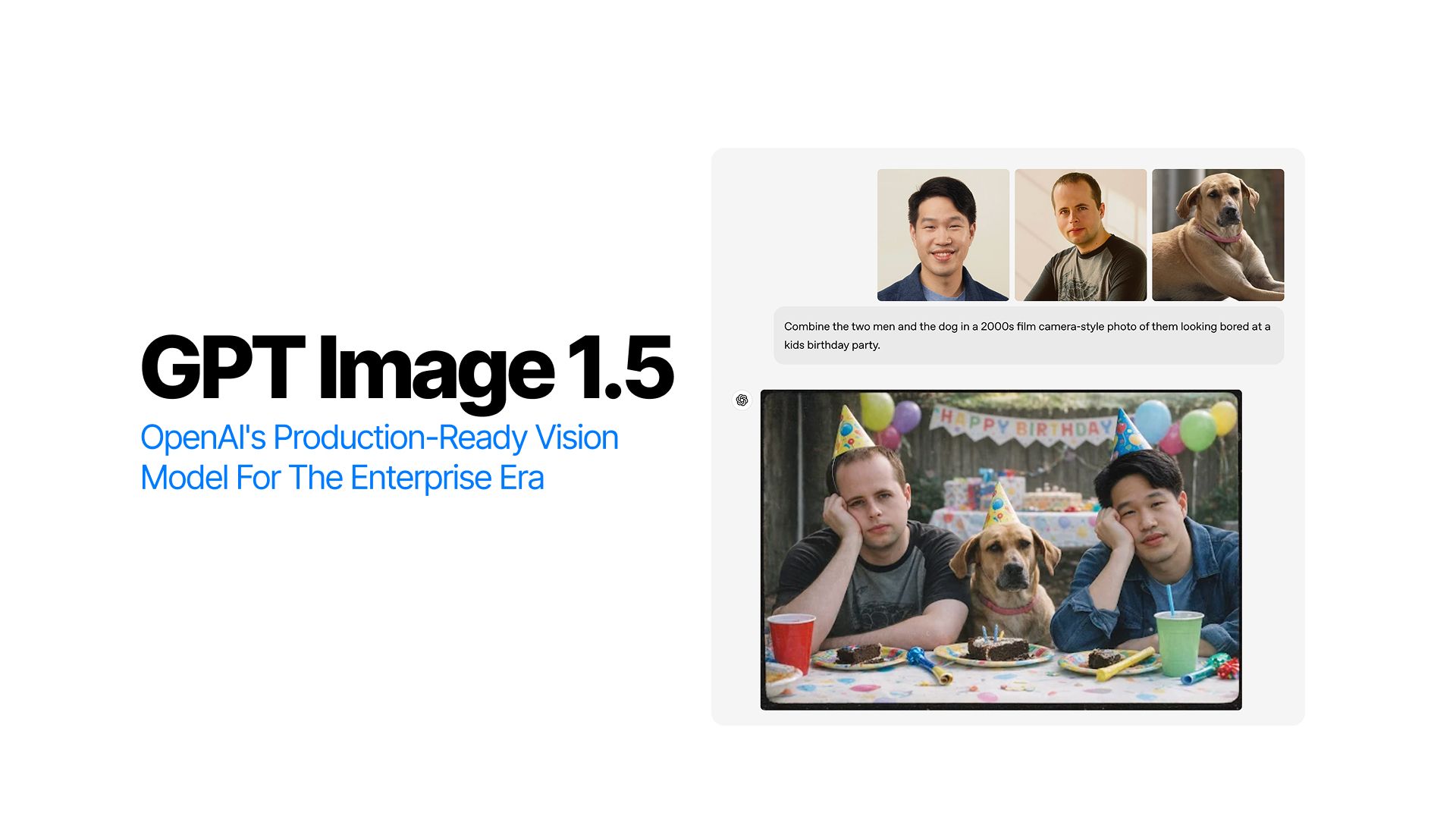
GPT Image 1.5: OpenAI's Production-Ready Vision Model for the Enterprise Era
While everyone was too busy observing the LLM war, OpenAI was busy perfecting its image generation capabilities.
- Speed
- Precision
- Cost-efficiency
- Seamless integration into existing workflows
Whether you're a solo creator designing social media assets or an enterprise team building product catalogs, GPT Image 1.5 represents a fundamental shift in how AI vision models serve real-world applications.
In this comprehensive guide, we'll explore what makes GPT Image 1.5 stand out, how it compares to leading competitors, and what it means for the future of multimodal AI.
What is GPT Image 1.5?
GPT Image 1.5 is OpenAI's latest multimodal vision model, launched on December 16, 2025. Unlike its predecessors DALL-E and GPT Image 1, which positioned themselves primarily as creative exploration tools, GPT Image 1.5 is explicitly designed as a production-ready system for professional workflows.
The model is available to all ChatGPT users and through OpenAI's API, with integration across Microsoft's Foundry platform for enterprise deployments.
The release represents more than just an incremental update.
Google's Nano Banana Pro launched on November 20, 2025 and quickly gained traction in enterprise circles for its superior text rendering and integration with Google Cloud services. ByteDance's Seedream 4.5 further intensified competition with its native 4K generation capabilities and character consistency features that appealed to content creators and animation studios.
GPT Image 1.5 emerged from this competitive crucible with a focused value proposition which was delivering enterprise-grade reliability without sacrificing creative flexibility.
What are GPT Image 1.5’s Key Features and Capabilities
OpenAI has packed GPT Image 1.5 with features that address the real pain points enterprises and creators face when working with AI-generated visuals. From precise editing controls to blazing-fast generation speeds, the model represents a fundamental rethinking of what production-ready AI image generation should deliver.
Enhanced Editing Precision and Element Preservation
The defining characteristic of GPT Image 1.5 lies in its enhanced editing precision.
The model demonstrates remarkable ability to follow specific instructions while preserving critical visual elements like facial features, lighting conditions, compositional balance, and brand logos. This precision addresses the unpredictability that made AI image generators unsuitable for professional work where brand consistency and specific visual requirements are non-negotiable.
For businesses managing established brand identities, this capability transforms AI from an experimental tool into a reliable asset creation system. The model can modify backgrounds, adjust color schemes, or change individual elements while maintaining the integrity of protected brand assets like logos or mascots.
Single-Turn Editing Excellence
GPT Image 1.5 excels at single-turn editing requests that previous models would struggle with through multiple iterations. While earlier systems often required three, four, or even five attempts to achieve desired results, GPT Image 1.5 can execute complex edits in one go.
For example, a user can request "change the background to a sunset beach while keeping the subject's pose and clothing exactly the same" and expect faithful execution without the frustrating back-and-forth that characterized earlier workflows.
This capability dramatically reduces the time from concept to final asset, transforming AI image generation from an exploratory process into a reliable production tool.
Marketing teams can cut their asset creation time by 60-70% compared to workflows using previous generation models. The elimination of iteration loops also reduces API costs significantly, as businesses pay per generation rather than per successful output.
Four Times Faster Generation Speeds
Performance improvements represent another major leap forward that fundamentally changes how teams can use AI image generation.
GPT Image 1.5 generates images up to four times faster than GPT Image 1, with generation times often under 10 seconds for standard requests. This speed enhancement changes workflow possibilities and enables entirely new use patterns.
- Designers can now iterate in real-time during client meetings, generating and refining concepts while stakeholders watch and provide immediate feedback.
- Marketers can generate multiple campaign variations in minutes rather than hours, allowing A/B testing of dozens of visual approaches before committing resources to production.
- Product teams can explore dozens of UI mockup concepts in a single brainstorming session, accelerating product development cycles.
The model also offers quality-latency tradeoffs, allowing users to prioritize speed for draft iterations or quality for final outputs, giving teams flexibility to match generation parameters to specific workflow needs.
Advanced Text Rendering Capabilities
Text rendering capabilities mark a particularly significant advancement and solve major pain points. Where earlier models struggled with anything beyond simple, large lettering, GPT Image 1.5 handles dense text blocks, small font sizes, and complex layouts with impressive fidelity.
This breakthrough enables use cases that were simply impossible with previous generation models:
- Infographics with multiple data points and statistical annotations
- UI mockups with realistic interface text and navigation labels
- Marketing materials with product descriptions and pricing information
- Social media posts with integrated copy and hashtags.
The model supports multilingual text rendering across major world languages, making it viable for global campaigns without requiring separate localized versions or language-specific models.
Typography rendering now extends to complex layouts including tables, charts with labels, and multi-column designs. For content creators and marketing teams, this capability eliminates the need for separate design passes to add text overlays, streamlining workflows and reducing the number of tools required in production pipelines.
Built-in Reasoning and World Knowledge
Most of the image generation models out there only understand the image description provided to them. That restricts their capabilities and forces the user to be extremely specific with their prompts.
GPT Image 1.5 changes all that with built-in reasoning and world knowledge integration.
When a user references "Bethel 1969," the model understands this refers to Woodstock and generates appropriate visual context including muddy fields, peace symbols, vintage aesthetics, tie-dye clothing, and the characteristic atmosphere of that historic music festival.
This contextual intelligence extends far beyond isolated examples to encompass:
- Cultural references
- Historical events
- Architectural styles
- Geographic locations
- Brand associations across human knowledge
It's comparable to having a knowledgeable creative partner who understands implicit context rather than a tool that requires explicit specification of every single detail.
A prompt like "Victorian London street scene" automatically incorporates appropriate clothing styles, architecture, lighting, weather conditions, and social elements without users needing to specify "gas lamps, cobblestones, horse-drawn carriages, fog, top hats" and dozens of other period-appropriate details.
This world knowledge enables more natural, conversational prompting and dramatically reduces the expertise barrier for non-technical users who may not know how to construct detailed visual prompts.
GPT Image 1.5 vs Competitors
Understanding how GPT Image 1.5 stacks up against alternatives like Nano Banana Pro and Seedream 4.5 is crucial for developing an efficient and smooth creative workflow. Each model brings distinct strengths and tradeoffs that make them better suited for different use cases and organizational contexts.
GPT Image 1.5 vs Google's Nano Banana Pro
The comparison between GPT Image 1.5 and Google's Nano Banana Pro reveals distinct approaches to multimodal AI that extend beyond mere feature comparisons.
Nano Banana Pro launched with strong integration into Google Cloud services, making it particularly attractive for enterprises already invested in that ecosystem who want seamless workflows across Google Workspace, BigQuery, and other Google enterprise tools. Its text rendering initially set industry benchmarks when it launched in November 2025, though GPT Image 1.5 has largely closed that gap with its December release.
GPT Image 1.5 offers broader compatibility through its API-first approach and Microsoft partnerships. For organizations with heterogeneous tech stacks or those seeking vendor diversification, GPT Image 1.5's platform-agnostic approach provides more flexibility.
The choice often comes down to existing infrastructure investments and strategic technology partnerships rather than pure capability differences.
Performance benchmarks between the two platforms show mixed results depending on specific use cases and evaluation criteria.
- Nano Banana Pro generally produces more photorealistic results for natural scenes and portraits, with particularly strong performance in lighting simulation, material rendering and complex shadow interactions.
- GPT Image 1.5 demonstrates superior instruction following for specific editing tasks and better preserves elements like logos, text, and facial features during iterative editing sessions.
Pricing represents another crucial distinction that impacts total cost of ownership as GPT Image 1.5 is considered more affordable for enterprises.
- Low-res (1024x1024): GPT $0.009; Nano $0.134 – GPT 93% cheaper.
- Medium-res (2K): GPT $0.034; Nano $0.139 – GPT ~75% cheaper.
- 500 images/month (medium): GPT ~$20; Nano $67 – GPT wins.
- High-res 4K enterprise: Nano $0.12 (batch) cheaper; GPT not offered.
- 1K scale: Comparable at $0.15-$0.17 each.
GPT Image 1.5 vs ByteDance's Seedream 4.5
- Its native 4K generation capability produces notably higher resolution outputs; GPT Image 1.5 maxes out at roughly 2K resolution.
- Seedream 4.5's character consistency features allow users to generate multiple images of the same character in different poses, expressions, and settings; a capability that remains challenging for GPT Image 1.5.
- For storyboarding, character design sheets, and animated content development, Seedream 4.5 holds distinct advantages that make it the preferred choice in entertainment vertical markets.
- The model also excels at stylistic consistency, allowing creative directors to establish a visual style guide and have that aesthetic applied reliably across hundreds or thousands of generated assets.
However, Seedream 4.5's impressive capabilities come with significant tradeoffs that limit its applicability for certain workflows and use cases.
- Generation times run significantly longer than GPT Image 1.5, often 30-60 seconds per image versus 10 seconds.
- The model also requires more detailed and technically sophisticated prompting to achieve desired results, creating a steeper learning curve that necessitates dedicated training for team members.
- Typography rendering, while improving with each update, still lags behind both GPT Image 1.5 and Nano Banana Pro.
- Seedream 4.5 lacks the broad enterprise integrations and API ecosystem that make GPT Image 1.5 and Nano Banana Pro attractive for business deployments. There's no equivalent to Microsoft Foundry or Google Cloud integration.
Technical Improvements Over GPT Image 1
While user-facing features capture most of the attention, the technical improvements underlying GPT Image 1.5 represent equally significant advancements in AI engineering. OpenAI has fundamentally re-architected the model's inference pipeline, API capabilities, and quality control systems to deliver enterprise-grade reliability.
Architectural Enhancements and Efficiency Gains
The architectural enhancements in GPT Image 1.5 extend beyond user-facing features into fundamental improvements in model efficiency and computational capability.
While OpenAI hasn't disclosed complete technical specifications (as is typical for competitive reasons), the 4× speed improvement suggests significant optimization in model architecture, inference infrastructure, or both.
The ability to maintain or improve output quality while dramatically reducing generation time indicates advances in diffusion model efficiency or potentially hybrid approaches that combine different generation strategies.
Industry analysts speculate that OpenAI may have implemented novel attention mechanisms that reduce computational complexity without sacrificing output fidelity. The speed improvements also suggest potential use of model distillation techniques, where a smaller, faster model learns to replicate the outputs of a larger teacher model.
Whatever the specific technical approaches, the practical result is that GPT Image 1.5 can serve far more users concurrently on the same infrastructure, improving both user experience and OpenAI's unit economics.
Strategic Cost Reduction and Competitive Pricing
The 20% lower token rates and the consequent cost reduction compared to GPT Image 1 reflects both computational efficiency gains and OpenAI's strategic pricing decisions to remain competitive in an increasingly crowded market.
The pricing strategy acknowledges that at enterprise scale, even small per-image cost differences compound into substantial budget impacts that influence platform selection decisions.
The combination of lower costs and faster generation means the effective cost per hour of productive work drops by potentially 70-80% compared to GPT Image 1.
Enhanced API Capabilities for Developer Integration
API improvements make GPT Image 1.5 significantly more developer-friendly than its predecessor, addressing pain points that limited production deployment of earlier versions.
- Enhanced parameter controls allow fine-tuning of generation characteristics like style strength, adherence to prompts, and quality-speed tradeoffs, giving developers the flexibility to optimize for different use cases within a single application.
- Better error handling and status reporting enable more robust production systems that can gracefully handle failures, provide meaningful user feedback, and implement retry logic for transient issues.
- The API now supports batch processing for large-scale generation tasks, crucial for applications like e-commerce catalog generation where thousands of product images need consistent styling and backgrounds generated overnight.
- Webhook support allows asynchronous generation patterns where applications submit generation requests and receive callbacks when images complete, preventing timeout issues for long-running generations.
These developer experience improvements significantly reduce the engineering effort required to build production-quality applications on top of GPT Image 1.5.
Flexible Quality Settings for Different Workflows
Quality settings provide unprecedented flexibility for different use cases, acknowledging that optimal performance characteristics vary dramatically across applications.
- Users can opt for "fast" mode when exploring concepts during brainstorming sessions, accepting slightly lower quality in exchange for near-instantaneous feedback that enables rapid iteration.
- "Balanced" mode serves most production work, providing strong quality at reasonable generation times for everyday marketing materials, social media content, and product visualization.
- "Quality" mode applies when final output fidelity is paramount like for print materials, large displays, or client presentations where every detail matters.
This tiered approach acknowledges that not every generation requires maximum computational investment.
The ability to seamlessly switch between quality levels within the same workflow represents a maturation of AI image generation from monolithic tool to adaptable system that conforms to human creative processes rather than forcing users to adapt to rigid technical constraints.
Real-World Use Cases: From Concept to Production
GPT Image 1.5 is not limited to any audience and can be used across multiple industries and use cases.
E-Commerce & Product Catalog Generation
E-commerce and product catalog applications represent one of the most immediate and tangible business benefits of GPT Image 1.5.
- Retailers can generate consistent, high-quality product imagery across thousands of SKUs without relying on traditional photoshoots.
- Products can be placed into realistic lifestyle environments while maintaining consistent lighting, perspective, and branding.
This allows customers to better visualize how a product fits their personal style and space. The speed and cost efficiency of GPT Image 1.5 make this approach accessible even to mid-market and small retailers who previously couldn’t afford extensive photography budgets.
Marketing & Brand Asset Creation
GPT Image 1.5’s strong prompt adherence and improved text rendering enable teams to generate campaign visuals with integrated copy, logos, and brand elements in a single step. Marketers can explore dozens of creative directions, different moods, layouts, and visual styles before committing to full production.
Brand consistency is a key advantage.
Logos, color palettes, typography styles, and overall visual identity can be preserved while varying execution across channels and regions. This makes GPT Image 1.5 suitable not just for early ideation, but for ongoing campaign production.
Small businesses gain access to professional-quality marketing assets without agency-level costs, while larger teams can dramatically accelerate creative iteration and localization for global markets.
UI/UX Prototyping & Design Mockups
In UI/UX workflows, GPT Image 1.5 acts as a rapid visualization tool that bridges the gap between ideas and execution.
- Designers can generate interface concepts, screen layouts, dashboards, and app mockups with realistic text, icons, and visual hierarchy.
- Multiple variations can be produced in minutes, enabling faster exploration of design directions during brainstorming sessions.
This capability significantly shortens the design iteration cycle. Product managers and stakeholders can evaluate visual concepts early, before committing time and resources to detailed design work in traditional tools.
By enabling quick visual feedback, GPT Image 1.5 helps teams make better decisions earlier in the product lifecycle and reduces the risk of costly revisions late in development.
Educational Content & Infographics
Educational content creation benefits heavily from GPT Image 1.5’s improved composition and text accuracy.
- Teachers and educators can generate custom diagrams, charts, and visual explanations tailored to specific lessons or learning objectives.
- Curriculum designers can create consistent, engaging materials at scale without relying on specialized graphic design skills.
- In corporate and institutional settings, training teams can produce instructional posters, safety guides, and process diagrams quickly and affordably.
The ability to combine visuals and readable text in a single generation step makes it practical to create professional-looking educational content that previously required multiple tools and specialized expertise.
Social Media Content Creation at Scale
GPT Image 1.5 makes high-volume social media content creation economically viable for businesses and creators of all sizes.
Brands can maintain a consistent visual identity while adapting content to the aesthetic norms of different platforms such as Instagram, LinkedIn, TikTok, or X. Visual variations can be generated rapidly without redesigning assets from scratch.
For influencers and content creators, this means faster production of thumbnails, promotional graphics, and branded visuals without expensive software or outsourced designers. The speed of generation enables timely, trend-responsive content.
Virtual Try-Ons & Style Transfers
Virtual try-ons and style transfer use cases highlight GPT Image 1.5’s strength in precise image editing and element preservation.
Retailers can allow customers to visualize products in different colors, materials, or patterns while maintaining realism. Furniture can be placed into real customer room photos with adjusted lighting and perspective, and apparel items can be previewed across multiple styles or configurations.
These experiences improve buyer confidence by reducing uncertainty before purchase. By enabling customers to explore customization options visually, businesses can increase engagement, lower return rates, and support more personalized shopping experiences.
This level of controlled, context-aware editing was previously difficult to achieve without complex pipelines or manual design work.
Conclusion
GPT Image 1.5 marks OpenAI’s shift from research-driven innovation to production-ready enterprise tooling. By prioritizing speed, reliability, cost efficiency, and seamless integration, it directly addresses the real-world needs of businesses deploying AI at scale.
Rather than chasing extremes in resolution or novelty, it positions itself as a balanced, dependable solution for high-volume commercial use. This pragmatic approach makes it especially competitive in operational environments where consistency matters more than experimentation.
For creators and organizations, GPT Image 1.5 delivers professional-quality visuals that are fast enough for iterative workflows and precise enough for brand-critical applications. Its improvements in instruction following, text rendering, and contextual understanding unlock use cases that were previously impractical for AI image generation.
As the competitive landscape continues to evolve, this well-rounded reliability makes GPT Image 1.5 a sensible choice for teams seeking long-term value._
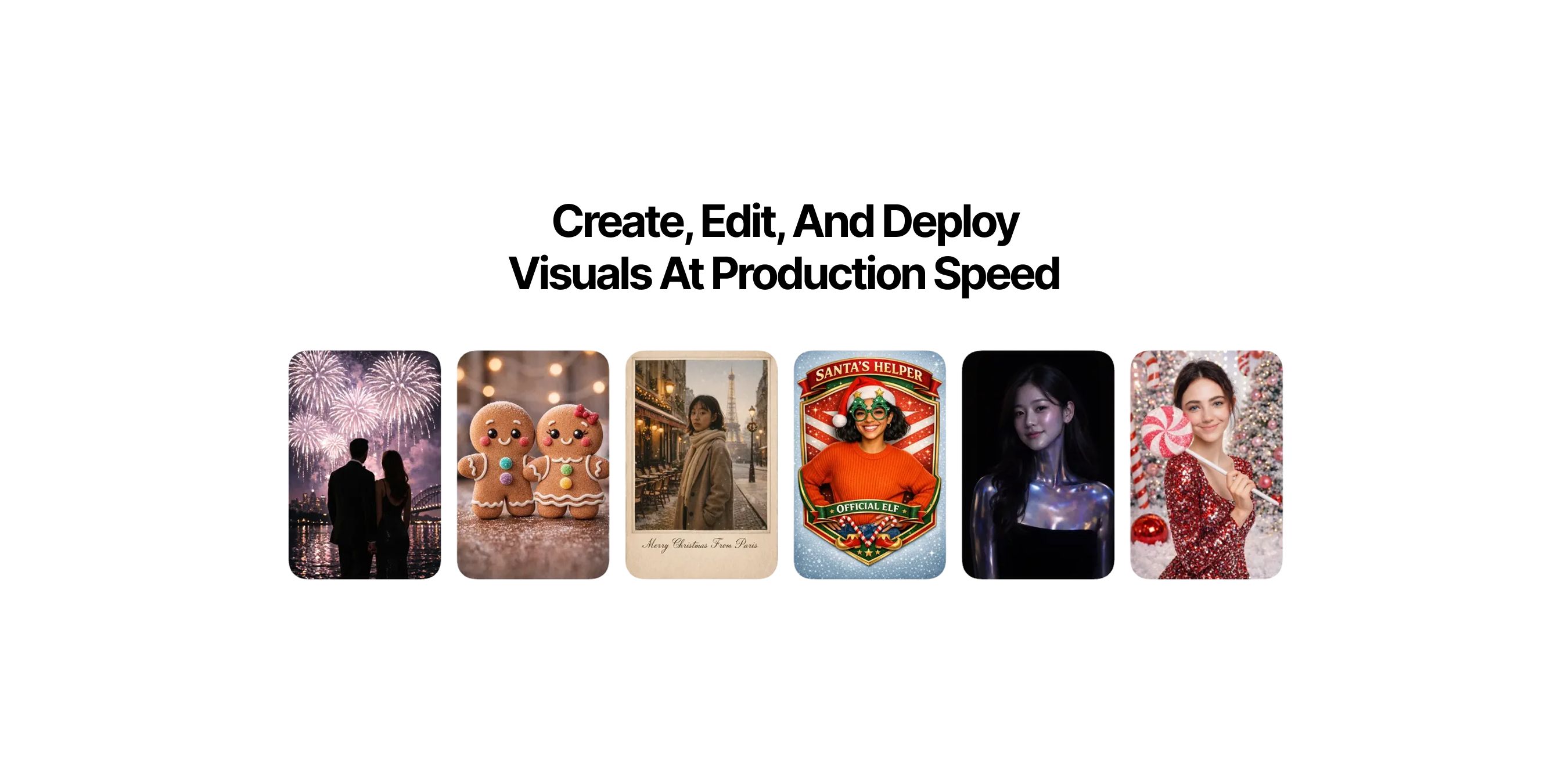
Frequently Asked Question
Need more information? Here are answers to some of the most common user questions.
More topics you may like
What Is AI Image Generation? The Complete Practical Guide for 2025

Muhammad Bin Habib

Why Diffusion Models Outperform Traditional Generators in Modern AI Systems
Muhammad Bin Habib
Gemini 2.5 Pro vs Gemini 3 Pro: Cost Analysis

Faisal Saeed

How to Use Chatly AI Chat: A Step-by-Step Guide
Faisal Saeed
Claude Opus 4.5: The Definitive Guide to Features, Use Cases, Pricing
Faisal Saeed