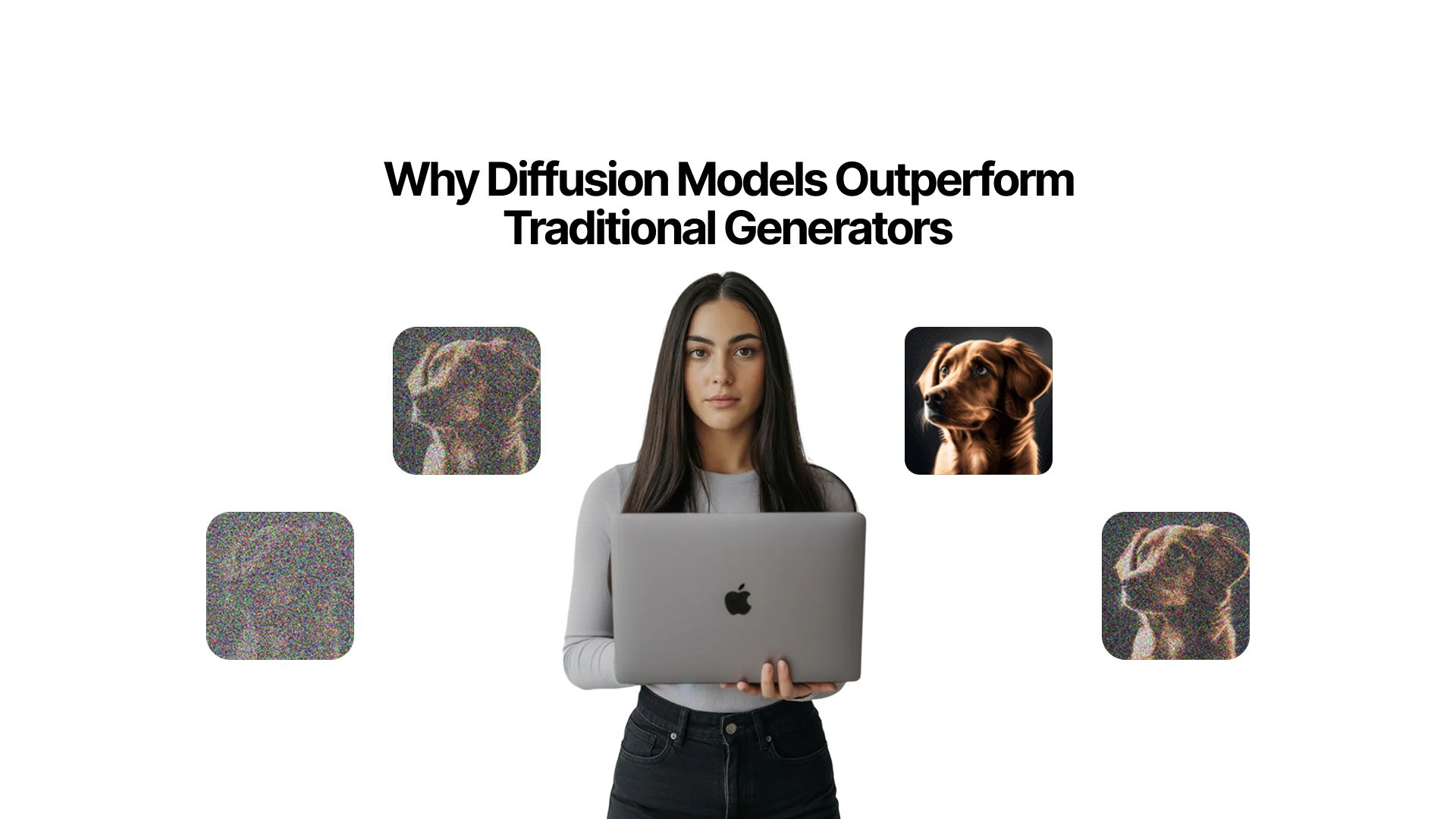
Why Diffusion Models Outperform Traditional Generators in Modern AI Systems
For years, generative models promised systems that could create images, text, audio, and video that felt human-made.
Early breakthroughs showed what was possible, but they also exposed limits that became harder to ignore as expectations grew. Outputs were often impressive at first glance, yet inconsistent, fragile, or difficult to control once used in real applications.
As generative AI moved from research labs into products, those weaknesses became more visible. Teams needed systems that behaved predictably, scaled reliably, and produced high-quality results without constant tuning.
This shift in expectations is what pushed diffusion models into the spotlight. They did not just improve generation quality. They changed how AI image generation itself works.
What Are Diffusion Models?
Diffusion models approach image generation as a gradual process rather than a single decisive step. Instead of trying to produce a complete output all at once, they learn how to refine noise into structure over a sequence of small, controlled transformations.
This difference in approach explains much of their performance advantage.
The Core Idea Behind Diffusion
At the heart of diffusion models is a simple but powerful concept. During training, the model learns how data gradually degrades when noise is added step by step. It then learns how to reverse that process, removing noise incrementally until a coherent result emerges.
This framing turns generation into a recovery problem rather than a guessing game. Each step gives the model an opportunity to correct itself, making small improvements instead of committing early to a flawed output. Over time, these small corrections add up to results that are sharper, more consistent, and more faithful to the data distribution.
Why Gradual Denoising Is Important
Traditional generators often make irreversible decisions early in the generation process. Once a mistake appears, there is little opportunity to fix it downstream. Diffusion models avoid this trap by spreading decision-making across many steps.
Because each stage refines the output slightly, errors tend to be corrected rather than amplified. This is one reason diffusion models handle complex structures and fine details more reliably, especially in high-dimensional domains like images, audio, and video.
From Noise to Structure
What makes diffusion models particularly effective is how naturally they align with learning patterns in real data. Real-world data rarely appears fully formed. It emerges from underlying structure layered on top of randomness.
By learning how to move from noise toward structure, diffusion models mirror this process mathematically. The result is a system that learns not just what outputs should look like, but how they come into being. This distinction becomes critical when comparing diffusion models to traditional generators.
What Are Traditional Generators?
Before diffusion models became widely adopted, most generative systems followed a very different philosophy. These models were designed to generate outputs in a small number of decisive steps, often committing to structure early and refining very little afterward.
GANs, VAEs, and Autoregressive Models
Generative Adversarial Networks, or GANs, rely on a competitive setup where one model generates outputs while another judges their realism. This adversarial dynamic can produce sharp results, especially in image generation, but it is also notoriously difficult to stabilize during training.
Variational Autoencoders are a type of AI that learns to shrink data into a small summary and then use that summary to make new examples that are similar to the original. While more stable than GANs, VAEs often struggle to produce outputs with the same level of detail and realism.
Autoregressive models generate data sequentially, predicting one element at a time based on previous outputs. This makes them flexible and expressive, but also slow and sensitive to early errors that compound as generation progresses.
Each of these approaches attempts to model complex data distributions directly. That ambition is also where many of their challenges arise.
Why Early Commitment Creates Fragility
A common thread across traditional generators is early commitment. Once the model makes a choice about structure or content, it has limited ability to revisit or revise that decision.
If an early prediction is slightly off, subsequent steps often build on that error rather than correcting it. This leads to outputs that may look plausible at first glance but fall apart under closer inspection or variation.
This fragility becomes especially apparent when models are asked to generate diverse outputs or operate under constraints. Small shifts in input or noise can lead to disproportionately large changes in results.
Mode Collapse and Coverage Gaps
Another persistent issue with traditional generators is incomplete coverage of the data distribution. Models may learn to generate a narrow subset of outputs that score well according to their training objectives, while ignoring other valid possibilities.
In GANs, this appears as mode collapse, where the generator repeatedly produces similar outputs. In other models, it shows up as a lack of diversity or an overrepresentation of common patterns.
These issues are not simply training bugs. They are structural consequences of how these models attempt to learn and generate data.
Why Diffusion Models Produce Higher-Quality Outputs
The performance gap between diffusion models and traditional generators becomes most visible when examining output quality. This difference is not accidental. It emerges directly from how diffusion models structure the generation process and how that process interacts with complex data.
Rather than aiming for a perfect result in a single step, diffusion models treat generation as a gradual refinement problem. This change in framing leads to more consistent and reliable outcomes across a wide range of inputs.
Iterative Refinement Over One-Step Generation
Traditional generators often attempt to produce a complete output in one decisive pass or through a tightly coupled sequence of predictions. When early decisions are slightly off, the model has limited opportunity to correct them later.
Diffusion models spread this decision-making across many small steps. Each step refines the output incrementally, allowing errors to be reduced rather than amplified. This iterative refinement creates space for adjustment and convergence, which results in outputs that feel more coherent and structurally sound.
Over time, this approach produces results that remain stable even as complexity increases.
Better Coverage of the Data Distribution
Another reason diffusion models outperform traditional generators lies in how they represent data diversity. Many earlier models struggle to capture the full range of valid outputs, often converging on a narrow subset that satisfies their training objectives.
Diffusion models learn how data transforms under noise across the entire distribution. This allows them to reconstruct a wider variety of valid outputs during generation, rather than repeatedly returning similar patterns. The result is improved diversity without sacrificing realism.
This balance between variety and quality is difficult to achieve with traditional approaches.
Training Stability as a Practical Advantage
Output quality is closely tied to how models behave during training. Traditional generators often require careful tuning to prevent instability, collapse, or divergence. Small changes in data or hyperparameters can lead to unpredictable outcomes.
Diffusion models tend to train more predictably. Their objective functions are simpler and more aligned with gradual learning, which reduces volatility during optimization. This stability makes it easier to scale models, iterate on architectures, and deploy systems with confidence.
In practical terms, stable training translates directly into more dependable outputs.
Why Diffusion Models Are More Controllable
As generative models are used in more practical settings, quality alone is no longer enough. Teams need systems that respond predictably to guidance, adapt to constraints, and allow meaningful refinement without retraining entire models. Diffusion models offer a level of control that traditional generators struggle to provide.
This advantage comes directly from how diffusion models structure the generation process.
Conditioning Without Instability
Diffusion models can incorporate guidance at multiple stages of generation. Instead of forcing the model to satisfy constraints in a single pass, conditioning signals are applied gradually as the output takes shape.
This makes it easier to guide generation using text prompts, class labels, reference images, or semantic constraints without destabilizing the model. Because guidance influences each refinement step, the model can adjust smoothly rather than overcorrecting.
In contrast, traditional generators often react sharply to conditioning signals, which can lead to brittle outputs or unexpected artifacts.
Editing and Iterative Refinement
Another practical benefit of diffusion models is their ability to support editing workflows. Since generation unfolds over many steps, it becomes possible to intervene partway through the process.
This allows users to modify specific attributes while preserving the rest of the output, whether that means adjusting style, structure, or content. Such fine-grained control is difficult to achieve with models that generate outputs in a single decisive pass.
For product teams and creators, this opens the door to tools that feel collaborative rather than opaque.
Why Control Matters in Real Applications
Control is not just a technical feature. It is what enables generative systems to be trusted in production environments. When outputs can be guided, inspected, and refined, teams can integrate these systems into workflows without constant oversight.
Diffusion models support this level of control by design. Their stepwise nature aligns well with human expectations around refinement and adjustment, making them easier to work with as systems scale.
Why Diffusion Models Scale Better With Data and Compute
As generative models grow larger and are applied to broader datasets, their ability to scale predictably becomes just as important as raw output quality. Diffusion models tend to behave more consistently as data and compute increase, which has made them attractive for teams building systems meant to improve over time rather than plateau early.
This scalability advantage is less about efficiency in isolation and more about how performance responds to investment.
Predictable Gains From More Data
Many traditional generators improve unevenly as more data is added. In some cases, additional data leads to marginal gains. In others, it introduces instability or amplifies existing weaknesses in the model’s representation of the data distribution.
Diffusion models typically benefit from larger datasets in a more gradual and predictable way. As the model is exposed to more examples of how data degrades under noise and how it can be reconstructed, its ability to generalize improves steadily. This makes performance gains easier to anticipate and plan for, especially in long-term development cycles.
For teams investing heavily in data collection and curation, this predictability matters.
Compute Tradeoffs and Sampling Speed
One common criticism of diffusion models is that they are slower at generation time. Because outputs are refined over many steps, sampling can take longer compared to one-pass generators.
In practice, this tradeoff is often acceptable. Many real-world applications prioritize quality, reliability, and control over raw generation speed. Advances in sampling techniques and hardware acceleration have also reduced latency enough that diffusion models remain practical in most settings.
The slower sampling process is best understood as a deliberate design choice rather than a limitation.
Scaling Without Fragility
As models grow larger, traditional generators can become increasingly sensitive to hyperparameters and training dynamics. Small changes may lead to instability or degraded outputs, especially at scale.
Diffusion models tend to scale more gracefully. Their training objectives remain well-behaved as model size increases, which reduces the risk of sudden performance regressions. This stability makes it easier to iterate, experiment, and deploy larger systems with confidence.
Over time, this characteristic has made diffusion models a more reliable foundation for large-scale generative systems.
Empirical Evidence of How Diffusion Models Outperform in Practice
The advantages of diffusion models are not limited to theory or controlled experiments. Their strengths become especially clear when evaluated across real benchmarks and practical applications, where consistency, diversity, and reliability matter more than isolated best-case results.
Across multiple domains, diffusion-based systems have demonstrated performance patterns that are difficult for traditional generators to match.
Image Generation Benchmarks
In image generation, diffusion models consistently achieve stronger results on widely used evaluation metrics. These include measures of visual fidelity, diversity, and alignment with real data distributions.
Unlike traditional generators that may excel on specific subsets of images, diffusion models tend to perform well across a broader range of styles and structures. Outputs maintain coherence even as complexity increases, which is especially noticeable in scenes with fine detail, varied textures, or unusual compositions.
These improvements are not limited to headline scores. They show up in qualitative assessments as well, where images appear more stable and less prone to obvious artifacts.
Beyond Images: Audio, Video, and Multimodal Tasks
The same principles that make diffusion models effective for images also translate well to other modalities. In audio generation, diffusion-based approaches produce smoother waveforms and more natural transitions. In video generation, they help maintain temporal consistency across frames, a challenge that traditional generators often struggle with.
Multimodal systems benefit in similar ways. When combining text, image, or audio inputs, diffusion models provide a flexible framework for integrating guidance without destabilizing the generation process. This versatility has made them a common choice for newer generative systems that operate across multiple data types.
Consistency Across Domains
What stands out most in empirical comparisons is not a single breakthrough metric, but the consistency of performance across tasks. Diffusion models tend to degrade gracefully when pushed beyond familiar data, while traditional generators often fail abruptly or unpredictably.
This consistency matters in practice. It allows teams to rely on these systems in a wider range of scenarios without extensive retraining or manual intervention.
Why Modern AI Models and Systems Prefer Diffusion
As generative AI systems transition from research prototypes to production-ready tools, the criteria for success shift. Raw novelty gives way to reliability, predictability, and the ability to integrate cleanly into existing workflows. Diffusion models align well with these requirements, which explains why they have become a common foundation for modern generative systems.
The preference is less about theoretical elegance and more about operational fit.
Reliability in Production Environments
In production settings, consistency matters more than occasional peak performance. Systems need to behave similarly across runs, inputs, and conditions. Diffusion models support this by design, as their iterative generation process reduces the impact of small variations that can otherwise lead to unstable outputs.
Because each step refines the output incrementally, diffusion-based systems tend to degrade gradually rather than failing abruptly. This makes them easier to monitor, debug, and trust once deployed.
Predictability Over One-Time Brilliance
Traditional generators can sometimes produce striking results, but those results are often difficult to reproduce consistently. Small changes in inputs or randomness may lead to large swings in output quality.
Diffusion models trade some generation speed for predictability. This tradeoff is often worthwhile in real products, where users expect similar prompts or inputs to produce comparable results. Predictable behavior reduces surprises and makes systems easier to explain, document, and support.
Alignment With Human Workflows
Another reason diffusion models fit well into modern systems is how closely their generation process mirrors human refinement. People rarely create complex outputs in a single step. They iterate, adjust, and refine.
Diffusion models follow a similar pattern. This makes them easier to integrate into tools that support editing, revision, and collaboration, rather than treating generation as a one-off event. As a result, they feel more natural to work with across creative, analytical, and technical use cases.
Limitations of Diffusion Models (And Why They Still Win)
Diffusion models are not without tradeoffs. Their advantages come with real costs, particularly around speed and computational demand. Understanding these limitations helps explain why diffusion models are chosen deliberately, not blindly, and why they continue to outperform traditional generators despite these constraints.
What matters most is how these tradeoffs align with real-world priorities.
Sampling Time and Latency
One of the most discussed limitations of diffusion models is sampling speed. Because generation unfolds over many refinement steps, producing an output can take longer than with one-pass generators.
In isolation, this may seem like a disadvantage. In practice, many applications value output quality, consistency, and control more than raw speed. Advances in sampling methods and hardware acceleration have also narrowed the gap, making latency manageable for most use cases.
The slower pace is a consequence of deliberate refinement rather than inefficiency.
Compute Requirements and Cost
Training diffusion models can be computationally expensive, especially at scale. They often require substantial resources to learn the full noise-to-structure transformation effectively.
However, this cost tends to scale predictably. Unlike some traditional generators that require extensive tuning to remain stable, diffusion models convert compute investment into measurable gains more reliably. For teams planning long-term systems, this predictability often outweighs higher upfront costs.
Where Traditional Generators Still Fit
There are scenarios where traditional generators remain useful. Tasks that require extremely fast generation or operate under tight resource constraints may still favor simpler models.
That said, as requirements expand to include quality, diversity, control, and reliability, diffusion models increasingly become the better foundation. Their limitations are understood and manageable, while their strengths address the core challenges of modern generative systems.
Diffusion Models vs Traditional Generators: A Direct Comparison
At a high level, diffusion models and traditional generators aim to solve the same problem: generating realistic data from learned distributions. The difference lies in how they approach that goal and what tradeoffs they accept along the way. Comparing them across a few core dimensions helps explain why diffusion models have become the preferred choice in many modern systems.
Generation Process
Traditional generators attempt to produce outputs in a small number of decisive steps. Whether through adversarial training, latent sampling, or sequential prediction, the model commits early to structure and content.
Diffusion models take the opposite approach. Generation unfolds gradually, with each step refining the output slightly. This allows the model to adjust continuously rather than locking in early decisions that are difficult to reverse. The result is a process that favors convergence over speed.
Training Stability
Training stability is one of the most significant points of divergence. Traditional generators often require careful balancing, tuning, and monitoring to avoid collapse or instability. Small changes in training conditions can lead to unpredictable behavior.
Diffusion models tend to train more smoothly. Their objectives align with gradual learning, which reduces sensitivity to hyperparameters and data shifts. This stability makes it easier to scale models and iterate without introducing fragile dependencies.
Output Quality and Consistency
Traditional generators can produce high-quality outputs, but quality often varies significantly across samples. Some outputs look excellent, while others fall short in subtle or obvious ways.
Diffusion models produce more consistent results across runs. Outputs tend to maintain structural integrity and visual coherence even as complexity increases. This consistency matters in applications where reliability is more important than occasional standout results.
Diversity and Distribution Coverage
Many traditional generators struggle to represent the full diversity of the data they are trained on. This leads to repeated patterns or limited variation, even when the model appears to perform well on average.
Diffusion models are better at covering the data distribution. By learning how noise transforms data across the entire space, they are able to reconstruct a wider range of valid outputs without collapsing into a narrow subset.
Control and Conditioning
Conditioning traditional generators often introduces instability or requires architectural compromises. Guidance signals can overpower the generation process or lead to brittle outputs.
Diffusion models integrate conditioning naturally into the refinement process. Guidance can be applied progressively, allowing the model to adapt smoothly rather than react sharply. This enables more reliable control over style, structure, and content.
Scalability and Long-Term Viability
As models grow larger and datasets expand, traditional generators often become harder to manage. Scaling introduces new failure modes and increases the need for manual intervention.
Diffusion models scale more predictably. Performance improvements track more closely with data and compute investment, making them a safer foundation for systems intended to evolve over time.
What This Shift Means for the Future of Generative AI
The rise of diffusion models signals more than a technical improvement. It reflects a broader shift in how generative systems are designed and evaluated. Rather than prioritizing speed or novelty alone, modern AI systems are increasingly optimized for reliability, controllability, and long-term improvement.
As generative models become embedded in real products, expectations change. Users care less about occasional impressive outputs and more about consistent behavior they can rely on. Diffusion models align naturally with this expectation because they treat generation as a process of refinement rather than a single moment of prediction.
This shift also influences how teams build around these models. Systems designed on diffusion-based foundations are easier to iterate on, easier to guide, and easier to adapt as requirements evolve. Over time, this flexibility compounds, making diffusion models a strong default for applications that need to grow in capability without becoming brittle.
Structural Shift that Diffusion Models Bring Along
Diffusion models outperform traditional generators not because they are faster or simpler, but because they reflect a more realistic approach to generation. By refining outputs step by step, they reduce fragility, improve consistency, and offer greater control over complex data.
Traditional generators laid the groundwork for modern generative AI, but their limitations become increasingly apparent as systems scale and expectations rise. Diffusion models address those limitations directly, offering a framework that balances quality, diversity, and reliability.
As generative AI continues to mature, the appeal of diffusion models lies in their alignment with real-world needs. They prioritize refinement over guessing and stability over spectacle. That shift in philosophy is what makes them not just an improvement, but a meaningful evolution in how generative systems are built.

Frequently Asked Question
Get more insights through some common queries from online users.
More topics you may like

What Is AI Image Generation? The Complete Practical Guide for 2025

Muhammad Bin Habib

10 Different Ways You Can Use Chatly AI Chat and Search Every Day

Faisal Saeed

11 Best ChatGPT Alternatives in 2026 (Tested, Compared & Priced)
Muhammad Bin Habib

21 Journaling Techniques That Actually Work in 2025
Muhammad Bin Habib

GPT-5.2 Is Here: What Changed, Why It Matters, and Who Should Care
Faisal Saeed