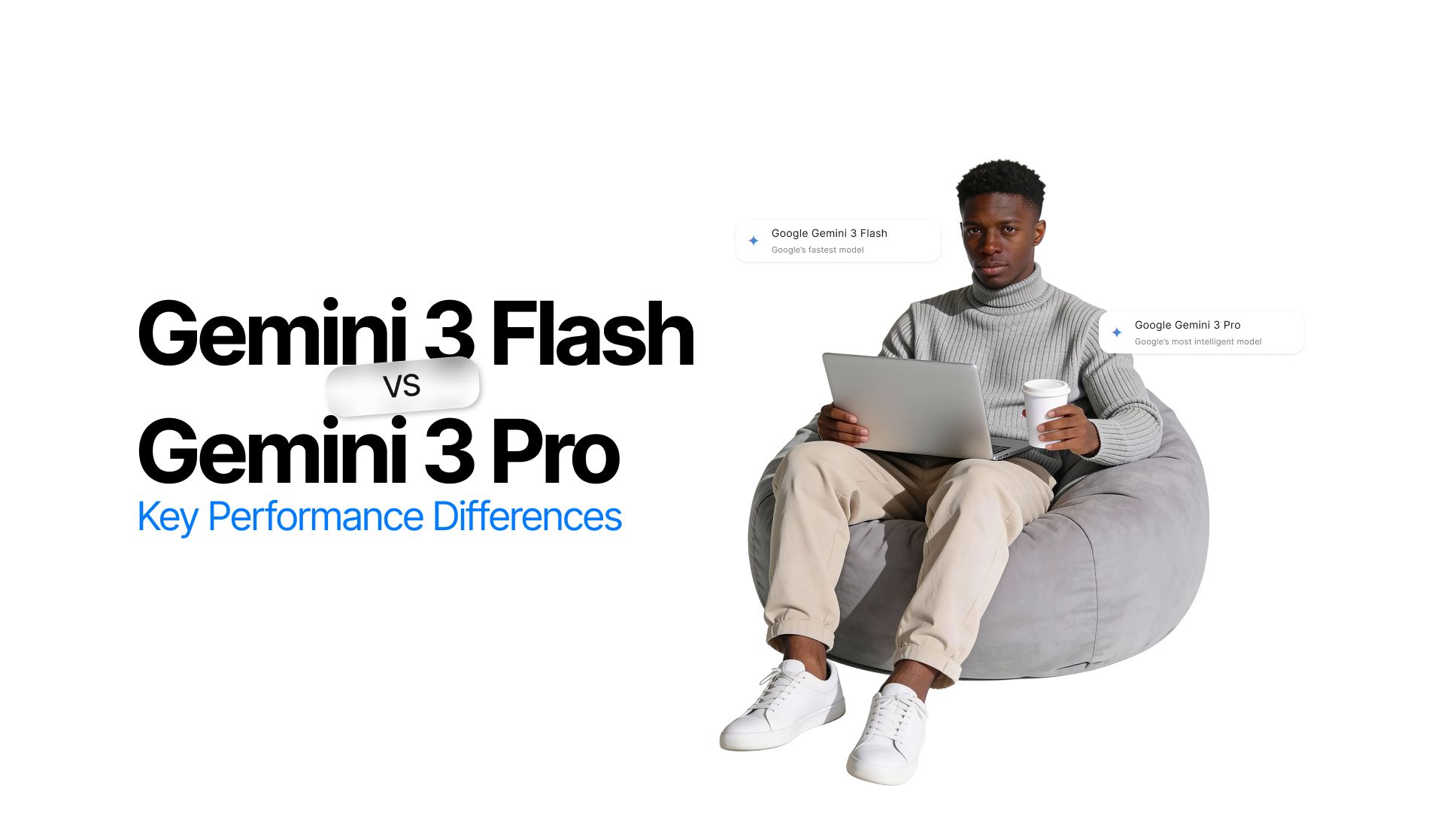
Gemini 3 Flash vs Gemini 3 Pro: Key Performance Differences
Every team has a constant struggle between choosing the best tool with best features and choosing a tool that does the job but costs less.
That dilemma carried over to AI models as well. Teams use an AI model but then a new one comes along which either offers lower prices or much better performance. Now teams have to go through the decision making process again and sacrifice one or the other.
But we finally have a model at our hand which costs significantly less and yet isn’t far behind its expensive predecessors.
Yes, I am talking about the newly released Gemini 3 Flash.
It delivers frontier-level intelligence at a fraction of the cost and faster speed, three times faster in case of models like Gemini 2.5 Pro.
It sits alongside Gemini 3 Pro in Google's model family, but the relationship between these two models isn't what you might expect. Flash sits on a lower tier in terms of cost but it matches or even exceeds Pro performance on several critical benchmarks while maintaining dramatic advantages in speed and cost.
This article breaks down the real differences between Gemini 3 Flash and Gemini 3 Pro. We'll examine performance benchmarks, analyze cost structures, and help you determine which model fits your specific use case.
The answer might surprise you: for most applications, Flash is the superior choice.
What's the Real Difference Between Gemini 3 Flash and Pro?
The main difference between the two models is obvious in the names. One prioritizes flashing speed while the other focuses on professional depth.
But we are here to move past this shallow difference and look deeper into their abilities to see what else differentiates these two capable models.
1. Model Positioning
Gemini 3 Flash and Gemini 3 Pro serve fundamentally different purposes, despite their similar capabilities.
- Flash positions itself as frontier intelligence at scale, aimed at delivering Pro-grade reasoning with exceptional efficiency.
- Pro remains Google's flagship for absolute maximum capability, designed for the most demanding frontier tasks where quality cannot be compromised.
2. The Performance Gap Reality
The performance gap between these models is remarkably narrow.
3. Token Efficiency Advantage
Perhaps most impressive is Flash's token efficiency. The model uses 30% fewer tokens on average than Gemini 2.5 Pro to complete typical tasks with higher performance. This efficiency stems from intelligent thinking modulation. Flash thinks longer for complex problems but completes routine tasks with minimal overhead.
4. The Decision Framework
The critical question isn't whether Flash matches Pro on every single metric. It's whether the 5-10% performance difference on the most complex tasks justifies quadruple the cost and one-third the speed. For most real-world applications, the answer is no.
Performance Deep Dive
So, Gemini 3 Flash is faster and cheaper. Is that it?
Amazingly, no.
What has been blowing people’s minds is how Gemini 3 Flash trades blows with Pro even when it is supposed to be the inferior model. Yes, it does not beat Gemini 3 Pro overall, but it's close. And if we talk about some specific use cases and scenarios, Flash emerges as the clear winner.
1. Agentic Coding: SWE-bench Verified
Gemini 3 Flash demonstrates surprising strength in coding capabilities, occasionally surpassing its more expensive sibling.
On SWE-bench Verified, which evaluates coding agent capabilities, Flash achieves 78.0% compared to Pro's 76.2%. This difference might seem marginal but it’s not. Considering the cost and the speed that Gemini 3 Flash model promises, it is mind blowing that it performs better at agentic coding tasks that matter to developers.
2. Multimodal Understanding: MMMU-Pro
If you thought Gemini 3 Flash beating Pro was a fluke, think again.
Multimodal understanding represents another area of Flash excellence. On MMMU-Pro, Flash scores 81.2% versus Pro's 81.0%, effectively achieving parity on complex visual reasoning tasks.
This makes Flash equally capable for applications requiring image analysis, document understanding, and visual question-answering.
3. Multilingual Capabilities: MMMLU
When Gemini 3 Flash is not busy beating Pro in multiple benchmarks, it ties it in multilingual capabilities.
Both models achieve 91.8% on MMMLU, demonstrating that Flash doesn't sacrifice global accessibility for speed. For applications serving international audiences, Flash delivers the same quality at significantly lower cost.
So, if you need to translate reports into multiple languages or need a reliable travel buddy, Flash is your go-to model.
4. Complex Reasoning: Humanity's Last Exam
Gemini 3 Pro maintains its advantage on the absolute frontier of AI capabilities. On Humanity's Last Exam, which tests PhD-level reasoning across diverse domains, Pro achieves 37.5% compared to Flash's 33.7%. This four-percentage-point gap represents the difference in handling truly unprecedented complexity.
But this exceptional model still punches way above its weight as it nearly matches the next best model. Without any tool calls, GPT-5.2 scores 34.5% and Flash follows with 33.7%.
5. Long Context Understanding: MRCR v2
Long context understanding reveals another Pro strength. When processing tasks approaching one million tokens, Pro scores 26.3% on MRCR v2 compared to Flash's 22.1%. For applications requiring deep analysis of extensive documents or codebases, Pro's superior context handling becomes relevant.
6. Scientific Knowledge: GPQA Diamond
Scientific knowledge shows a modest Pro advantage. On GPQA Diamond, Pro reaches 91.9% versus Flash's 90.4%. This 1.5-percentage-point difference matters primarily for specialized scientific applications where absolute accuracy is paramount.
But for use cases, where absolute accuracy is not a requirement, a case can be made for Gemini 3 Flash usage.
7. Mathematics: AIME 2025
Mathematical reasoning demonstrates near-parity between the models.
- Without code execution, Flash achieves 95.2% while Pro reaches 95.0%.
- When code execution is enabled, both models hit 99.7-100% success rates, showing that tool-augmented capabilities eliminate even minor differences.
The Performance Takeaway
The performance story reveals that the performance is not as straightforward as it might seem.
Flash dramatically closes the gap from previous model generations. Where earlier Flash models lagged significantly behind Pro counterparts, Gemini 3 Flash competes directly with Pro across most metrics. The 5-10% difference on frontier tasks represents the only meaningful distinction.
This shift fundamentally changes the decision calculus. You're no longer choosing between "good enough" and "excellent." You're choosing between "excellent" and "marginally better in specific scenarios," with massive cost and speed implications.
How does Performance Affect Cost & Speed?
Flash offers a performance so close to the pro version that if you just saw the numbers without knowing which model it was, you might assume it was a rival company trying to beat Google.
If that were the case, the only restriction might have been the cost.
But surprisingly it's just a lighter version of Google’s own Pro model which means significant cost reduction.
Pricing Breakdown
Gemini 3 Flash's pricing represents its most compelling advantage.
- Flash costs $0.50 per million input tokens and $3.00 per million output tokens.
- Pro costs $2.00 per million input tokens ($4.00 beyond 200k tokens) and $12.00 per million output tokens ($18.00 beyond 200k tokens).
Real-World Cost Comparison
Let's translate this into real numbers.
Processing 10 million input tokens and generating 2 million output tokens costs $5,500 with Flash versus $26,000 with Pro (a savings of $20,500). For high-volume production applications, this difference transforms business models.
Applications that would be economically infeasible with Pro become viable with Flash.
Speed Advantage
Speed advantages compound beyond raw cost savings. Flash operates three times faster than Gemini 2.5 Pro, enabling entirely new application categories. Real-time gaming assistants, live video analysis, and interactive debugging tools require sub-second response times that Pro simply cannot deliver at scale.
Token Efficiency Benefits
Token efficiency further enhances Flash's value proposition. Using 30% fewer tokens to achieve comparable or better results means your dollar stretches even further. A task requiring 1,000 tokens with 2.5 Pro might need only 700 tokens with Flash, while simultaneously delivering higher quality output.
Use Cases: Which Model for Your Needs?
With the performance gap so marginal, it becomes difficult to decide which model might be suitable for which tasks. You might be tempted to use one model thinking the difference is too little to notice, but the effects compound and marginal difference transform into significant problems.
So let’s see where you can use these models and get away with the performance differences.
Choose Flash For Most Applications
1. Agentic Coding and Development
SWE-bench Verified is one of the benchmarks where Flash beats pro. This makes Flash the perfect choice for agentic coding since it costs less. The model excels at iterative development, rapid prototyping, and continuous refinement. Development tools from JetBrains, Cursor, and Replit have adopted Flash specifically because it balances quality with the speed necessary for responsive developer experiences.
2. High-Volume Production Systems
High-volume production systems benefit enormously from Flash's cost structure. Applications processing millions of requests daily (chatbots, document analysis pipelines, content generation systems) cannot afford Pro's pricing. Flash makes frontier AI economically sustainable at enterprise scale.
3. Real-Time and Interactive Applications
Real-time and interactive applications demand Flash's low latency. Gaming assistants providing strategic guidance during gameplay, live video analysis systems, and augmented reality applications all require near-instantaneous responses. Pro's superior reasoning doesn't matter if users abandon your application due to lag.
4. Data Extraction and Transformation
Data extraction and transformation workflows thrive on Flash's multimodal capabilities. Box, a cloud content management company, reports a 15% improvement in accuracy on complex extraction tasks like handwriting recognition and financial document analysis. Flash's combination of speed and quality makes it ideal for processing large document volumes.
5. Rapid Prototyping and A/B Testing
Rapid prototyping and A/B testing benefit from Flash's fast iteration cycles. Design tools like Figma use Flash to generate multiple UI variations in seconds, enabling designers to explore creative directions without waiting. The speed advantage directly translates to productivity gains.
Choose Pro For Specialized Scenarios
1. Complex Research and Academic Work
2. Extensive Long Context Analysis
Long context understanding approaching one million tokens favors Pro. Analyzing entire codebases, processing extensive legal documents to write case studies for laws, or synthesizing information from numerous research papers all benefit from Pro's superior long-context capabilities. If your application routinely processes hundreds of thousands of tokens, Pro's advantage becomes tangible.
3. Quality-Critical Applications
Applications where quality absolutism matters regardless of cost should consider Pro. For example, medical diagnosis support systems, legal contract analysis, financial risk assessment. These are scenarios where errors carry significant consequences and can benefit from Pro's marginal quality advantage. The cost difference becomes irrelevant when accuracy is paramount.
Real-World Adoption Patterns
Enterprise adoption patterns reveal industry consensus.
- JetBrains integrates Flash into their AI Chat and agentic coding evaluation systems, citing quality close to Pro with significantly lower latency and cost.
- Workday deploys Flash to fuel their AI-first strategy across customer-facing applications and internal operations.
- Figma's Chief Design Officer notes that Flash enables rapid prototyping while maintaining attention to detail and responding to specific design directions.
- Salesforce incorporates Flash into Agentforce to unlock high-quality reasoning and rapid iteration within familiar tools.
- Even Bridgewater Associates, requiring models capable of reasoning over vast unstructured datasets, finds Flash delivers "Pro-class depth at the speed and scale our workflows demand."
When some of the world's most sophisticated firms choose Flash, the message is clear: Flash provides frontier intelligence without frontier costs.
Conclusion
Gemini 3 Flash proves that speed and scale don't require sacrificing intelligence. The model delivers 90-95% of Pro's capabilities at 25% of the cost and three times the speed, fundamentally changing what's possible with AI.
This breakthrough democratizes frontier AI capabilities. Small teams and individual developers can now access intelligence that previously required enterprise budgets. Production applications can scale to millions of users without prohibitive costs.
The future of AI doesn't lie in choosing between quality and efficiency but in models like Flash that deliver both. As Google continues evolving the Gemini family, expect this trend to accelerate: more capable models at lower costs with faster performance.
Frequently Asked Question
Here are some of the most common questions users ask online about these Gemini models.
More topics you may like
Gemini 2.5 Pro vs Gemini 3 Pro: Cost Analysis

Faisal Saeed
Gemini 3 Pro Overview: Features, Pricing, and Use Cases
Faisal Saeed
Claude Opus 4.5: The Definitive Guide to Features, Use Cases, Pricing
Faisal Saeed

11 Best ChatGPT Alternatives in 2026 (Tested, Compared & Priced)

Muhammad Bin Habib
Kimi K2 Overview: Complete Guide to the Open-Source AI That Beats GPT-4.1 & Claude
Faisal Saeed