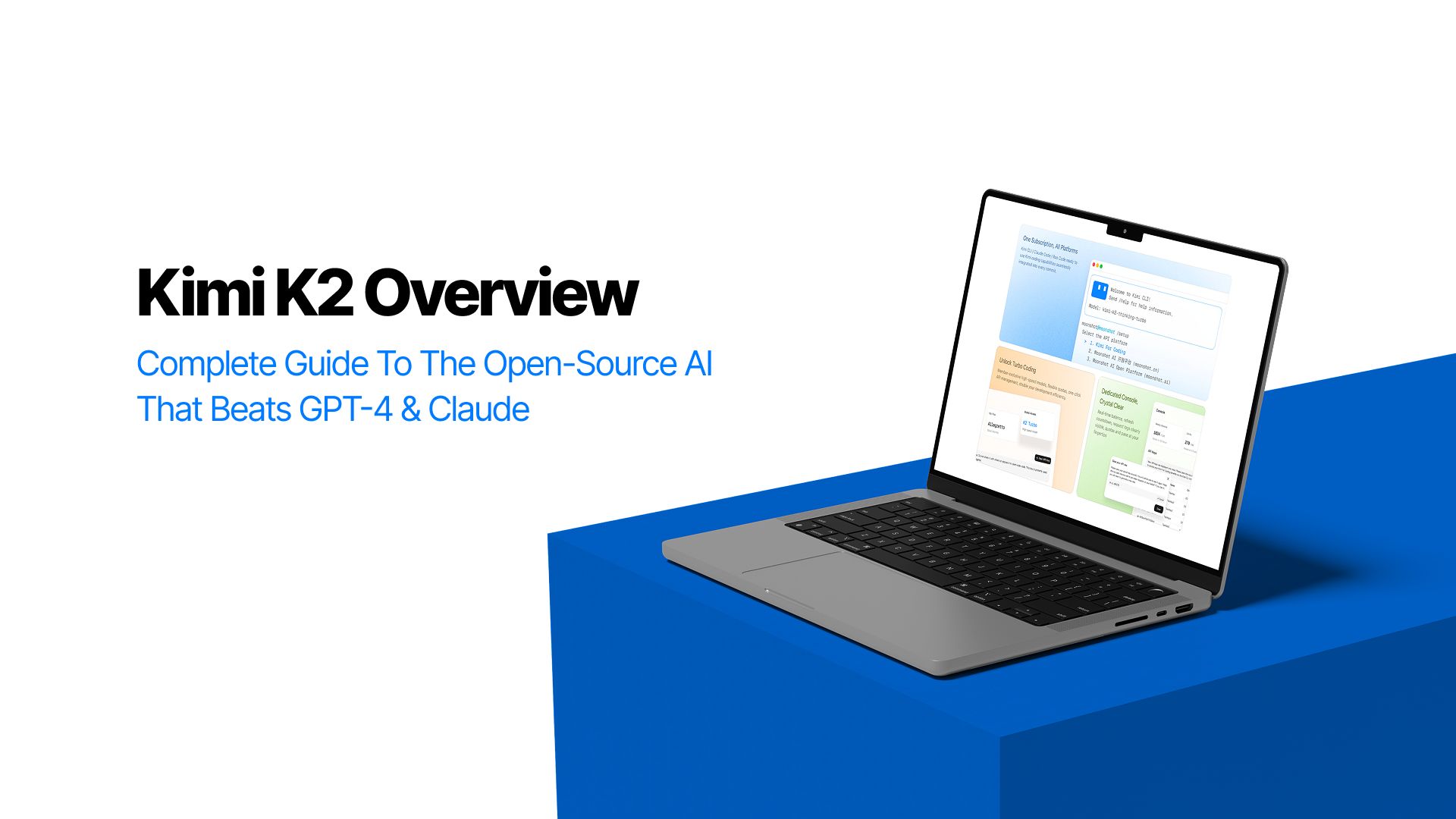
Kimi K2 Overview: Complete Guide to the Open-Source AI That Beats GPT-4.1 & Claude
With immense fundings and investments in the AI sector, whenever a model claims to be stronger, smarter, or faster, you’d imagine that it comes with significant price hikes.
However, that’s not the case with Kimi K2.
A Chinese startup released an open-source AI model that rivals GPT-4.1 and Claude while costing 100 times less to run. Kimi K2, developed by Moonshot AI, is turning heads with its impressive benchmarks and revolutionary pricing structure.
Kimi K2 represents a fundamental disruption similar to the "DeepSeek moment" that sent shockwaves through the industry. With a trillion parameters and cutting-edge agentic capabilities, this model challenges the dominance of proprietary AI systems.
In this comprehensive guide, you'll discover everything about Kimi K2. We'll explore its architecture, performance benchmarks, pricing, and how it compares to industry leaders like GPT-4.1 and Claude.
What is Kimi K2 AI?
Moonshot AI, a Beijing-based startup, created Kimi K2 as part of China's push for AI innovation. The company has backing from tech giant Alibaba and other major investors. Their mission focuses on building cost-effective AI that matches or exceeds proprietary models.
The release of Kimi K2 follows the broader trend of Chinese AI labs producing competitive models at a fraction of typical costs. This approach democratizes access to advanced AI chat capabilities. Moonshot AI has positioned itself as a challenger to Western AI dominance.
Core Architecture
Kimi K2 uses a Mixture-of-Experts (MoE) architecture that sets it apart from traditional models. The system contains 1 trillion total parameters but activates only 32 billion per token. This selective activation makes it incredibly efficient while maintaining high performance.
The model comes in two main variants that serve different purposes:
- Kimi-K2-Base: Foundation model for fine-tuning and customization
- Kimi-K2-Instruct: Chat-optimized version for direct interaction and instruction-following
Both variants leverage advanced training techniques including the MuonClip Optimizer. The training dataset spans 15.5 trillion tokens with zero training instability. This robust foundation enables consistent performance across diverse tasks.
The "Thinking" Variant
Moonshot AI released Kimi K2 Thinking on November 7, 2025 as their most advanced offering. This variant incorporates enhanced reasoning capabilities similar to OpenAI's o1 model. It excels at complex problem-solving that requires multiple steps of logical deduction.
The Thinking variant uses native INT4 quantization for improved efficiency. This technical innovation reduces memory requirements without sacrificing accuracy. Users can deploy it on less powerful hardware while maintaining strong performance.
Kimi K2 Large Language Model Features
Kimi K2 packs numerous advanced features that distinguish it from competitors. Let's explore the capabilities that make this model exceptionally powerful for real-world applications.
Agentic Capabilities
The standout feature of Kimi K2 is its autonomous task execution ability. The model can perform 200-300 sequential tool calls without requiring human guidance. This means it can complete complex multi-step projects independently from start to finish.
Consider a research task requiring web searches, data analysis, and report generation. Kimi K2 handles the entire workflow autonomously. It decides which tools to use, when to use them, and how to combine results into coherent outputs.
This level of autonomy transforms how developers build AI applications. Instead of scripting every step, you can describe the goal and let K2 figure out the execution path.
Context Window
Kimi K2 supports context windows ranging from 128K to 256K tokens depending on the version. This massive context capacity enables it to process entire books or lengthy codebases. The model maintains coherence even when working with extensive documents.
Unlike some competitors, Moonshot AI doesn't charge special fees for long-context usage. You pay standard rates regardless of context length. This pricing approach makes it economical for applications requiring extensive context understanding.
Training Innovation
The MuonClip Optimizer represents a breakthrough in training efficiency for Kimi K2. This proprietary technique enables stable training across the model's trillion-parameter architecture. Most large models struggle with training instability, but K2 achieved zero critical failures.
The training dataset of 15.5 trillion tokens provides comprehensive knowledge coverage. This extensive training enables strong performance across domains from coding to creative writing. The quality and diversity of training data directly impact the model's versatility.
Tool Use & Integration
Kimi K2 features native tool-calling capabilities built into its core architecture. The model seamlessly integrates with web browsers, code interpreters, and various APIs. This integration happens automatically without complex prompt engineering.
The API follows OpenAI and Anthropic compatibility standards. Developers can switch from GPT-4.1 or Claude with minimal code changes. This interoperability reduces migration friction and accelerates adoption.
Key integration capabilities include:
- Web browsing and information retrieval
- Python code execution and debugging
- RESTful API calls and data processing
- File system operations and data management
Multi-domain Excellence
Kimi K2 demonstrates strong performance across multiple specialized domains. It excels particularly in coding and software engineering tasks. The model writes clean, efficient code and can debug complex issues autonomously.
Mathematical reasoning represents another area of exceptional capability. K2 solves advanced problems involving calculus, algebra, and competitive mathematics. This makes it valuable for education, research, and technical applications.
Long-form writing and multi-step research tasks showcase the model's coherence and planning abilities. It maintains context and logical flow across thousands of tokens. Users report high-quality outputs for reports, articles, and documentation.
Moonshot AI Kimi K2 vs Kimi 1.5
Understanding the evolution from Kimi 1.5 to K2 helps illustrate the rapid progress Moonshot AI has achieved. The improvements span architecture, capabilities, and practical performance in real-world scenarios.
Performance Improvements
Kimi K2 delivers substantially enhanced agentic capabilities compared to its predecessor. The model executes longer sequences of tool calls with greater reliability. Task completion rates improved significantly for complex multi-step workflows.
Tool orchestration became more intelligent and context-aware in K2. The model makes better decisions about which tools to use and when. This leads to more efficient problem-solving with fewer wasted operations.
Stability across long-horizon tasks represents a major advancement. Kimi 1.5 sometimes lost coherence during extended workflows. K2 maintains focus and quality even during projects spanning hundreds of tool calls.
Architecture Evolution
The scaling from K1.5 to K2 involved sophisticated refinements to the MoE architecture. Engineers optimized how experts are selected and activated. This improves both efficiency and output quality without increasing computational costs.
Memory management and attention mechanisms received substantial upgrades. K2 handles longer contexts more effectively than K1.5. The model also maintains better consistency across different types of tasks.
Use Case Expansion
Kimi 1.5 primarily served as a conversational AI for chat applications. K2 expands into autonomous agent territory with enterprise-grade reliability. This shift opens new markets and use cases for Moonshot AI's technology.
Developers now build complete autonomous systems on K2 rather than just chatbots. The model powers research assistants, coding copilots, and data analysis tools. This versatility makes K2 suitable for production deployments in various industries.
Kimi K2 AI Benchmarks and Performance
Benchmarks provide objective measures of Kimi K2's capabilities against competing models. The results reveal both impressive strengths and areas where K2 leads the industry.
Coding Benchmarks
Kimi K2 achieves 65.8% on SWE-bench Verified, matching Claude 4 Opus performance. This benchmark tests real-world software engineering by requiring models to fix actual GitHub issues. The high score demonstrates K2's practical coding ability.
On LiveCodeBench, K2 scores 53.7% compared to GPT-4.1's 44.7%. This benchmark evaluates coding skills on recently published problems that weren't in training data. The significant lead over GPT-4.1 highlights K2's robust code generation capabilities.
OJ-Bench results show similar patterns with K2 performing competitively against top proprietary models. These coding benchmarks collectively establish Kimi K2 as one of the strongest code-capable models available. Developers report high-quality outputs that often require minimal revision.
Mathematical Reasoning
Mathematical benchmarks reveal Kimi K2's exceptional analytical capabilities. On MATH-500, K2 achieves 97.4% accuracy compared to GPT-4.1's 92.4%. This benchmark includes challenging problems across various mathematical domains.
The AIME 2025 results place K2 among the top-performing models. AIME tests competition-level mathematics requiring creative problem-solving. K2's strong performance indicates genuine mathematical understanding rather than memorization.
HMMT 2025 performance further validates K2's mathematical prowess. The model handles complex proofs and multi-step derivations effectively. These results make K2 particularly valuable for STEM education and research applications.
Agentic & Tool-Use Benchmarks
Tau2 and AceBench evaluate complex agentic workflows requiring multiple tool calls. K2 performs exceptionally well on these benchmarks, often exceeding proprietary models. The results validate Moonshot AI's focus on agentic intelligence.
These benchmarks measure real-world capabilities that matter for practical applications. High scores translate directly to better performance when building autonomous systems. K2's leadership in this category explains its growing adoption for agent-based projects.
Knowledge & Reasoning
MMLU (Massive Multitask Language Understanding) tests broad knowledge across 57 subjects. Kimi K2 scores competitively with leading models, demonstrating comprehensive knowledge coverage. The model performs consistently across humanities, sciences, and professional domains.
GPQA-Diamond results show strong scientific reasoning abilities. This benchmark requires a graduate-level understanding of physics, chemistry, and biology. K2's performance indicates deep conceptual understanding beyond surface-level pattern matching.
Humanity's Last Exam (HLE) challenges models with deliberately difficult questions. K2 performs well though not perfectly, reflecting the current limitations of AI reasoning. These results help calibrate expectations for what K2 can and cannot do.
Notable Strengths & Weaknesses
Kimi K2 excels at multi-step tasks requiring planning and execution. The model's agentic capabilities and coding skills represent clear competitive advantages. Long-context understanding and tool orchestration also rank among its strengths.
Domain-specific knowledge shows some gaps, particularly in specialized fields like medicine. HealthBench scores reveal room for improvement in medical reasoning. This suggests K2 works best for general applications rather than highly specialized domains.
Kimi K2 vs GPT-4.1, Claude, and Other Latest Models
Direct comparisons reveal how Kimi K2 stacks up against industry-leading proprietary models. These matchups help determine when K2 represents the best choice for specific applications.
vs GPT-4.1
Kimi K2 matches or exceeds GPT-4.1 performance across many benchmarks, particularly in coding. The most dramatic difference appears in pricing as it costs significantly less than GPT models. This cost advantage makes K2 viable for applications where GPT-4.1 would be prohibitively expensive.
GPT-4.1 maintains advantages in certain knowledge domains and conversational polish. The OpenAI model sometimes produces more refined outputs for creative writing. However, K2's superior agentic capabilities and tool use often outweigh these benefits.
For production systems requiring extensive API calls, K2's pricing becomes decisive. Applications involving code generation, data analysis, or research benefit particularly from K2. GPT-4.1 may still lead for customer-facing chatbots where polish matters most.
vs Claude 4 (Sonnet & Opus)
Claude 4 Opus and Kimi K2 deliver comparable coding performance based on SWE-bench results. Both models execute complex programming tasks reliably. K2 sometimes edges ahead in execution speed and tool-call efficiency.
Stability and consistency favor Claude in some scenarios, particularly for creative writing. Anthropic's models maintain a distinctive voice and coherence across long outputs. K2 matches this for technical content but may vary more in creative applications.
Agentic task performance tilts toward K2 due to its optimization for autonomous workflows. The model handles longer sequences of tool calls more reliably. For building AI agents, K2 often proves more capable than Claude.
vs GPT-5
Tool-use efficiency generally favors K2 due to its agentic optimization. The model requires fewer calls to accomplish the same goals. This efficiency translates to faster execution and lower costs in production systems.
GPT-5 maintains some advantages in conversational nuance and creative tasks. OpenAI's latest model exhibits a more sophisticated understanding of context and user intent. The choice between them depends on whether you prioritize reasoning depth or agentic execution.
vs Other Open-Source Models
DeepSeek V3 represents K2's closest open-source competitor with similar architecture and philosophy. Both models deliver exceptional value compared to proprietary alternatives. K2 generally leads in agentic benchmarks while DeepSeek excels in pure reasoning tasks.
Mistral and Qwen offer strong alternatives in the open-source space. K2's advantages include its massive context window and tool-use capabilities. The model's training efficiency and stability also stand out compared to these alternatives.
K2's combination of performance, cost, and agentic capabilities makes it unique in open-source AI. No other freely available model matches its specific strengths. This explains why K2 has gained rapid adoption despite being relatively new.
Kimi K2 API Documentation and Pricing
Understanding pricing and API access helps you get started with Kimi K2 efficiently. Multiple options exist for different use cases and budgets.
Pricing Structure
Kimi K2's pricing dramatically undercuts proprietary alternatives across all dimensions. Input tokens cost just $0.15 per million with cache hits providing further savings. Output tokens run $2.50 per million, still substantially cheaper than GPT-4.1 or Claude.
Tool calls add only $0.005 per execution. This minimal fee enables agentic applications with hundreds of tool calls. The pricing structure makes complex workflows economically viable.
Here's how K2 compares to leading alternatives:
- Kimi K2: $0.15/1M tokens for input and $2.50/1M tokens for output
- GPT-4.1: $2.0/1M tokens for input and $8.0/1M tokens for output
- Claude 4 Sonnet: $3.0/1M tokens for input and $15/1M tokens for output
API Access Options
The official Moonshot AI platform at platform.moonshot.ai provides direct API access. Registration requires basic verification but approval typically comes within hours. This option offers the most direct relationship with Moonshot AI for support.
OpenRouter includes K2 with a free tier for experimentation. The platform aggregates multiple model providers into a single API. This simplifies testing different models without managing separate accounts.
Alternative providers include SiliconFlow, Fireworks, and Novita with varying pricing and features. These platforms often add convenience features like enhanced monitoring. Choose based on your specific requirements for scaling and support.
Self-Hosting Option
Kimi K2 releases under a modified MIT License allowing commercial self-hosting. This option appeals to organizations prioritizing data privacy. You maintain complete control over the model and data processing.
Infrastructure requirements include 8x H100 GPUs for optimal performance. This represents significant upfront investment but eliminates ongoing API costs. Break-even analysis depends on your usage volume and data sensitivity requirements.
Organizations with high API usage may find self-hosting cost-effective within months. The open license permits modifications and fine-tuning for specialized needs. This flexibility justifies the infrastructure investment for some enterprises.
API Documentation
Kimi K2 implements OpenAI-compatible endpoints for easy integration. Standard chat completion and tool-calling formats work without modification. This compatibility allows drop-in replacement of existing OpenAI code.
Authentication uses API keys generated through the provider dashboard. Include keys in request headers following standard bearer token format. Most HTTP libraries handle this automatically with minimal configuration.
Basic Python usage looks like this:
import openaiclient = openai.OpenAI(
api_key="your-api-key",
base_url="https://api.moonshot.ai/v1"
)response = client.chat.completions.create(
model="kimi-k2-instruct",
messages=[{"role": "user", "content": "Explain quantum computing"}],
temperature=0.6
)
Temperature recommendations vary by variant: use 0.6 for Instruct and 1.0 for Thinking. These values balance creativity with coherence. Adjust based on your specific application requirements.
Usage Tiers
Free tiers typically provide limited requests for testing and development. These tiers let you validate K2 for your use case before committing. Rate limits vary by provider but generally allow meaningful experimentation.
Student plans cost approximately $0.72 per month with generous usage limits. This pricing makes K2 accessible for academic research and learning. Verification typically requires valid student email addresses.
Professional plans run $9-10 monthly with substantially higher limits. These tiers suit small businesses and serious individual developers. Most providers offer pay-as-you-go options above included amounts.
Enterprise options provide custom pricing, dedicated support, and SLAs. Contact providers directly to negotiate terms. Large-scale deployments benefit from volume discounts and priority access.
Getting Started with Kimi K2
Multiple access methods accommodate different skill levels and use cases. Choose the approach that best fits your technical expertise and goals.
Four Ways to Access
The official web interface at kimi.com offers the simplest entry point. No coding required—just start chatting immediately. This option works well for general users exploring K2's capabilities.
Hugging Face Spaces hosts demo versions for quick testing. These demos showcase specific features like code generation or reasoning. They help you understand K2's strengths before deeper integration.
Downloading open-source weights enables complete customization and self-hosting. This approach requires technical expertise and substantial hardware. It provides maximum flexibility for specialized applications.
API integration balances ease of use with programmatic control. You can build applications without managing infrastructure. This remains the most popular choice for production deployments.
Recommended Inference Engines
vLLM delivers high throughput for serving K2 at scale. The engine optimizes memory usage and supports batching. Use vLLM for production deployments requiring high performance.
SGLang excels at complex structured generation tasks. It provides better control over output formats. Choose SGLang when building applications with specific format requirements.
KTransformers offers CPU-friendly inference for lower-powered systems. Performance drops compared to GPU options but eliminates hardware requirements. This makes K2 accessible on standard servers.
TensorRT-LLM provides NVIDIA-optimized performance for GPU deployments. It delivers maximum speed on supported hardware. Use for latency-critical applications on NVIDIA infrastructure.
Best Practices
Select Kimi K2 Base for tasks requiring fine-tuning or domain adaptation. The foundation model offers maximum flexibility for customization. This works well when building specialized applications.
Choose K2 Instruct for general-purpose chat and instruction-following. It handles most common use cases effectively. The optimized training makes it easier to work with than Base.
Use K2 Thinking for complex reasoning tasks requiring multiple logical steps. This variant excels at mathematics, planning, and analysis. Expect slower response times but higher quality reasoning.
Optimization tips include caching frequently used context and batching requests when possible. These techniques reduce costs and improve response times. Monitor usage patterns to identify optimization opportunities.
Conclusion
Kimi K2 represents a watershed moment in AI accessibility and performance. The model delivers capabilities rivaling GPT-4.1 and Claude while costing 100 times less. This combination of quality and affordability disrupts traditional AI economics.
The open-source nature adds tremendous flexibility beyond just cost savings. Organizations can self-host for privacy, fine-tune for specialized needs, and modify freely. These freedoms prove invaluable for production deployments with specific requirements.
Frequently Asked Question
Learn more about Kimi K2 and it's agentic abilities from some trending online questions.
More topics you may like
11 Best ChatGPT Alternatives in 2026 (Tested, Compared & Priced)

Muhammad Bin Habib
Gemini 3 Pro Overview: Features, Pricing, and Use Cases

Faisal Saeed

GPT-5.2 Is Here: What Changed, Why It Matters, and Who Should Care
Faisal Saeed
Gemini 2.5 Pro vs Gemini 3 Pro: Cost Analysis
Faisal Saeed
Claude Opus 4.5: The Definitive Guide to Features, Use Cases, Pricing
Faisal Saeed