50+ AI Prompts for Resume Writing That Get You Interviews
You have been applying for months. The experience is there. The skills are there. But the responses are not. Somewhere between your actual abilities and what a recruiter sees on screen, something is getting lost.
This guide gives you 52 AI prompts for resume writing covering bullet points, summaries, ATS optimization, job tailoring, cover letters, LinkedIn, interview prep, and more. Built to produce outputs you can use, not starting points you rewrite from scratch. If you want to see how professionals across industries are using AI to work faster, the how professionals use AI chat guide is worth a read alongside this one.
Stop guessing what recruiters want to see. Try Chatly.
Why You Need Strong Prompts for Your Resume
Most resumes do not fail because the person is underqualified. They fail because the resume does not communicate what the person actually did or how well they did it. If you are not using AI for your resume yet, here is what you are leaving on the table:
- ATS rejection before a human sees it. Most applications are filtered out automatically because the keywords do not match the job description language.
- Vague bullet points that describe duties, not achievements. "Managed social media" tells a recruiter nothing. "Grew Instagram following by 40% in 6 months" does.
- Generic summaries that could belong to anyone. A professional summary that does not name the target role, industry, or a specific result is invisible.
- Untailored applications sent to every role. One resume sent to 50 jobs performs worse than 5 tailored resumes sent to the right 5.
- Cover letters that repeat the resume. Most cover letters add nothing. A well-prompted AI cover letter adds context, personality, and a hook the resume cannot.
We have 52 prompts in this guide covering every part of the process.
How ATS Systems Actually Work
Applicant tracking systems do not read your resume the way a human does. They scan for keywords, parse formatting, and score relevance against the job description. Use Chatly's Chat PDF to upload any job description and ask AI to pull out the exact requirements before you start tailoring.
A resume with the right experience but the wrong keywords scores lower than a weaker resume that mirrors the job description language. That means two things:
- Your resume needs to match the language of the role, not just the content.
- Formatting matters more than most people realize. Tables, columns, graphics, and fancy fonts are invisible to most ATS parsers. Clean, simple formatting wins.
The Difference Between Ranking and Getting Read
A resume that ranks clears the ATS. A resume that gets read compels a human after it does. You need both. Most people optimize for one and fail at the other.
The bullet points that get you through ATS are keyword-rich and specific. The bullet points that get you the interview are achievement-focused and quantified. The prompts in this guide are built to produce both at the same time.
The Most Common AI Resume Mistake
Most people paste in their old resume and ask AI to "make it better." AI cannot make a vague bullet point specific. It cannot add numbers you have not provided. It cannot tailor your resume to a job it has not seen.
The prompts in this guide work differently. They ask AI to do specific, bounded tasks: rewrite this bullet using this formula, extract these keywords from this job description, reframe this experience for this role. That is how you get outputs worth using.
If you want AI to generate a fully formatted resume document rather than working section by section, Chatly's AI Resume Generator builds complete resumes from your inputs directly.
AI Prompts for Writing Stronger Resume Bullet Points
Bullet points are where most resumes fall apart. They describe what you did instead of what you achieved. These prompts fix that.
Prompts to Quantify and Strengthen Bullet Points
The formula that works is: action verb + what you did + measurable result. Every bullet should answer the question: so what?
Prompt 1: Achievement-focused bullet rewrite
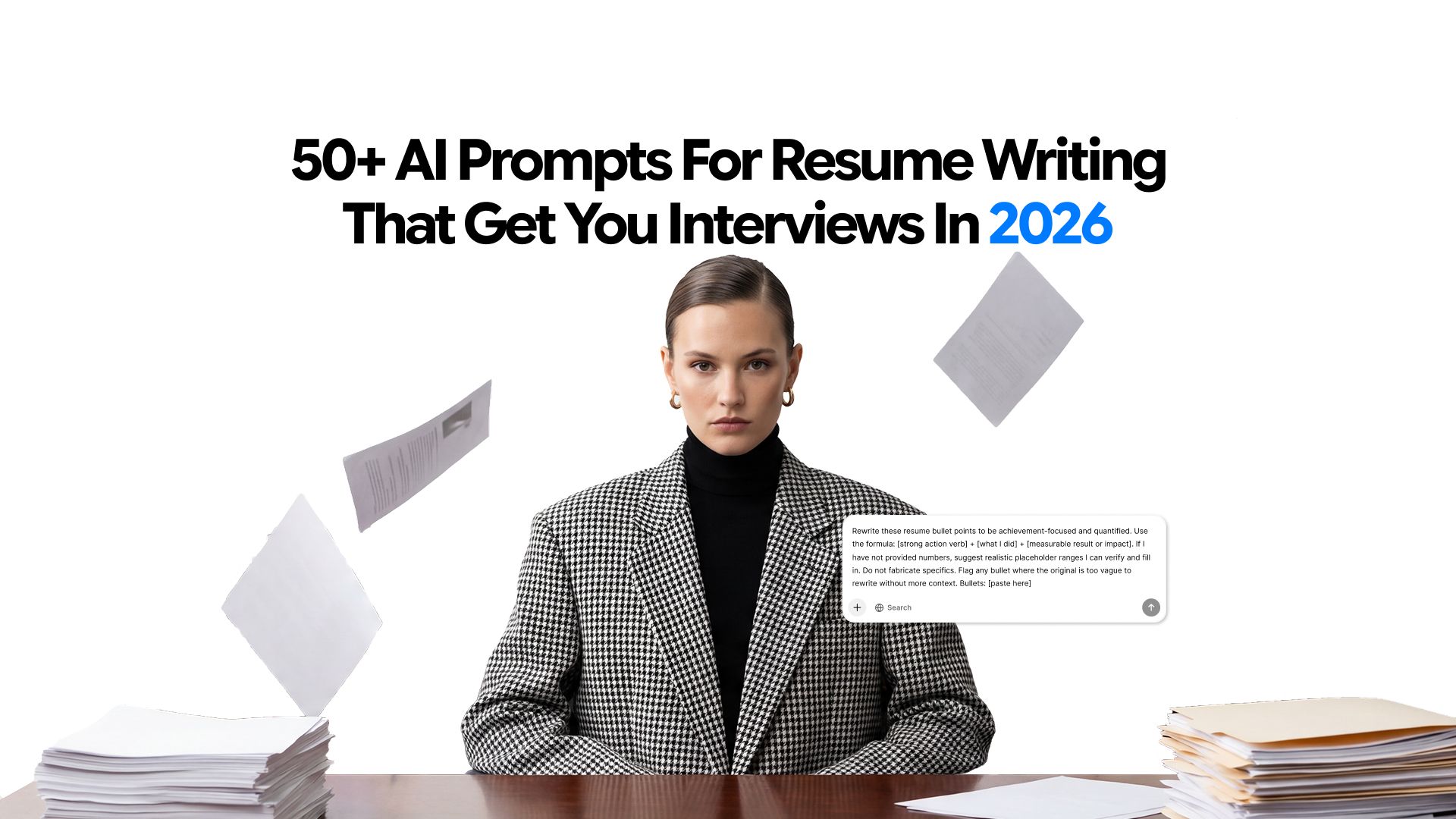
"Rewrite these resume bullet points to be achievement-focused and quantified. Use the formula: [strong action verb] + [what I did] + [measurable result or impact]. If I have not provided numbers, suggest realistic placeholder ranges I can verify and fill in. Do not fabricate specifics. Flag any bullet where the original is too vague to rewrite without more context. Bullets: [paste here]"
What this is for: Turning a list of job duties into evidence of impact. Use this before anything else.
Prompt 2: Bullet points for a specific role type
"Write 6 strong resume bullet points for a [job title] with [X years] of experience in [industry]. Focus on: [key responsibility area 1], [key responsibility area 2], and [key responsibility area 3]. Use varied action verbs. Quantify where possible using realistic figures for this role type. Tone: confident and specific."
What this is for: Building bullet points for a role you are applying to, not just describing the one you had.
Prompts to Replace Weak Action Verbs
"Responsible for" and "helped with" are resume killers. So are "managed", "led", and "supported" when used without context.
Prompt 3: Action verb audit and replacement
"Review these resume bullet points and identify every weak or overused opening verb. Replace each with a stronger, more specific verb that better reflects the level of ownership and impact described. Provide 2 alternative verb options per bullet so I can choose the one that fits best. Bullets: [paste here]"
What this is for: A quick pass to strengthen language without rewriting the whole thing.
Industry-Specific Bullet Point Prompts
Prompt 4: Industry-specific bullets
"Write 5 resume bullet points for a [job title] in [industry: e.g. fintech, healthcare, e-commerce]. Use terminology, metrics, and language that hiring managers in this industry would recognize and value. Each bullet should reflect a different area of impact: revenue, efficiency, team, product, or customer outcome."
What this is for: Making your resume read like it was written by someone who knows the industry, not someone describing tasks in generic language.
AI Prompts for Resume Summary and Professional Profile
The summary is the first thing a recruiter reads if the ATS lets them get that far. Most summaries are either missing entirely or so generic they add nothing.
Summary Prompts by Industry and Career Level
Prompt 5: Professional summary
"Write a 3-sentence professional summary for a [job title] with [X years] of experience in [industry] targeting a [target role] position. Sentence 1: who I am and my core area of expertise. Sentence 2: a specific achievement or differentiator. Sentence 3: what I bring to this type of role. Tone: confident, specific, human. Do not use 'results-driven', 'dynamic', 'passionate', 'synergy', or 'thought leader'."
What this is for: The top section of any resume. Rerun this for each role you apply to with the target role filled in differently.
Prompt 6: Senior or executive summary
"Write a 4-sentence executive summary for a [C-suite or senior title] with [X years] of experience in [industry]. Lead with a career-defining achievement. Include a quantified outcome. Reference the type of organization or challenge they thrive in. Close with a forward-looking statement about what they are seeking. Under 80 words. No generic language."
What this is for: Senior candidates who need a summary that signals gravitas without sounding like a LinkedIn cliche.
Summary Prompts for Career Changers
Prompt 7: Career change summary
"Write a professional summary for someone transitioning from [current industry or role] to [target industry or role]. Emphasize transferable skills: [list 3 to 5]. Acknowledge the transition briefly without apologizing for it. Focus on what this person brings to the new field that someone coming from inside the industry might not. Under 60 words."
What this is for: Anyone making a pivot who needs their summary to reframe their background as an asset, not a liability.
AI Prompts for Tailoring Your Resume to a Job Description
Sending the same resume to every job is one of the most common reasons people get no response. Tailoring does not mean rewriting from scratch. It means adjusting the language and emphasis for each role.
Gap Analysis Prompts Before You Apply
Prompt 8: Resume vs job description gap analysis
"Compare my resume against this job description. Give me three things: (1) the experience and skills I have that clearly match, (2) the gaps where I am weak or missing qualifications, and (3) experience I have that I should reframe to better align with what they are looking for. Be honest, not reassuring. JD: [paste]. Resume: [paste]."
What this is for: Before you apply to anything. Run this first so you know what you are working with.
Prompts to Reframe Experience for a New Role
Prompt 9: Experience reframe
"I am applying for a [target role] but my background is in [current field]. Here is a relevant experience from my resume: [paste bullet or section]. Reframe this experience using the language and priorities of the target role. Do not fabricate anything. Only use what is there. Make it sound like it belongs on the resume of someone who has always been in [target field]."
What this is for: Career changers, internal candidates applying to different departments, or anyone whose experience is relevant but not obviously named as such.
Skills Section Optimization Prompts
Prompt 10: Skills section rewrite
"Review my current skills section and the following job description. Identify: skills I have listed that are not mentioned in the JD and could be deprioritized, skills mentioned in the JD that I have but have not listed, and the optimal ordering of skills based on what this role values most. Current skills: [paste]. JD: [paste]."
What this is for: Making the skills section work harder without adding skills you do not have.
AI Prompts for ATS Optimization and Keyword Targeting
This is the part most people skip and then wonder why they are not getting callbacks.
ATS Keyword Extraction Prompts
Prompt 11: ATS keyword extraction
"Analyze this job description and extract the top 15 ATS keywords grouped into three categories: must-have technical skills, must-have soft skills or competencies, and industry or role-specific terminology. Then review my resume and tell me which keywords are missing or underrepresented. JD: [paste]. Resume: [paste]."
What this is for: Any application to a company that uses an ATS, which is most companies with more than 50 employees.
Prompt 12: Keyword integration
"I need to integrate these keywords into my resume naturally without keyword stuffing: [list keywords]. Review my current resume and suggest where each keyword can be added or substituted, either in bullet points, the summary, or the skills section. Only suggest placements that are accurate to my actual experience. Resume: [paste]."
What this is for: After you have identified the keywords you are missing, this is how you add them without making your resume read like a keyword list.
ATS Formatting Audit Prompts
Prompt 13: ATS formatting check
"Review this resume for ATS compatibility. Flag: any formatting elements that ATS parsers typically cannot read (tables, columns, text boxes, headers and footers, graphics, unusual fonts), any section headings that may not be recognized by standard ATS systems, and any structural issues that could cause parsing errors. Suggest a clean, ATS-safe alternative for each flagged element. Resume: [paste]."
What this is for: Anyone using a designed or template resume. Most look great to humans and are invisible to ATS.
AI Prompts for Cover Letters That Get Responses
Most cover letters are ignored because they repeat the resume and add nothing. These prompts produce cover letters that do something different.
Cover Letter Opening Prompts
Prompt 14: Cover letter hook variations
"Write 3 alternative opening paragraphs for a cover letter applying to [role] at [company]. Each should use a different angle: Angle 1: lead with a shared company value or mission and connect it to my background. Angle 2: lead with a specific achievement of mine that is directly relevant to this role. Angle 3: lead with a question or observation about the company that shows genuine research. Under 60 words each. No 'I am writing to apply for' opener. No 'I have always been passionate about'."
What this is for: The opening paragraph is where 80% of cover letters lose the reader. Test all three angles and use the one that fits the company culture best.
Cover Letter Body Prompts
Prompt 15: Cover letter body
"Write the body section of a cover letter for [role] at [company]. I need to address these 3 requirements from the job description: [paste requirements]. For each requirement, connect it to a specific experience from my background: [paste relevant experiences]. Do not repeat what is already on my resume. Add context and dimension that the resume cannot show. Under 200 words total for the body."
What this is for: Making the cover letter do actual work instead of summarizing a document the recruiter already has.
Cover Letter Closing Prompts
Prompt 16: Cover letter closing
"Write 3 closing paragraph options for a cover letter for [role]. Each should: thank the reader without being sycophantic, express genuine interest in a next conversation, and include a confident but not arrogant CTA. Under 40 words each. No 'I look forward to hearing from you at your earliest convenience'."
What this is for: Endings that leave a good impression rather than trailing off with a formality.
AI Prompts for LinkedIn Profile Alignment with Your Resume
Your LinkedIn and resume need to tell the same story in different formats. If a recruiter checks your LinkedIn after reading your resume and it feels like a different person, that is a problem.
LinkedIn Headline Prompts
Prompt 17: LinkedIn headline
"Write 5 LinkedIn headline options for a [job title] who is [actively job seeking / open to opportunities / building a personal brand]. Each headline should be under 220 characters and include: current or target role, a key skill or area of expertise, and one differentiator. Include keywords relevant to [industry]. Avoid: 'passionate about', 'results-driven', 'thought leader', 'guru', 'ninja', 'rockstar'."
What this is for: The headline is the most-read line on your LinkedIn. Most people leave it as their job title and miss the entire opportunity.
LinkedIn About Section Prompts
Prompt 18: LinkedIn about section
"Write a LinkedIn About section for a [role] with [X years] in [industry]. Goal: [attract recruiters / build clients / establish credibility in a new field]. Tone: professional but conversational, first person. Include: what I do, who I help, what makes my approach different, and a clear CTA. Under 300 words. Do not just restate my resume. Add voice, context, and a point of view."
What this is for: The About section is the one place on LinkedIn where your personality can show. Use it.
LinkedIn Experience Bullet Prompts
Prompt 19: LinkedIn experience bullets
"Rewrite these resume bullet points for LinkedIn format. LinkedIn bullets can be slightly longer and more conversational than resume bullets. Add context where helpful. Keep each under 40 words. Maintain the achievement-focus but allow for a slightly more human tone than a formal resume. Bullets: [paste]."
What this is for: LinkedIn experience sections that read well in the feed, not just as a document download.
AI Prompts for Interview Preparation Using Your Resume
Your resume got you the interview. Now it needs to prep you for it.
STAR Story Prompts From Your Resume
Prompt 20: STAR story development
"Take this resume bullet point and develop it into a full STAR story (Situation, Task, Action, Result) I can use in an interview. Write it in natural spoken language, not rehearsed script. Keep it under 2 minutes when spoken aloud. Add a reflection line at the end that shows what I learned or how I would apply it going forward. Bullet: [paste]."
What this is for: Preparing for behavioural interview questions. Every strong bullet point on your resume should have a STAR story behind it. Use Chatly's AI Story Generator to develop narrative versions of your experience that work in interviews, not just on paper.
Likely Interview Question Prediction Prompts
Prompt 21: Interview question prediction
"Based on this job description and my resume, predict the 10 most likely interview questions I will be asked. Include: 3 behavioural questions based on the competencies in the JD, 3 technical or role-specific questions, 2 questions about gaps or transitions in my background, and 2 culture or motivation questions. For each, note what a strong answer would focus on. JD: [paste]. Resume: [paste]."
What this is for: Walking into an interview with the 10 most likely questions already prepared instead of hoping for the best.
AI Prompts for Career Changers and Non-Linear Experience
Non-linear careers are more common in 2026 than they have ever been. The prompts in this section are built for people whose path does not fit a straight line.
Prompts to Map Transferable Skills
Prompt 22: Transferable skills map
"I am transitioning from [current field] to [target field]. Here is a summary of my experience: [paste]. Identify the top 8 transferable skills from my background that are directly relevant to [target field]. For each skill: name it, explain how my experience demonstrates it, and suggest how to frame it on a resume targeting [target role]. Be specific, not generic."
What this is for: Identifying and naming the strengths you already have that you might not realize translate.
Prompts for Freelance and Portfolio Careers
Prompt 23: Freelance experience summary
"Write a resume section for someone with [X years] of freelance or contract experience in [field]. Group projects by: skill area or outcome rather than client name (for confidentiality). Highlight: range of clients served (by type, not name), key deliverables and outcomes, and any recurring or long-term client relationships. Tone: professional and credible. Avoid making it look like job-hopping."
What this is for: Freelancers and consultants whose experience does not fit a traditional employment history format.
AI Prompts for Formatting and Resume Audit
A resume that cannot be parsed is a resume that does not exist.
Resume Audit and Readability Prompts
Prompt 24: Resume audit
"Audit this resume for: length (is it appropriate for the experience level?), structure (does the most important information appear first?), readability (are sections clearly labeled and easy to scan in under 30 seconds?), ATS compatibility (any formatting red flags?), and language (any weak verbs, vague claims, or filler phrases to cut?). Give specific recommendations for each category. Resume: [paste]."
What this is for: A full diagnostic before you submit to any application. Run this once and fix the issues before anything else.
Prompt 25: Resume cut-down
"This resume is [X pages] long and needs to be [target length]. Identify: the 3 sections or bullet points with the lowest impact that should be cut or condensed, any repetition across sections that can be removed, and any older experience (10+ years ago) that can be summarized rather than detailed. Keep all the strongest evidence of impact. Resume: [paste]."
What this is for: Experienced candidates whose resume is too long and needs to be tightened without losing the substance.
AI Prompts for Senior and Executive Resumes
Executive Resume Prompts
Prompt 26: C-suite resume summary
"Write a 4-sentence executive summary for a [C-suite title] with [X years] in [industry]. Lead with a career-defining outcome or transformation they led. Include a quantified business result. Reference the type of organization or challenge they thrive in. Under 80 words. Zero generic language."
What this is for: CEO, CFO, COO, CTO, and VP-level candidates who need a summary that signals gravitas immediately.
Prompt 27: Board member bio
"Write a professional board member bio for [name or 'me'], a [background description]. This bio will be used on a company website and in investor materials. Include: current and most relevant past roles, key expertise areas, notable achievements, and any board or advisory roles held. Third person. Under 150 words. Authoritative but human."
What this is for: Board positions, advisory roles, investor presentations, conference speaker bios.
Prompt 28: Executive leadership statement
"Write a 3-paragraph leadership philosophy statement for a [executive title] in [industry]. Paragraph 1: core belief about leadership and people. Paragraph 2: how that translates to how they build and run teams. Paragraph 3: what they are focused on and why it matters now. Authentic and specific. Not generic motivational language."
What this is for: Executive portfolios, board applications, thought leadership profiles.
AI Prompts for Specific Resume Sections
Skills, Education, and Certification Prompts
Prompt 29: Skills section build
"Build a skills section for a [job title] targeting [target role] in [industry]. Organize skills into 3 to 4 categories (e.g. technical skills, tools and platforms, soft skills, languages). Include only skills that are relevant to [target role]. Prioritize skills that appear most frequently in job descriptions for this role type."
What this is for: Building or rebuilding a skills section that passes ATS and reads well to a human.
Prompt 30: Education section optimization
"Review my education section and suggest how to present it most effectively for a [target role]. Current education: [paste]. Should I include GPA, relevant coursework, awards, or extracurriculars? What should I cut? How should I order it relative to my experience section given that I have [X years] of work experience?"
What this is for: Recent graduates, career changers, and anyone unsure how prominently to feature their education.
Prompt 31: Certifications and training section
"Write a certifications and professional development section for my resume. I have completed: [list certifications, courses, training]. Organize these by relevance to [target role]. Flag any that are expired or that I should not include. Suggest the best format: list, table, or inline with skills."
What this is for: Technical roles, regulated industries, and anyone with multiple certifications who needs to present them cleanly.
Prompt 32: Projects and portfolio section
"Write a projects section for my resume targeting [target role]. Projects to include: [list projects with brief descriptions]. For each project write: a one-line description, the technologies or skills used, your specific contribution if it was a team project, and the outcome or impact. Format consistently. Each entry under 50 words."
What this is for: Developers, designers, consultants, and anyone whose work lives in a portfolio or project history.
AI Prompts for Job Search Strategy
Job Search Strategy and Application Prompts
Prompt 33: Target company research brief
"I am applying to [company name] for the role of [role]. Research their: core business model, recent news or announcements, culture and values based on public information, the likely priorities of the hiring manager in this role, and how my background in [your background] aligns with what they need. Format as a brief I can use to tailor my application and prepare for interview."
Chatly's Ask AI tool lets you query company information and get structured answers fast before you run this prompt.
What this is for: High-priority applications where you want to show genuine company knowledge.
Prompt 34: Job description analysis
"Analyze this job description and tell me: the top 5 must-have requirements, the top 3 nice-to-haves, the likely day-to-day responsibilities not explicitly stated, the seniority level implied by the language, any red flags in the wording, and the culture signals I can pick up from how it is written. JD: [paste]."
What this is for: Before you apply to any role. Understand what you are applying to before you customize your materials.
Prompt 35: Application tracking system
"Help me set up a simple job application tracker. I need columns for: company name, role title, date applied, application status, next action required, deadline, contact name, and notes. Suggest 5 status labels that cover the full journey from applied to offer or rejection. Format as a table I can copy into a spreadsheet."
What this is for: Anyone applying to multiple roles who needs to stay organized without losing track of where they are.
Prompt 36: Salary negotiation email
"Write a salary negotiation email for a job offer from [company] for the role of [role]. The offered salary is [amount]. My target is [target]. Justify the ask using: [reason 1: e.g. market data], [reason 2: e.g. competing offer or current salary], and [reason 3: specific experience or value I bring]. Tone: confident, collaborative, not demanding. Under 200 words."
What this is for: Negotiating a first offer without sounding entitled or leaving money on the table.
AI Prompts for Networking and Referral Requests
Networking and Referral Prompts
Prompt 37: Referral request email
"Write an email to [contact name], a [their role] at [company I am applying to], asking if they would be willing to refer me for the [role] position. We know each other from [context]. Include: a brief reminder of who I am, why I am excited about this specific role, and a low-friction ask that does not put them in an awkward position. Under 150 words."
What this is for: Activating your network for internal referrals, which significantly increase interview rates.
Prompt 38: Cold outreach to hiring manager
"Write a cold outreach message to [hiring manager name or 'the hiring manager'], [title] at [company], about the [role] position. I am not applying through the standard portal. Reference something specific about the company or their work: [specific detail]. Make a brief case for why my background in [your background] is relevant. End with a low-pressure ask. Under 120 words. Platform: [LinkedIn/email]."
What this is for: Bypassing the ATS entirely by reaching the decision-maker directly.
Prompt 39: LinkedIn connection request to recruiter
"Write a LinkedIn connection request to a recruiter at [company] who works on [type of roles]. I am actively looking for [target role] opportunities. Reference something specific about their profile or recent posts if possible: [detail or 'nothing specific']. Under 200 characters. Do not start with 'I came across your profile'."
What this is for: Building recruiter relationships before a role is posted.
Prompt 40: Thank you email after interview
"Write a thank you email to send within 24 hours of an interview for [role] at [company]. Interviewer: [name and title]. Reference one specific thing we discussed: [topic]. Reinforce one key reason I am the right fit. Close with genuine enthusiasm for the next step. Under 150 words. Professional and warm, not sycophantic."
What this is for: Post-interview follow-up that reinforces your candidacy and keeps you top of mind.
AI Prompts for Specialized Resume Types
Academic, Government, and International Resume Prompts
Prompt 41: Academic CV summary
"Write an academic CV personal statement for a [academic role: e.g. lecturer, postdoc, research fellow] in [field]. Include: research focus in plain language, key publications or projects, teaching philosophy in 1 sentence, and what I am looking for in my next position. Under 200 words. Formal academic tone."
What this is for: Academic job market applications, fellowship applications, research position submissions. Use the Chatly Citation Generator to format your publications correctly before adding them to your CV.
Prompt 42: Federal or government resume
"Help me adapt this resume for a federal government application. Federal resumes require more detail than standard resumes. For each role, expand the description to include: exact dates (month and year), hours per week, supervisor name and contact placeholder, detailed duties using government-friendly language, and specific accomplishments. Current resume: [paste]. Target agency and role: [details]."
What this is for: US federal job applications, government contractor roles, public sector positions.
Prompt 43: International resume adaptation
"Adapt this resume for a job application in [target country]. Note any format differences I should be aware of (e.g. photo, date of birth, nationality, references format, CV vs resume length norms). Rewrite the summary and top bullet points using language and terminology common in [country]'s [industry] job market. Current resume: [paste]."
What this is for: Relocating internationally or applying to multinational companies with regional hiring standards.
Prompt 44: Creative industry resume
"Rewrite this resume for a [creative role: e.g. art director, UX designer, copywriter, filmmaker] applying to [company type]. Creative industry resumes prioritize: portfolio link prominence, project-based experience, tools and software proficiency, and a distinctive voice. Make this feel like it belongs to a creative professional, not a corporate one. Current resume: [paste]."
What this is for: Design, advertising, media, fashion, and entertainment industry applications.
AI Prompts for Resume Quality Control
Final Review Prompts Before You Submit
Prompt 45: Consistency check
"Review this resume for consistency issues: date formats (are they all the same?), punctuation at the end of bullet points (all or none?), tense (past tense for past roles, present for current?), capitalization of job titles and company names, and spacing or formatting irregularities. Flag every inconsistency with the line number or section. Resume: [paste]."
What this is for: The final pass before submitting. Inconsistency signals carelessness to a hiring manager.
Prompt 46: Jargon and clarity check
"Review this resume and flag: industry jargon that a recruiter outside my field might not understand, acronyms that are not spelled out on first use, vague phrases that could be made more specific, and any sentence that takes more than one read to understand. Suggest a plain-language alternative for each flagged item. Resume: [paste]."
What this is for: Anyone applying across industries or to companies where the hiring manager may not be a subject matter expert.
Prompt 47: Keyword density check
"Compare this resume against this job description and tell me: how many times the most important keywords appear in my resume, whether the density feels natural or forced, which keywords I am still missing, and whether my resume reads like a human wrote it or like it was stuffed with keywords for an ATS. JD: [paste]. Resume: [paste]."
What this is for: Final ATS check before submitting to a role you really want.
Prompt 48: First impression test
"Read this resume as if you are a recruiter who has 10 seconds to decide whether to read further. After 10 seconds of scanning: what role does this person appear to be applying for, what is their most impressive qualification, what is confusing or unclear, and would you read further? Give honest feedback, not encouragement. Resume: [paste]."
What this is for: Stress-testing whether your resume communicates clearly at a glance before a human sees it.
Prompt 49: Final submission checklist
"Run a final pre-submission checklist on this resume. Check: correct name and contact details at the top, no placeholder text left unfilled, file name is professional (not 'Resume_final_v3_FINAL'), no personal information that should not be included (e.g. age, marital status, photo if applying to US/UK roles), and the format saves cleanly as a PDF. Flag anything that needs fixing. Resume: [paste]."
What this is for: The last 5 minutes before you hit send.
Prompt 50: Recruiter eyes review
"Pretend you are an in-house recruiter at a [company type] who receives 200 applications a week for [role type]. Review this resume and tell me: does it make the shortlist or not, and exactly why. If it does not, what are the top 3 reasons it gets rejected? Be blunt. Do not soften the feedback. Resume: [paste]."
What this is for: Getting honest, calibrated feedback before you apply anywhere else.
Prompt 51: Post-rejection resume audit
"I applied for [role] at [company] and did not get an interview. Here is my resume: [paste]. Here is the job description: [paste]. Identify the most likely reasons my application was rejected: ATS filtering, qualification gaps, weak bullet points, poor tailoring, or something else. Tell me specifically what to fix before I apply to similar roles."
What this is for: Learning from rejections instead of repeating the same application mistakes.
Prompt 52: Peer comparison prompt
"Imagine you are comparing my resume against a strong competing candidate for [role] at [company type]. The competing candidate has [X years] of experience in [field]. Where does my resume fall short in comparison? What would make mine stronger? Be specific about what to add, remove, or reframe. My resume: [paste]."
What this is for: Understanding how you stack up against competition before the interview stage.
ChatGPT vs Claude vs Gemini for Resume Writing in 2026
Different models handle resume tasks differently. Most people do not realize this until they have submitted a mediocre resume that could have been much better.
Which Model Is Best for Resume Bullet Points
GPT-5 is the strongest model for structured resume tasks. It follows formatting instructions precisely, produces clean bullet points at the right length, and handles keyword integration without over-stuffing. For ATS optimization and bullet rewrites, GPT-5 is the most reliable starting point.
Claude Sonnet 4.6 produces more natural-sounding language and is the strongest model for summaries, cover letters, and anything where the tone needs to sound like a real person wrote it. If your bullet points are technically fine but feel robotic, run them through Claude.
Gemini 2.5 Pro is useful when you want to cross-reference your resume against real-time job market language or current industry trends. It is less consistent than GPT-5 for structured formatting tasks.
Which Model Works Better for Cover Letters
Claude wins here consistently. Cover letters require voice, personality, and tone calibration that GPT-5 handles adequately but Claude handles with more nuance. If you are writing a cover letter for a role where culture fit matters as much as credentials, Claude is the model to use.
Why Running Multiple Models on Chatly Matters
Most resume tools give you one model and call it done. Chatly lets you run the same resume prompt across GPT-5, Claude Sonnet 4.6, Gemini 2.5 Pro, and more in one interface. One might nail the structure. One might nail the voice. You pick the best of both instead of settling for whatever one model gives you. If you want a full breakdown of how different AI models compare across writing tasks, the ChatGPT alternatives guide covers that in detail.
How Chatly Helps You Compare Resume Rewrites Across Models
Most AI resume tools give you one output from one model and call it done. If that output is mediocre, you either accept it or start over somewhere else.
Chatly lets you run the same resume prompt across GPT-5, Claude, Gemini, and more in one interface. You see both outputs side by side. You take the bullet structure from one and the tone from another. You end up with something better than either model would have produced alone.
You can also use Chatly's Paraphrasing Tool to adapt your resume language for different industries without rewriting every bullet from scratch, and the AI Humanizer to make sure your cover letter sounds like a person wrote it, not a tool trying to sound like a person. For a complete AI-generated resume document rather than section-by-section editing, the AI Resume Generator builds a full resume from your inputs directly.
Less rewriting. More interviewing.
FAQs About Using AI Prompts for Resume Writing
More topics you may like