
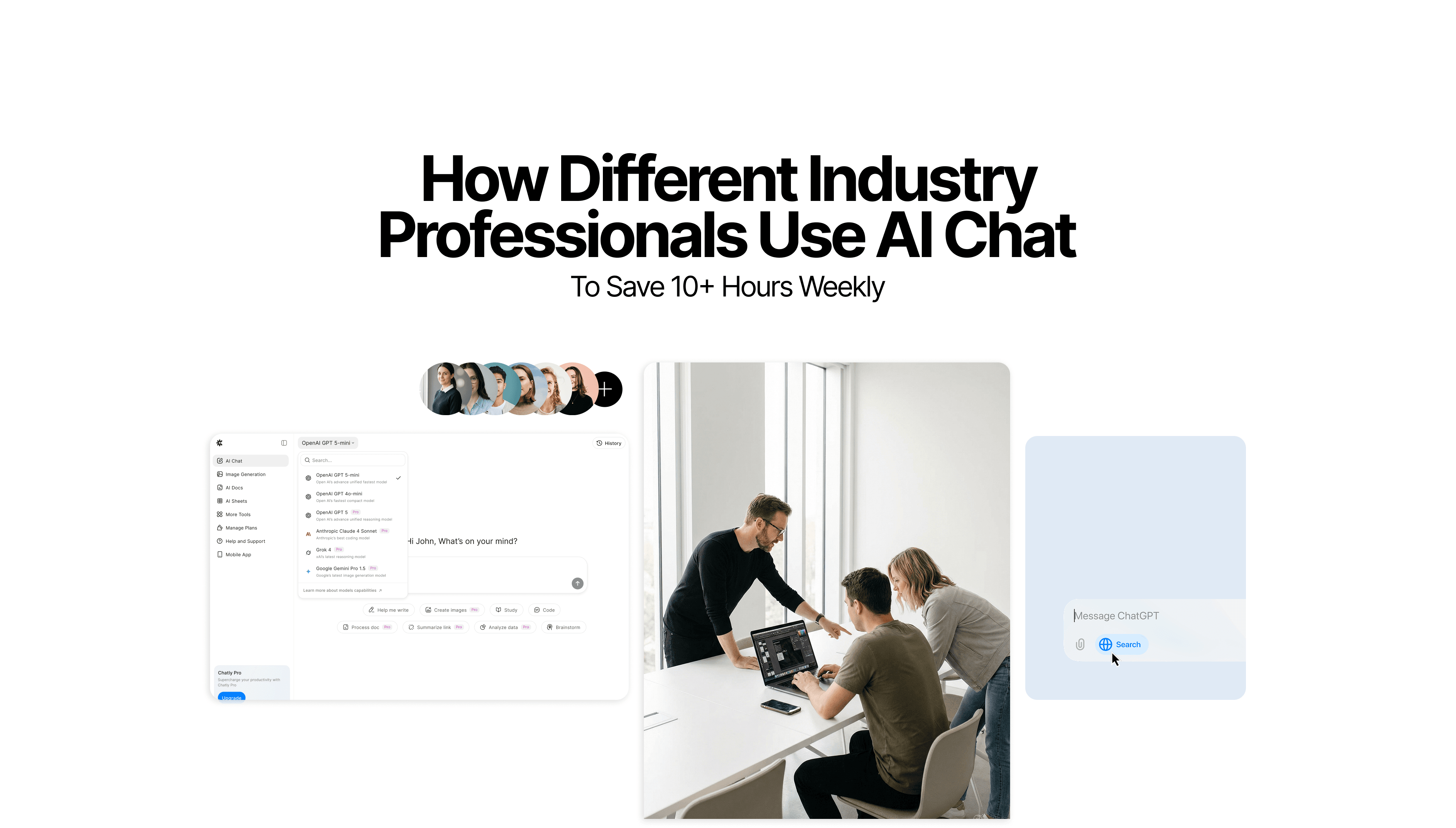
How Different Industry Professionals Use AI Chat to Save 10+ Hours Weekly
The professional world has changed dramatically in the past couple of years. AI chat tools have moved from experimental curiosities to essential productivity partners across different industries.
What started as a tool for tech-savvy early adopters has become as commonplace as email or spreadsheets.
Professionals worldwide are discovering that AI chat helps them work smarter and faster. Once you master how to set it up properly according to your need, conversational AI has applications that can transform your daily workflow.
This guide explores how different industries are using AI chat in practical, revenue-generating ways. You'll discover real applications that professionals are using right now to save time, improve quality, and focus on what they do best.
But first, it’s important to clarify why professionals trust AI as much as they do.
Why Professionals Are Making the Switch
Professionals using AI chat report saving 5-10 hours weekly on routine tasks. That's measurable time redirected from drafting and administrative work toward client relationships and strategic thinking.
Quality improvements matter equally. AI chat maintains consistency, reduces errors, and provides expert-level assistance on unfamiliar topics. And on top of that, it's roughly the price of a few software subscriptions for 24/7 assistance.
So, teams no longer have to have expensive subscriptions to different tools. They can just get one AI tool that provides similar results.
But successful application hinges on successful identification. What I mean by that is that you cannot just impose AI on your workers and expect results.
It has to be strategic and thoughtful. Identify repetitive tasks in your workflow that follow similar patterns. Monthly reports, client emails, project documentation, and research tasks yield the highest returns.
Privacy considerations vary by industry as well. Healthcare and legal professionals need extra caution with client data. Always understand your industry's regulations and your tool's data handling policies.
Best practices remain consistent:
- Review all outputs,
- Maintain professional judgment
- Be transparent when appropriate
Now let's explore how specific industries are putting these principles into practice.
1. Healthcare & Medicine
I know people get skeptical when they hear AI and healthcare in the same sentence. But hear us out.
The healthcare industry has embraced AI chat cautiously but effectively, focusing on administrative efficiency rather than clinical decision-making.
Clinical documentation represents the biggest time sink for healthcare providers. Physicians spend nearly 2 hours on paperwork for every hour of patient care. AI chat helps draft progress notes, patient education materials, and follow-up communications in minutes instead of hours.
Researchers have reported that patient education has improved dramatically as well. Doctors translate complex medical information into plain language that patients understand, creating customized post-visit instructions and medication explanations.
Specific applications by role:
- Physicians & Surgeons: Pre-operative documentation, patient follow-up templates, medical research summaries, and peer consultation preparation
- Nurses: Shift handoff reports, patient care documentation, health education materials, and family communication support
- Mental Health Professionals: Session notes, treatment plans, therapeutic resource creation, and progress report generation
- Pharmacists: Drug information sheets, patient counseling guides, medication therapy management documentation
- Medical Researchers: Literature reviews, grant writing assistance, public health journals, data interpretation support, and publication drafting
Physicians using AI chat for documentation report saving 4-6 hours weekly, time redirected toward patient care.
2. Legal Services
Law firms were initially skeptical too. But early adopters gained significant competitive advantages through faster turnaround times.
Legal research has been transformed. Lawyers use AI chat to understand case law, identify precedents, and draft research memos. While it doesn't replace legal databases, it excels at extracting information from said databases and synthesizing information to explain complex concepts.
Case studies and reviews along with drafting support saves junior associates countless hours. AI chat identifies standard clauses, suggests language for provisions, and flags unusual terms for attorney review. This allows senior lawyers to focus on strategy.
Client communication becomes more efficient with AI assistance. Lawyers draft engagement letters, status updates, and explanation emails faster while maintaining appropriate formality and precision.
Specific applications by role:
- Attorneys & Lawyers: Case research, legal writing, client correspondence, deposition preparation, and brief drafting
- Paralegals: Document review, citation checking, filing preparation, client intake forms, and discovery organization
- Legal Researchers: Precedent analysis, regulatory updates, case summaries, and jurisdictional comparisons
- Compliance Officers: Policy documentation, regulatory interpretation, audit preparation, and training material creation
Mid-sized firms report AI chat allows them to compete with larger firms on turnaround time without increasing headcount.
3. Real Estate
Real estate professionals use AI chat primarily for marketing and client communication. Before AI chat, firms spent way too much time on marketing copies and content. Now, it takes half that.
Property listing optimization makes the biggest impact. Agents craft compelling descriptions that highlight features, appeal to target buyers, and incorporate keywords. What once took 30-45 minutes per listing now takes 5-10 minutes.
Market analysis and comparative reports become faster to produce. Agents structure market updates, explain pricing trends, and create neighborhood guides efficiently.
Client communication throughout transactions benefits enormously from AI assistance. From initial outreach to closing, agents maintain consistent, professional communication without hours on email.
Specific applications by role:
- Real Estate Agents: Listing descriptions, buyer/seller emails, market updates, open house promotions, and social media content
- Property Managers: Tenant communications, maintenance requests, lease reviews, property reports, and policy documentation
- Real Estate Appraisers: Appraisal report writing, market analysis, comparable property research, and client explanations
- Commercial Brokers: Investment analysis summaries, tenant prospecting, proposal creation, and due diligence documentation
Top agents report AI chat allows them to serve 20-30% more clients without sacrificing service quality.
4. Finance & Banking
Financial professionals balance AI adoption with regulatory compliance, finding value in client communication and analysis.
Financial analysis and report generation benefit significantly from AI assistance. Analysts structure investment memos and summarize earnings reports while maintaining consistency.
Client education has improved across the industry. Financial advisors create personalized newsletters, portfolio reviews, and planning documents faster, serving more clients while maintaining personalization.
Market research and trend analysis move faster with AI chat. Professionals synthesize information from multiple sources and create executive summaries in a fraction of traditional time.
Specific applications by role:
- Financial Advisors: Client newsletters, portfolio reviews, financial planning documents, meeting preparation, and educational content
- Investment Analysts: Research reports, earnings analysis, sector comparisons, investment memos, and presentation creation
- Accountants & CPAs: Tax planning guides, client explanations, financial statement notes, audit documentation, and advisory letters
- Insurance Agents: Policy comparisons, coverage explanations, claims documentation, client proposals, and renewal communications
- Loan Officers: Application review summaries, client communications, documentation preparation, and product explanations
Advisors using AI chat report 40% faster turnaround on client requests, leading to higher satisfaction and retention.
5. Marketing & Advertising
Marketing has perhaps the highest AI chat adoption rate because the possibilities are endless. Marketers can implement it across channels and campaigns and drive conversions.
Campaign strategy and creative ideation has become a walk in the park. AI can generate variations quickly and marketers can brainstorm headlines, test messaging angles, and develop content themes in collaborative sessions.
Multi-channel content creation represents the most common use case. Marketers draft social posts, email campaigns, landing pages, and blog content with AI assistance, adapting core messages across formats and audiences.
Performance analysis becomes less tedious. Marketers interpret analytics, identify trends, and create client-facing reports that explain what numbers mean and what actions to take.
Specific applications by role:
- Digital Marketers: Campaign briefs, ad copy variations, landing page content, A/B test hypotheses, and performance summaries
- Social Media Managers: Content calendars, post variations, community responses, trend analysis, and engagement strategies
- Content Marketers: Blog outlines, SEO optimization, content repurposing, editorial calendars, and topic research
- Brand Strategists: Brand voice guides, positioning statements, competitive analysis, and messaging frameworks
- Email Marketers: Subject lines, email sequences, segmentation strategies, and performance analysis
- SEO Specialists: Keyword analysis, content optimization, meta descriptions, and content gap identification
Marketing teams report 50-70% reduction in time spent on first drafts, allowing more time for strategy and optimization.
6. Content Creation & Media
Content creation requires hours of research, writing, editing, and reviewing. So, when they realized they have a tool that can do most of this for them in half the time, they adapted it faster than anyone else.
Since that, it has been a valuable partner in enhancing creativity and productivity.
Content ideation and brainstorming accelerate with AI assistance. Creators overcome writer's block, explore new angles, and develop content series faster. The tool serves as an always-available brainstorming partner.
Research and fact-gathering become more efficient. Content creators quickly understand new topics, find relevant statistics, and synthesize information from multiple sources, allowing consistent publication schedules.
Drafting and editing support helps creators produce higher-quality work faster. While most write their own final content, AI chat helps with outlines, rough drafts, and structural feedback.
Specific applications by role:
- Writers & Authors: Outline development, research, script & character development, editing support, and writer's block solutions
- Podcasters: Episode planning, show notes, guest research, question preparation, and transcript editing
- Video Creators/YouTubers: Script writing, title optimization, description writing, content strategy, and thumbnail concepts
- Journalists: Interview preparation, source research, article structuring, fact-checking support, and headline variations
- Bloggers: Topic ideation, SEO optimization, content updates, reader engagement, and monetization strategies
- Copywriters: Campaign concepts, headline variations, body copy drafts, and brand voice adaptation
Professional creators report maintaining or improving quality while increasing output by 30-40%.
7. Education & Training
Educators use AI chat to enhance lesson quality and reduce administrative burden, freeing more time for actual teaching.
Curriculum and lesson planning benefit enormously from AI assistance. Teachers create lesson plans, learning activities, and unit outlines faster while ensuring alignment with objectives. The tool helps generate fresh approaches and adapt content for different levels.
Assessment creation and rubric development accelerate with AI chat. Educators generate quiz questions, discussion prompts, and project ideas efficiently, ensuring comprehensive coverage of objectives.
Student feedback and communication improve in quality and can be provided in a timely manner. Teachers draft parent communications, student feedback, and recommendation letters faster, ensuring every student receives thoughtful attention.
Specific applications by role:
- Teachers (K-12): Lesson plans, differentiated materials, parent communications, assignment creation, and grading rubrics
- Professors & Academics: Syllabus development, lecture notes, research paper feedback, academic writing support
- Corporate Trainers: Training modules, workshop materials, assessment design, learning objectives, and post-training surveys
- Instructional Designers: Course outlines, learning activities, multimedia scripts, learner personas, and evaluation frameworks
- Tutors: Personalized study guides, concept explanations, practice problems, progress reports, and learning strategies
Educators report AI chat saves 3-5 hours weekly on planning and administrative tasks, time reinvested in student interaction.
8. Technology & Software
The tech industry was among the first to adopt AI chat, and developers continue discovering new applications daily.
Technical documentation creation has become significantly faster. Developers write clear API documentation, user guides, and code comments efficiently. What once required dedicated technical writers can now be handled by engineers with AI assistance.
Code review, debugging support, and now vibe coding accelerates development cycles. AI helps developers spot potential issues, suggest optimizations, and explain complex code. Junior developers particularly benefit from having AI explain unfamiliar patterns.
Product specification writing improves in speed and clarity. Product managers draft requirements documents, user stories, and feature specifications faster while maintaining precision.
Specific applications by role:
- Software Developers: Code debugging, documentation writing, algorithm explanations, code review comments, and technical blog posts
- Product Managers: PRDs, user stories, roadmap communications, stakeholder updates, and feature specifications
- UX/UI Designers: User research synthesis, interface copy, design critiques, usability testing scripts, and persona creation
- DevOps Engineers: Runbook creation, incident reports, system documentation, automation scripts, and postmortem analyses
- Technical Writers: API documentation, user guides, tutorials, release notes, and knowledge base articles
Development teams report 30-40% reduction in documentation time, allowing engineers to focus more on building.
9. Sales & Business Development
Sales professionals have discovered that AI chat dramatically increases their ability to personalize outreach without neglecting intent or message.
Sales representatives craft customized emails that reference specific pain points and industry challenges, maintaining authenticity while eliminating time bottlenecks.
Proposal and pitch creation accelerates significantly. Account executives draft customized proposals, create presentation decks, and develop ROI calculations tailored to each prospect.
Market and competitor research becomes more efficient. Business development teams synthesize competitive intelligence, identify market trends, and prepare for client conversations effectively.
Specific applications by role:
- Sales Representatives: Email sequences, pitch personalization, objection responses, follow-up templates, and demo preparation
- Business Development Managers: Partnership proposals, market analysis, outreach strategies, and contract summaries
- Account Executives: Proposal writing, presentation decks, ROI calculations, client onboarding, and renewal communications
- Customer Success Managers: Onboarding guides, health check frameworks, upsell strategies, and customer advocacy programs
- Sales Engineers: Technical demonstrations, solution documentation, RFP responses, and proof of concept plans
Top sales teams report closing deals 20% faster due to improved response times and proposal quality.
10. Human Resources & Talent
HR professionals use AI chat to maintain consistency and professionalism across employee communications while handling higher volumes.
Job descriptions and recruitment materials improve in quality and inclusivity. Recruiters craft compelling job postings that attract diverse candidates and accurately represent company culture.
Employee communication and policies benefit from AI's ability to explain complex topics clearly. HR managers draft policy updates and benefit explanations that employees understand, reducing follow-up questions.
Training and development content accelerates with AI assistance. Talent development specialists create learning programs and career development frameworks faster.
Specific applications by role:
- HR Managers: Policy drafts, employee handbooks, internal announcements, benefits communications, and HR reports
- Recruiters: Job postings, candidate outreach, interview guides, rejection letters, and employer branding content
- Talent Development Specialists: Training programs, career development plans, skill assessments, and learning paths
- Career Coaches: Resume feedback frameworks, interview preparation guides, career transition plans, and personal branding strategies
HR departments report handling 35% more employee inquiries without additional headcount while improving response quality.
11. E-commerce & Retail
Online retailers have found AI chat particularly valuable for product content and customer service, two areas that directly impact conversions.
Product content optimization drives measurable revenue improvements. E-commerce managers craft compelling product descriptions that highlight benefits and incorporate keywords naturally. Split testing shows AI-optimized descriptions often outperform human-only versions.
Customer service becomes faster and more consistent. Service teams develop comprehensive response templates for common issues while maintaining brand voice and empathy.
Marketing and promotional content production accelerates significantly. Store owners create email campaigns, social media posts, and promotional copy faster.
Specific applications by role:
- E-commerce Managers: Product descriptions, category page content, email campaigns, customer FAQs, and site content optimization
- Online Store Owners: Product naming, SEO optimization, customer service templates, returns policies, and promotional copy
- Retail Buyers: Vendor communications, trend analysis, product assortment planning, and buying justifications
- Customer Service Representatives: Response templates, troubleshooting guides, escalation documentation, and feedback analysis
E-commerce businesses using AI-optimized product content report conversion rate improvements of 8-15%.
12. Construction & Engineering
Construction and Engineering might seem odd applications for AI Chat tools. But these field are much more than concrete and machinery.
These fields require proposals and estimate writing which becomes far more efficient with ai chat. Contractors draft project proposals and scope documents that clearly explain technical details, allowing smaller firms to compete on professionalism.
Technical documentation and specifications improve in clarity. Architects and engineers write detailed specifications and create client-facing documentation that non-technical stakeholders understand.
Client communication throughout projects benefits from AI assistance. Project managers draft status updates, explain delays, and maintain professional correspondence with all stakeholders.
Specific applications by role:
- Contractors: Project proposals, estimate explanations, client communications, safety protocols, and change order documentation
- Architects: Project briefs, technical specifications, client presentations, building descriptions, and design rationale
- Engineers: Technical reports, calculation documentation, project proposals, regulatory compliance, and peer review comments
- Project Managers: Status updates, stakeholder communications, risk assessments, and project closeout reports
Construction firms report 25-30% faster proposal turnaround, allowing them to bid on more projects.
13. Hospitality & Food Service
Hospitality businesses use AI chat primarily for guest communications and marketing, both critical for competitive differentiation.
Guest communication and service excellence improve with AI-assisted messaging. Hotel managers craft personalized pre-arrival emails, respond to reviews professionally, and handle guest requests efficiently.
Staff training and operations documentation accelerates significantly. Hospitality managers create training materials and service protocols faster, ensuring consistent service quality.
Specific applications by role:
- Restaurant Owners: Menu descriptions, staff training guides, social media content, customer review responses, and event planning
- Hotel Managers: Guest communications, service protocols, staff handbooks, marketing materials, and online listing optimization
- Chefs & Culinary Professionals: Recipe documentation, menu planning, dietary accommodation guides, and cooking class materials
- Event Coordinators: Event proposals, timeline creation, vendor management communications, and client briefings
Hospitality businesses using AI chat report higher satisfaction scores and improved online reputation ratings.
The End of App Switching
The traditional workflow involves constant context switching. Write in Google Docs, research in your browser, analyze in Excel. Each switch breaks your focus and wastes minutes.
AI chat changes this fundamentally. Instead of jumping between applications, professionals accomplish multiple tasks within one conversational interface. Research, drafting, editing, analysis, and planning happen in one place.
The cognitive load reduction is significant. When you're not constantly switching tools, your brain has more energy for thinking. Deep work becomes easier when your workspace is a conversation.
This unified approach accelerates iteration. Need to revise that proposal? Continue the conversation: "Make it more formal" or "Add ROI data." The AI maintains context instantly.
Different industries discover unique benefits. Lawyers reduce time switching between research databases and drafters. Marketers move from strategy to content seamlessly. Teachers go from planning to creation in one workflow.
Conclusion
The AI chat revolution is here. Across every industry, professionals are discovering that conversational AI fundamentally changes how work gets done.
The patterns are clear. AI chat excels at writing, research, analysis, and ideation. What changes is the specific application. Legal briefs versus lesson plans, property listings versus patient education.
The professionals gaining value start small, develop prompting skills, and maintain judgment. They view AI chat as a collaborator, not a replacement.
Start this week. Choose one repetitive task. Use AI chat to handle it efficiently. The future belongs to professionals who augment their capabilities without losing the human judgment that defines excellent work.

Frequently Asked Question
Professionals exploring AI chat often have practical questions that go beyond basic features or hype. Here we attempt to answer some of the most common ones.
More topics you may like

How to Use AI Chat for Influencer Campaigns in 2025

Muhammad Bin Habib

How To Use AI Chat to Guide Customers Through Loan Options (Complete 2025 Guide)
Muhammad Bin Habib
How to Use Chatly AI Chat: A Step-by-Step Guide

Faisal Saeed
10 Different Ways You Can Use Chatly AI Chat and Search Every Day
Faisal Saeed
How to Use AI Chat for Real-Time Event Registration with Chatly
Muhammad Bin Habib