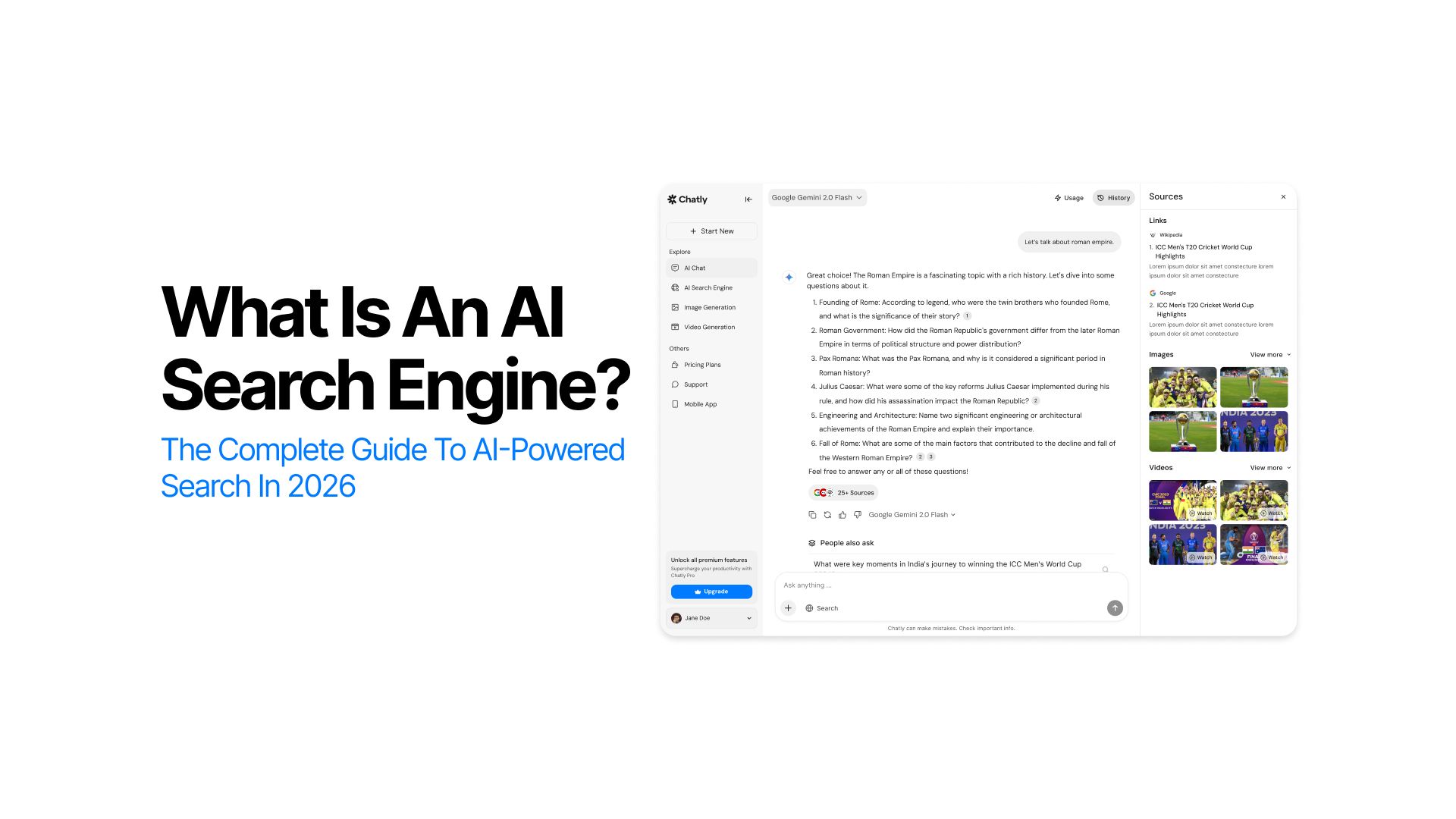
What is an AI Search Engine? The Complete Guide to AI-Powered Search in 2026
Ever since search engines were first introduced back in the 1990s, products and businesses have been in a race to rank their websites on the first page of search engine result page (SERP).
Why? You might ask.
Because that’s where all the action is. Honestly, I don't remember the last time I visited the 2nd page on SERPs. Because I know if a page is ranking on the first page that means Google, and most importantly users, trust it for providing quality product or service.
But this race to the top of the SERPs gave way to SEO war and sometimes some very questionable and misleading practices.
Now, when you search something, you are faced with loads of sponsored results underneath which you might find a website that ranks first but might not provide the value you are looking for. This makes traditional search exhausting and frustrating.
But days of scrolling through such links on SERPs are fading fast. AI search engines are fundamentally changing how we find information online, shifting from delivering lists of websites to providing direct, conversational answers.
This transformation affects everyone.
Businesses need to rethink their visibility strategies, marketers must adapt their content approaches, and everyday users are discovering faster, more intuitive ways to get answers.
Whether you're curious about the technology behind AI search or trying to understand its implications for your business, this comprehensive guide covers everything you need to know.
What is an AI Search Engine?
An AI search engine is a search platform that uses artificial intelligence, particularly large language models (LLMs) and natural language processing (NLP), to understand user queries and generate direct, synthesized answers rather than simply providing a list of relevant links.
Just like you would do in Google, you add your query in an AI search engine. But instead of providing a list of links for you to explore, AI search engines extract data from top websites and formulate a conversational answer so that you do not have to go through all that hassle.
Unlike traditional search engines that match keywords to indexed web pages, AI search engines comprehend the intent and context behind your questions. They can interpret conversational queries, understand nuances, and provide comprehensive responses by synthesizing information from multiple sources.
This is why there was a significant shift in the traffic over the past few years.
According to Semrush data, ever since the introduction of ChatGPT, Google’s global traffic declined by 7.91%. And this happened within a year.
The core characteristics that distinguish AI search include:
- Natural language understanding
- Contextual awareness across multi-turn conversations
- Ability to generate original explanatory text
- Multimodal capabilities that can process and respond to text, images, and voice inputs simultaneously.
How Do AI Search Engines Work?
AI search engines operate through a sophisticated multi-stage process that goes far beyond traditional keyword matching.
- Query Understanding: When you enter a question, natural language understanding models analyze the semantic meaning, user intent, and context. The system identifies key entities, relationships, and what type of answer you're seeking.
- Information Retrieval: The engine searches through its knowledge base, which may include pre-trained model knowledge, real-time web searches, or specialized databases. Advanced systems use semantic search techniques that find conceptually relevant information.
- Answer Generation: This is where AI search truly differentiates itself. Large language models synthesize information from multiple sources to generate coherent, comprehensive answers. The AI understands the information and reformulates it in response to your specific question.
- Source Attribution: Quality AI search engines cite their sources, providing transparency about where information comes from and allowing users to verify answers or explore topics deeper.
- Continuous Learning: Through user interactions and feedback mechanisms, AI search engines improve over time, learning to provide more accurate and relevant responses.
AI Search vs Traditional Search: What’s the Difference?
As our lives get busier and attention spans shorten, we do not have the time or the patience to invest in manual website scraping for a dress we may or may not buy.
This is why, the contrast between AI-powered and traditional search doesn’t just show you the evolution of technology but of human behavior as well.
Traditional search engines like classic Google operate primarily through keyword indexing and ranking algorithms.
- They match your search terms to web pages
- Rank results based on factors like relevance, authority, and backlinks.
- You receive a list of potential sources and must visit multiple pages, read through content, and synthesize information yourself.
AI search engines interpret the meaning and intent behind your queries. Instead of showing you where to find answers, they provide the answers directly. They excel at handling complex, conversational queries like "What's the best programming language for building mobile apps if I already know JavaScript?" rather than requiring you to search "best programming language mobile apps JavaScript."
The user experience differs dramatically.
- Traditional search optimizes for finding the right page
- AI search optimizes for answering the question.
This shift means fewer clicks, faster answers, and a more conversational interaction model—but it also raises questions about source discovery, traffic to original content creators, and answer accuracy.
Generative AI Search vs Keyword Search
Generative AI search or as many would call it semantic search represents the latest evolution in AI-powered search technology, distinguished by its ability to create original responses.
Keyword search relies on matching your search terms to pre-existing content in an index. It finds documents containing those words and ranks them by relevance. The technology is deterministic as the same query returns the same ranked results.
This gives rise to ranking practices that prioritize keyword stuffing over answering the user query properly.
Generative AI search uses large language models to understand your query and generate new text that answers your question. These systems process language at the token level (smaller units than words), enabling them to understand context, nuance, and relationships between concepts.
Each response is dynamically created based on your specific question.
The generative approach excels at synthesis tasks like combining information from multiple sources into coherent explanations, adapting answers to different complexity levels, and handling follow-up questions that build on previous context.
However, this power comes with challenges. Generative models can occasionally produce confident-sounding but incorrect information (hallucinations), and determining the exact sources for each piece of generated text can be complex.
Top AI Search Engines in 2025
The AI search landscape has rapidly diversified, with several platforms offering unique approaches to AI-powered information discovery.
1. Chatly
It integrates conversational AI chat with real-time web search capabilities, excelling at complex research tasks and multi-turn conversations where context matters. It's particularly effective for exploratory research and questions requiring synthesis across multiple domains.
2. Perplexity AI
Perplexity positions itself as an "answer engine" with a strong focus on citations and source transparency. It provides footnoted responses with clear attribution, making it popular among researchers and professionals who need verifiable information.
3. You.com
This AI search engine emphasizes privacy and customization, allowing users to personalize their AI search experience with apps and preferred sources while maintaining strong privacy protections.
Other notable platforms include Claude (Anthropic), which offers nuanced understanding and careful reasoning, Brave Search with independent indexing and privacy focus, and emerging specialized AI search tools for academic research, code search, and specific professional domains.
When choosing an AI search engine, consider factors like citation quality, response accuracy, update frequency, privacy policies, and whether the tool specializes in your area of interest.
What is Retrieval Augmented Generation (RAG)?
Retrieval Augmented Generation (RAG) represents a crucial technological breakthrough that makes AI search engines more accurate and reliable.
Pure generative AI models, while impressive, are limited to knowledge from their training data and can confidently generate incorrect information. This is what experts call AI hallucination. They can't access real-time information or cite specific sources reliably.
RAG provides the solution for this. This approach combines two powerful techniques (information retrieval and text generation) into a two-phase process:
-
Retrieval Phase: When you ask a question, the system first searches through external knowledge sources (web pages, documents, databases) to find relevant information. This retrieval uses semantic search techniques, often employing vector databases that represent concepts as mathematical vectors, enabling the system to find conceptually similar information even when exact keywords don't match.
-
Generation Phase: The retrieved information is provided to the language model as context. The model then generates an answer grounded in this retrieved information rather than relying solely on its training data.
This architecture significantly reduces hallucinations because the AI is working from actual source material. It enables citations and source transparency since the system knows which documents it used.
RAG systems can access up-to-date information by retrieving from current sources, and they can be customized for specific domains by pointing the retrieval component at specialized knowledge bases.
Pros and Cons of AI Search Engines
Like any transformative technology, AI search engines come with significant advantages and important limitations.
Let's start with the advantages first:
- Intuitive Interaction: You can ask questions in natural language, exactly as you'd ask another person, without worrying about keyword optimization or search syntax. The conversational interface feels more natural and accessible.
- Direct Answers: Instead of clicking through multiple pages to piece together information, you receive synthesized answers that directly address your question, saving significant time for research tasks.
- Contextual Conversations: AI search remembers your previous questions within a session, allowing for follow-up queries like "What about for beginners?" or "Compare those two options" without repeating context.
- Complex Query Handling: These systems excel at multi-faceted questions that would require multiple traditional searches, such as "Compare the climate policies of major 2024 presidential candidates and their potential economic impacts."
- Multimodal Capabilities: Increasingly, AI search can understand and respond to images, voice inputs, and other media types, not just text queries.
While there are a lot of good things about AI search engines, there are also a lot of areas where it lacks.
- Accuracy Concerns: AI search engines can generate confident-sounding answers that contain errors or "hallucinations." Critical information always requires verification against original sources.
- Source Transparency: While improving, not all AI search engines provide clear citations for every claim, making fact-checking difficult.
- Recency Challenges: Some AI search engines have knowledge cutoffs or delays in accessing the latest information, though real-time web search integration is addressing this.
- Computational Costs: Generating AI responses requires significantly more computing power than traditional search, raising questions about sustainability and access.
- Bias and Fairness: AI models can reflect and amplify biases present in their training data, potentially affecting the perspectives and information prioritized in answers.
- Privacy Considerations: Conversational search means sharing more context about your information needs, raising privacy questions about how this data is used and stored.
Understanding these trade-offs helps users leverage AI search effectively while maintaining appropriate skepticism and verification habits.
The Impact of AI on Search Engine Optimization (SEO)
AI search engines are forcing a fundamental rethinking of search engine optimization strategies that have dominated digital marketing for two decades.
But the landscape is changing. And you just have to look at yourself to understand that.
How has your search behavior changed in recent times? Do you find yourself turning to LLMs and AI search engines repeatedly to find information that you once Googled for? Do you still look at the reviews and product listings before making a purchase? Or do you just ask AI to summarize everything for you?
As people rely more and more on AI-powered tools for their search and purchase decisions, businesses need to find a way to crack marketing through LLMs. The key is to appear in AI’s answers whenever people search for a relevant query.
Traditional SEO focused heavily on ranking for specific keywords, earning backlinks, and optimizing technical elements to appear high in search results pages. AI search changes the game.
Instead of competing to rank #1 for a keyword, content creators now compete to be cited as a source in AI-generated answers.
And this has given rise to several trends.
Zero-Click Searches and Traffic Implications
When AI search provides complete answers, users don't need to click through to websites. This "zero-click" phenomenon threatens the traffic that many businesses depend on, particularly for informational queries.
In the U.S, U.K and EU, during March 2024 and March 2025, zero click searches increased by 3% which means more searches were completed without clicking on any result. Most of this happened because of AI Overviews.
This is why publishers and content creators must find new ways to demonstrate value and maintain audience relationships by appearing in Overview answers..
Answer Engine Optimization (AEO)
A new discipline is emerging. SEO is still important but alongside that brands are optimizing content to be selected and cited by AI search engines. This involves creating authoritative, well-structured content that AI systems can easily understand, extract, and attribute.
E-E-A-T Becomes Critical
Google's emphasis on Experience, Expertise, Authoritativeness, and Trustworthiness (E-E-A-T) becomes even more important in the AI era. AI systems are more likely to cite and rely on content from established, credible sources with clear expertise signals.
Practical Strategies for the AI Search Era
The changes might feel overwhelming. BUt it’s nothing you have not been doing already. You just have to make some tweaks here and there and add some extra sauce to get up to speed.
Let's put those ideas and tweaks into words.
- Depth Over Breadth: Comprehensive, authoritative content on specific topics performs better than shallow coverage of many keywords. AI systems favor thorough explanations over keyword-stuffed pages.
- Structured Data and Schema: Implementing schema markup helps AI systems understand and extract information from your content accurately.
- Clear Attribution and Sourcing: Content that cites its own sources and demonstrates research rigor is more likely to be trusted and cited by AI systems.
- Original Research and Unique Data: Content that AI systems can't simply synthesize from multiple sources becomes increasingly valuable. This includes original studies, surveys, or unique datasets
- Focus on Expertise Signals: Author bios, credentials, publication history, and other expertise indicators help AI systems assess content credibility.
- Multi-Format Content: As AI search becomes multimodal, content in various formats (video, audio, images, interactive elements) alongside text may offer new optimization opportunities.
SEO is still important; you just need to change the way you approach it. Success in the AI search era requires creating genuinely valuable, authoritative content that serves human readers while being structured in ways that AI systems can understand and cite.
Change your keyword research. Clarify who your audience is and what is their intent. Constantly be on the look out to see what users are asking for – not just on Google but on specific forums. Get your topic ideas directly from your intended audience.
The Future of Search Engines and Artificial Intelligence
The trajectory of AI search points toward several transformative developments that will reshape how we access and interact with information.
Multimodal Search Evolution
The future of search isn't just text. Emerging AI search systems seamlessly process voice commands, images, video, and text simultaneously. Imagine photographing a plant and asking "Is this safe for cats?" or pointing your camera at a building and querying its architectural style, with instant, comprehensive answers.
We are already seeing this trend in modern products like Gemini 3 Pro which can analyze the video of someone playing golf and immediately find the flaws and recommended fixes for their technique.
Personalized AI Search Agents
We're moving toward persistent AI search agents that learn your preferences, expertise level, and information needs over time. These agents will proactively surface relevant information, understand your context without repeated explanation, and adapt their communication style to your preferences.
Think of recent developments like Perplexity’s Comet and OpenAI’s Atlas which can take over your email and shopping tasks, book hotels, and order food. All it needs is a prompt.
The Competitive Landscape
Google's search dominance, unchallenged for nearly two decades, faces its first serious threat from AI-native search platforms. This competition is driving rapid innovation, with major technology companies investing billions in AI search capabilities.
The market may fragment into specialized AI search tools for different domains rather than a single dominant player.
Regulatory and Ethical Considerations
As AI search becomes central to information access, questions about content licensing, creator compensation, misinformation management, and algorithmic transparency will intensify. We'll likely see new regulations governing how AI systems can use online content and requirements for citation and attribution.
We are already seeing concerns with tools like Comet and Atlas.
Perplexity's Comet browser is reportedly up to 85% more vulnerable to phishing and web attacks compared to Google Chrome, with independent analyses indicating that browsers like these, including Atlas, blocked only 5.8% of phishing attacks, significantly lower than Chrome's 47% and Microsoft Edge's 53%.
Conclusion
With the emergence of AI search engines, we're moving from an era where finding information required skill in query formulation and patience in sifting through sources, to one where knowledge access feels as natural as asking a knowledgeable friend.
For everyday users, this means faster answers, more intuitive interactions, and the ability to explore complex topics without specialized search skills. The key is developing healthy skepticism where we use AI search as a powerful starting point while maintaining habits of verification and source checking for important information.
The convergence of search, conversation, and intelligence isn't exactly a replacement for traditional search but an expansion of our options for accessing information. The most effective approach for most users will involve using different tools for different needs:
AI search for synthesis and explanation, traditional search for comprehensive research and discovery, and specialized tools for specific domains.
As this technology matures, our challenge is ensuring that AI search serves its fundamental purpose: democratizing access to accurate, useful information. The tools are powerful and improving rapidly. How we use them, regulate them, and integrate them into our information ecosystem will shape not just how we search, but how we think, learn, and understand our world.

Frequently Asked Question
Learn more about AI Search Engines and their capabilities through user questions.
More topics you may like

GPT-5.2 Is Here: What Changed, Why It Matters, and Who Should Care

Faisal Saeed

11 Best ChatGPT Alternatives in 2026 (Tested, Compared & Priced)

Muhammad Bin Habib

21 Journaling Techniques That Actually Work in 2025
Muhammad Bin Habib

Gemini 3 Pro Overview: Features, Pricing, and Use Cases
Faisal Saeed
28 Best AI Tools for Students in 2025 – The Complete AI-Powered Academic Success Guide
Muhammad Bin Habib