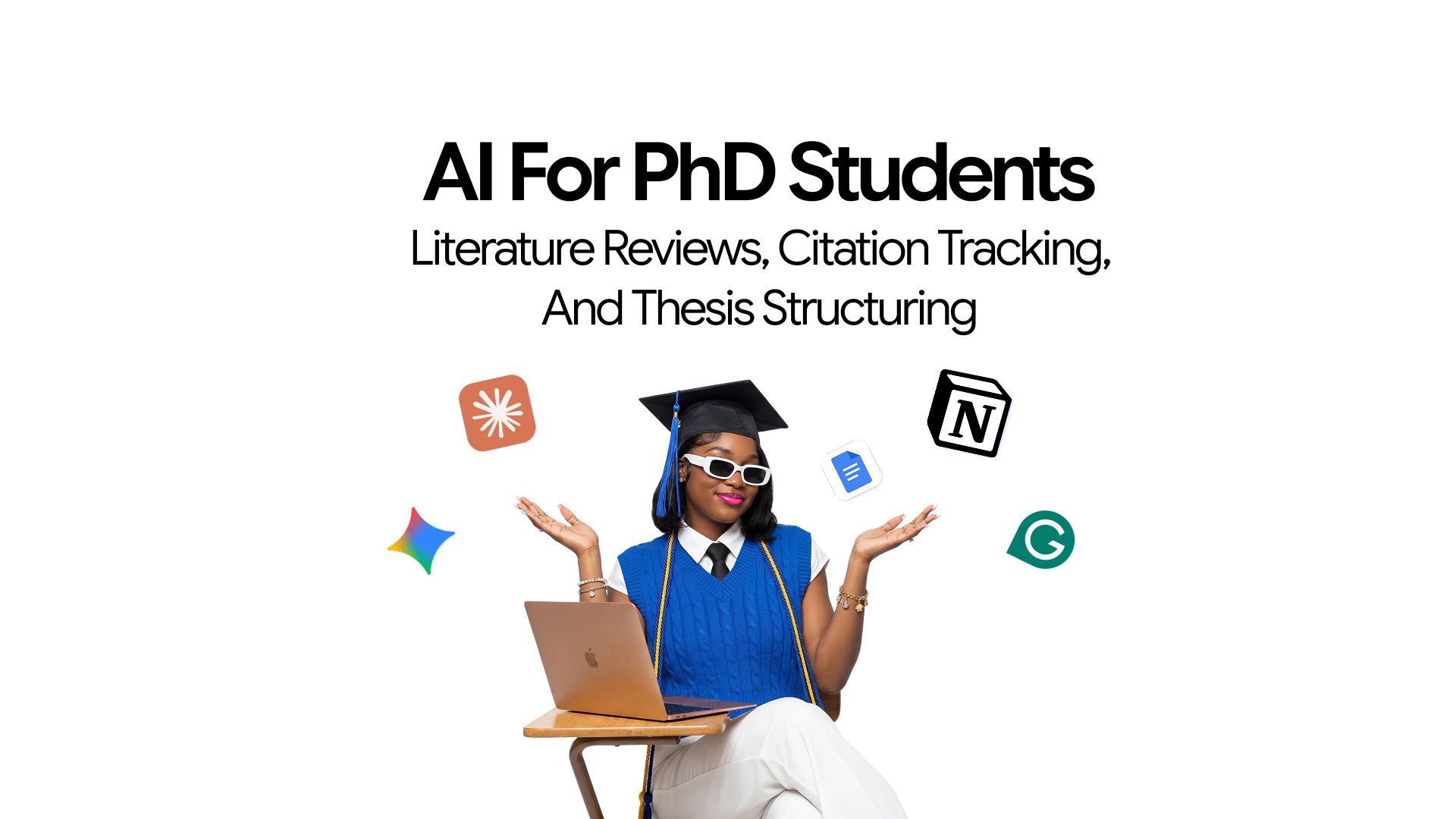
AI for PhD Students: Literature Reviews, Citation Tracking, and Thesis Structuring
PhD research moves slowly for reasons that have little to do with the quality of thinking. It is mostly operational build-up and a lot of diligence that slows things down.
Finding the right papers, processing hundreds of sources, and maintaining a coherent argument across a thesis written over several years are all operational problems.
They consume time that should be going toward the work that actually determines the quality of the research, at least after the advent of modern AI tools at our disposal. So today, we are covering how PhD students can leverage (read exploit) artificial intelligence and the tools built around it to improve their productivity multi-fold.
About AI for PhD Students
The value AI adds in doctoral research is not in generating ideas or writing arguments. It is in compressing the time between having a research question and having an organised, well-sourced foundation to build from.
A PhD student who uses AI well spends more time thinking and less time managing information. For a broader look at how students across disciplines are using AI tools in their work, the our guide for students, professionals, and creators covers practical workflows across different use cases.
The sections below focus on the three areas where AI makes the biggest difference in doctoral research:
- Literature reviews
- Citation tracking
- Thesis structuring
AI for Literature Reviews
A literature review is not a list of papers. It is an argument about the state of knowledge in a field:
- Where consensus exists
- Where disagreement lies
- Where the gap the current research addresses is located.
Building that argument requires finding the right sources, understanding what each contributes, and organising them into a structure that makes the gap visible. AI assists at each of those stages without replacing the critical reading that gives the review its depth.
Speeding Up Source Discovery
The central problem with keyword-based database searches is vocabulary mismatch. A study on "emotional regulation" in psychology and a study on "affect management" in organisational behaviour may address the same phenomenon, but a keyword search for one will not surface the other.
A search strategy built only on familiar terminology reproduces the researcher's existing knowledge rather than expanding it.
AI-powered academic search tools work from semantic relationships between concepts rather than keyword matches, which means searching with a full research question surfaces papers the researcher would not have known to look for.
The tools most worth knowing for this:
- Semantic Scholar searches more than 200 million papers using natural language processing and surfaces citation velocity data, showing which papers in a field are being cited most frequently and recently, rather than just historically
- SciSpace allows searching by full research question and returns a filterable table of results that can be screened by methodology, study location, sample size, or any other defined dimension, which is particularly useful for systematic reviews
- Elicit and Consensus both work from research questions rather than keywords; Consensus is particularly strong in medical and social science research because it synthesises findings across papers rather than listing them
For identifying how a concept is framed outside academic literature or tracking recent developments that have not yet appeared in peer-reviewed databases, our AI search engine retrieves current information grounded in live sources rather than fixed training data.
Synthesising Large Reading Loads
By the second year of a PhD, most students have a reference manager with two hundred papers: fifty read closely, eighty skimmed, and seventy unopened.
A paper that looks peripheral from its abstract sometimes contains the most relevant methodology or the clearest articulation of a gap. Triaging two hundred papers by reading each fully is not viable.
AI helps at the triage stage. Read the abstract and conclusion first, then use AI to ask structured questions about the full text:
- What is the central research question, and how is it framed?
- What methodology was used, and what are its stated limitations?
- What are the key findings, and how do they relate to a specific aspect of the research?
- What gaps or future directions does the paper identify?
The Chat PDF feature handles this kind of structured querying directly, letting researchers upload a paper and ask targeted questions rather than reading forty pages to find two relevant paragraphs.
Every response should be verified against the source text before anything is cited. Scholarcy produces automated summaries structured around methods, findings, and limitations, useful for building a quick reading matrix across a large collection.
For synthesis across multiple papers, paste summaries or key passages and ask AI to identify where studies agree, where they contradict, and what questions remain unresolved. The summary generator compresses large batches of reading notes into structured, scannable summaries that make cross-paper synthesis faster.
Structuring the Literature Review
The most common structural failure in a literature review is sequential description:
- Paper A does this
- Paper B found that
- Paper C argues something else
This describes sources rather than building an argument. A reader who finishes a sequential review knows what individual papers say but not what the field has established, where it disagrees, or what gap justifies the current research.
A well-structured review is organised around ideas, not sources. The three most common organising principles are:
- Thematic — grouping sources by the aspect of the phenomenon each addresses, showing how different dimensions of the topic have been studied
- Chronological — tracing how understanding of a topic has shifted over time and what caused those shifts
- Debate-based — mapping the evidence on each side of a contested question and identifying where disagreement lies
The right choice is whichever makes the gap in the existing literature most visible. Once reading notes exist, paste them into AI and ask: "Group these sources into themes based on their central arguments. Within each theme, identify where papers agree, where they contradict each other, and what questions they leave unanswered."
The AI document generator then converts that thematic map into a structured outline with section headings, the argument each section makes, and the sources that belong in each section.
AI for Citation Tracking
Citation tracking is how a researcher understands not just what a field currently says but how it arrived there.
- Which earlier work shaped current thinking?
- Which ideas have been challenged and refined?
- Which claims rest on foundational papers that themselves rest on contested assumptions?
These questions matter because a literature review that describes the field without understanding its intellectual history misses the context that makes arguments credible.
Tracing Research Influence
Forward citation tracking finds all papers that have cited a particular work, showing how its ideas were developed, challenged, or applied after publication. Backward tracking follows a paper's references to its sources, building understanding of the intellectual lineage of a claim. Doing either manually is slow.
The tools that make it practical:
- Connected Papers generates a visual graph showing the relationships between a seed paper and related work, clustered by similarity, making the structure of a field's intellectual history visible at a glance
- Litmaps builds a timeline view showing how a body of literature evolved and supports real-time monitoring for new papers entering the network
- Research Rabbit maps connections between papers and authors simultaneously, which identifies the small number of researchers whose work everyone else is responding to
For understanding how a foundational paper's central claim has been developed or challenged, paste its abstract and several citing abstracts into AI and ask: "How has the central argument of the original paper been developed or challenged in the citing literature? Has the methodology been replicated, extended, or criticised?"
Staying Current
A PhD is a multi-year project, and the literature does not stop developing while the thesis is being written. A paper published in year three may be directly relevant to an argument developed in year one. Missing it is not visible during writing, but it will be visible to an examiner.
Two tools that keep new literature visible automatically:
- Semantic Scholar and Litmaps both offer alert systems that notify researchers when new papers cite their tracked works or match their tracked topics, so relevant literature surfaces without requiring periodic manual searches
- Scite shows whether each citation is supportive, contradicting, or merely mentioning a work, which matters because a paper that appears well-cited may have attracted many citations that challenge its claims — a distinction a simple citation count makes invisible
Finding Missing Sources
Gaps in citation coverage are often invisible because missing sources sit outside the areas the researcher has been searching. Two common blind spots:
- A researcher working within one national or linguistic context misses relevant work published in another
- A researcher inside one disciplinary tradition misses adjacent literature that addresses the same question using different methods
AI surfaces missing sources through lateral search: paste the abstract of a paper already identified and ask what other work it should be in conversation with, given its claims and methodology.
Elicit is particularly useful here because asking the same research question in slightly different framings surfaces different papers, revealing whether a narrow search strategy has been missing relevant work.
AI for Thesis Structuring
A thesis is a single sustained argument distributed across chapters. The most common structural failure is not that individual chapters are weak but that they do not build on each other. The specific ways this shows up:
- The literature review establishes a gap, but does not connect it to the research question
- The methodology describes an approach without linking back to what the literature revealed
- The discussion interprets findings without returning to the theoretical framework established at the start
AI helps catch and correct these failures before they are embedded in hundreds of pages.
Building Chapter Logic
Before drafting begins, the chapter structure should be mapped. The introduction should contain the thesis argument in miniature: the gap, the question, the argument, and how each chapter contributes to answering it. If that map cannot be written clearly before drafting, the structural problems are harder to fix afterward.
Paste the research question, the key findings from the literature review, and the research methodology into AI and ask: "Propose a chapter structure for a thesis addressing this research question. For each chapter, describe its specific function in the overall argument, what it must establish before the next chapter can proceed, and how it connects to the central research question."
Structural gaps identified at this stage cost a few edits. The same gaps identified during the final revision cost weeks. The AI document generator converts research notes and reading summaries into structured chapter drafts.
For approaches to maintaining structure and consistency across a long document over years of writing, the technical documentation guide covers structural consistency workflows that apply directly to thesis writing.
Improving Argument Flow
Argument flow breaks down in specific, detectable ways that are hard for the author to catch because the context that fills the gaps on the page lives in the writer's head rather than in the text. The most common patterns:
- Paragraphs restate earlier claims without advancing the argument
- Transitions between sections are generic rather than logical
- Chapters end without establishing what question is now open for the next chapter to address
AI reads the text without the author's context. Paste a section and ask: "Does each paragraph advance the argument from the previous one, or does any paragraph restate a point already made? Identify any transition that does not explain how the current section connects to the previous one and what new ground it covers."
The output is specific: not "the argument could be clearer" but "paragraph three restates the claim in paragraph one" and "the transition into the methodology section does not explain why this approach follows from the gap the review identified." These are edits the researcher makes with that diagnostic, not rewrites generated by AI.
Managing Drafts
A thesis written over three or four years accumulates inconsistency without the researcher noticing. The specific ways drift happens:
- Terminology defined in Chapter Two gets used differently in Chapter Five
- A claim established in the introduction is quietly contradicted in the discussion
- Arguments built in the early chapters are not reflected in the conclusions
AI helps with revision by scanning across chapters rather than within them.
- Paste the introduction and conclusion, and ask whether the argument stated at the start is the argument concluded at the end.
- Paste the theoretical framework and the discussion, and ask whether findings are interpreted through the same framework established earlier.
Entering New Research Areas Faster
A useful orientation prompt: "Give me an overview of the key debates and foundational work in [field/subfield]. What are the central theoretical frameworks? What methodological approaches are most common? Which papers or authors would a researcher new to this area need to engage with first?"
The orientation process follows a consistent logic regardless of the field:
- Identify the structure of the field before reading individual papers deeply
- Map the key debates and the researchers whose work defines them
- Trace one clear argument through the literature to understand how evidence is used
- Build outward from that foundation rather than starting with random papers
Chatly's Ask AI app handles these targeted orientation questions with depth and specificity. The codebase onboarding guide covers this same systematic orientation approach for technical systems, and the logic applies equally to unfamiliar academic fields.
For building reusable prompt templates across literature review, synthesis, and structuring tasks, the system prompts guide covers how to structure prompts for consistent results across sessions.
Risks and Good Practice
Using AI in doctoral research responsibly requires understanding where it fails, not just where it helps. Three failure modes are significant enough to affect the quality and integrity of a thesis.
Hallucinated Citations
General-purpose AI tools generate citations that do not exist. The paper title, author, journal, and year can all be plausible and all be fabricated. A hallucinated citation in a thesis is academic fraud regardless of how it was produced.
The rules are non-negotiable:
- Every citation must be found in a database before it enters a reference list
- The abstract must be read to confirm that the paper exists and is what the AI described
- The specific claim attributed to the paper must be verified against what the paper actually argues
Tools built on verified academic databases are safer for citation discovery. Semantic Scholar, Elicit, Connected Papers, and Litmaps retrieve from established sources rather than generating text. When using general-purpose AI, treat every specific claim about a paper's findings as a lead to investigate, not a fact to cite.
Loss of Nuance in Summarisation
AI summaries lose three things that a good literature review depends on:
- The caveats the authors placed on their conclusions
- The methodological context that shapes how findings should be interpreted
- The limitations that affect how much weight the evidence can bear
A synthesis built on AI summaries without close reading of the primary sources is a synthesis of compressed representations. Use AI summaries to triage and orient reading, not to replace the reading that builds genuine understanding of what the literature actually shows.
Over-Reliance Instead of Critical Engagement
A thesis whose structure and argument were generated by AI has not demonstrated the independent scholarly thinking a doctoral qualification requires. Examiners can detect when the analysis is thin:
- Themes are generic rather than specific to the data and field
- The argument tracks the shape of existing literature rather than engaging critically with it
- Gaps identified are obvious rather than genuinely found through close reading
AI is for the operational parts of research: finding papers, organising notes, checking structure, and maintaining consistency. Identifying what the literature shows, developing an original argument, and engaging critically with existing work remain the researcher's responsibility.
Conclusion
The researchers who benefit most from AI are those who use it to accelerate tasks that are high in volume and low in intellectual demand, and protect their own thinking time for the work that determines the quality of the thesis.
Finding papers, organising reading, checking argument structure, and tracking citation networks are all tasks AI handles well. Deciding what matters, developing an original position, and engaging critically with complex evidence are not.
Frequently Asked Questions
Learn how PhD students can use AI for their research
More topics you may like

AI for Developers: Code Review, Debugging, Documentation, and Integrated Workflows

Arooj Ishtiaq

AI for Frontend Engineers: Component Generation, Refactoring, and Accessibility
Arooj Ishtiaq

AI for Product Managers: How to Use AI for PRDs, Research Synthesis, and Prioritisation?
Arooj Ishtiaq
Master Technical Writing & Documentation: An AI Guide
Arooj Ishtiaq
How to Use AI to Read Research Paper
Arooj Ishtiaq